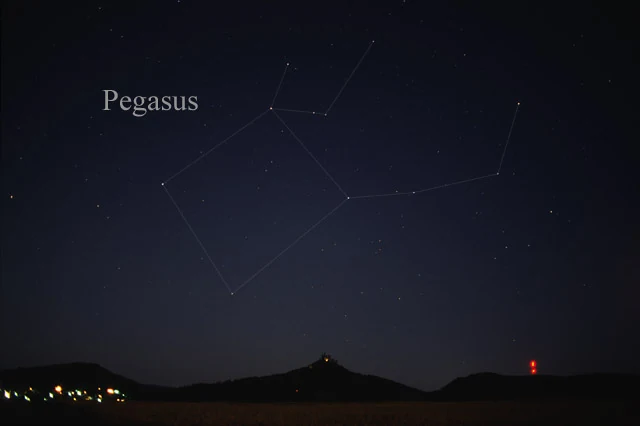
Go outside after dark this week and look east. There’s a big, slightly lopsided square of four stars climbing over the rooftops, and you need nothing to find it but your eyes. That’s the Great Square of Pegasus, and for the next two months it’s the easiest landmark in the sky. Learn it once and it becomes your key to the whole autumn sky: it points the way to the Andromeda galaxy, it doubles as a ruler and a dark-sky meter, and it marks the season turning over.
From my balcony in Nicosia I can find all four corners on a hazy night when almost nothing else is up yet, and that’s the point of the Square. Its stars are bright enough to punch through city light, and there’s nothing else nearby shaped like it. Here’s how to find it, and everything it hands you once you have.
The four stars, and why they stand out
The Square is an asterism, not a constellation. It’s a memorable shape stitched from stars that mostly belong to Pegasus, the winged horse. Four stars of nearly matched brightness mark the corners: Alpheratz (apparent magnitude 2.1), Scheat (about 2.4), Markab (2.5), and Algenib (2.8). None is especially bright on its own. What makes the pattern jump out is four second-magnitude stars sitting at the corners of a big, near-empty box, with nothing else in the autumn sky that looks the same.
One quirk is worth knowing. Alpheratz, the corner that points toward Andromeda, isn’t a Pegasus star at all. It’s Alpha Andromedae, on loan to the horse. When the constellation boundaries were formally drawn in 1922 the star went to Andromeda, but the Square kept it. Scheat, the opposite corner, is a red giant that varies a little in brightness over weeks and months, so if the four corners ever look slightly uneven, that’s why.
How big it is, and how to use that
The Square is large. Each side spans roughly 15°, so the whole box is about half again as wide as your clenched fist held at arm’s length, since a fist covers around 10° of sky. Once that scale is in your head, the Square becomes a handy ruler for judging how far apart other things in the sky are.
It also works as a dark-sky meter. The four corners are easy, but the inside of the box is nearly empty to the naked eye, and how many faint stars you can tease out of it tells you how good your sky is. The rough scale, not counting the corners: 0–2 stars is a poor, light-polluted sky; 3–7 is average; 8–11 is good; 12 or more is excellent. From my Bortle 7 balcony I’m lucky to get one or two. From Troodos at 1,700 m the box fills in, and that difference is the whole argument for driving up there. Give your eyes the full 30 minutes to dark-adapt before you count, or you’ll sell your sky short.
Finding it this week
Face east once the sky is properly dark. In mid-September from Cyprus that’s around 20:30 local, a little later as the month runs on. The Square rises balanced on one corner, so it looks less like a square and more like a big diamond tipped onto its point, climbing out of the east. By late September it’s high in the southeast around midnight, and from 35°N it passes almost straight overhead: Alpheratz culminates near 84° altitude here, so at its best you’re looking through the least air possible. Through October the whole thing is up earlier each evening.
If you’re not sure you’ve locked onto the right pattern, two signposts help. The Summer Triangle is still high overhead as darkness falls this month, and the Square is the next big figure to its east. The W of Cassiopeia, climbing in the northeast, has one side that points roughly down toward it. A stargazing app will confirm it in a second if you want to be certain, but the Square is distinctive enough that after the first night you probably won’t reach for one.
Why it’s a horse, sort of
The Square is the body of Pegasus, and the constellation is drawn upside down, the winged horse hanging head-down from the sky with only its front half shown. You don’t need the mythology to use the box, but the shape of the horse is a decent memory aid. A curving line of stars runs west off the Square toward Enif (magnitude 2.4), the horse’s muzzle, and just beyond Enif sits M15, one of the finest globular clusters in the northern sky and an easy catch in binoculars from a dark site. Find the box, follow the neck west to the nose, and you’ve found a genuine deep-sky target on your first night out.
What the Square unlocks
Once you own the Square, it opens up the rest of the autumn sky.
Andromeda comes first. From Alpheratz, the corner nearest overhead as the Square climbs, two gently curving lines of stars trail off to the northeast, forming the body of Andromeda. Follow them out a couple of stars and you reach M31, the Andromeda galaxy, the most distant object the human eye can see unaided at about 2.5 million light-years. The light landing on your retina tonight left that galaxy before our species existed. I wrote a full naked-eye route to M31 if you want it step by step, and the Square is where it starts.
Go the other way for Fomalhaut. Run a line down the western side of the Square, from the top corner through the bottom one, and keep dropping toward the horizon: you’ll land on a single bright star sitting alone in an otherwise empty stretch of the southern sky. That’s Fomalhaut, magnitude 1.2, the brightest star in Piscis Austrinus and the only first-magnitude star for a long way around, which earned it the nickname the Lonely One. This is where a Mediterranean latitude wins. Fomalhaut culminates about 25° up from 35°N; from Britain or northern Germany it barely scrapes the horizon, when it clears it at all. From Cyprus it’s an easy, obvious star.
Just south of the Square, under a darker sky, lies the Circlet of Pisces, a faint ring of stars marking the head of the western fish. It’s a real dark-sky target, so don’t expect it from a balcony. And if you own a telescope or a smart scope, the northwest corner of Pegasus is where SN 2026aaiv is brightening in the galaxy NGC 7331 right now. Finding the Square puts you in the right part of the sky to go hunting for it.
The signpost of the season
There’s a reason the Great Square turns up in every autumn observing guide. It rises as the Summer Triangle sinks, and it stands highest around the September equinox, this year on September 23 at 00:06 UTC (03:06 local in Cyprus), the moment the Sun crosses the celestial equator heading south and day and night run nearly equal. From then until December the Square owns the evening sky, sliding a little further west each week.
Learn it now, while it’s climbing the east after dinner, and you’ll have a fixed reference point for the next three months of observing. Nearly every autumn object I’ve mentioned hangs off those same four stars. It’s the first thing I look for when I step onto the balcony this time of year, and once you’ve found it a few times you won’t be able to un-see it.