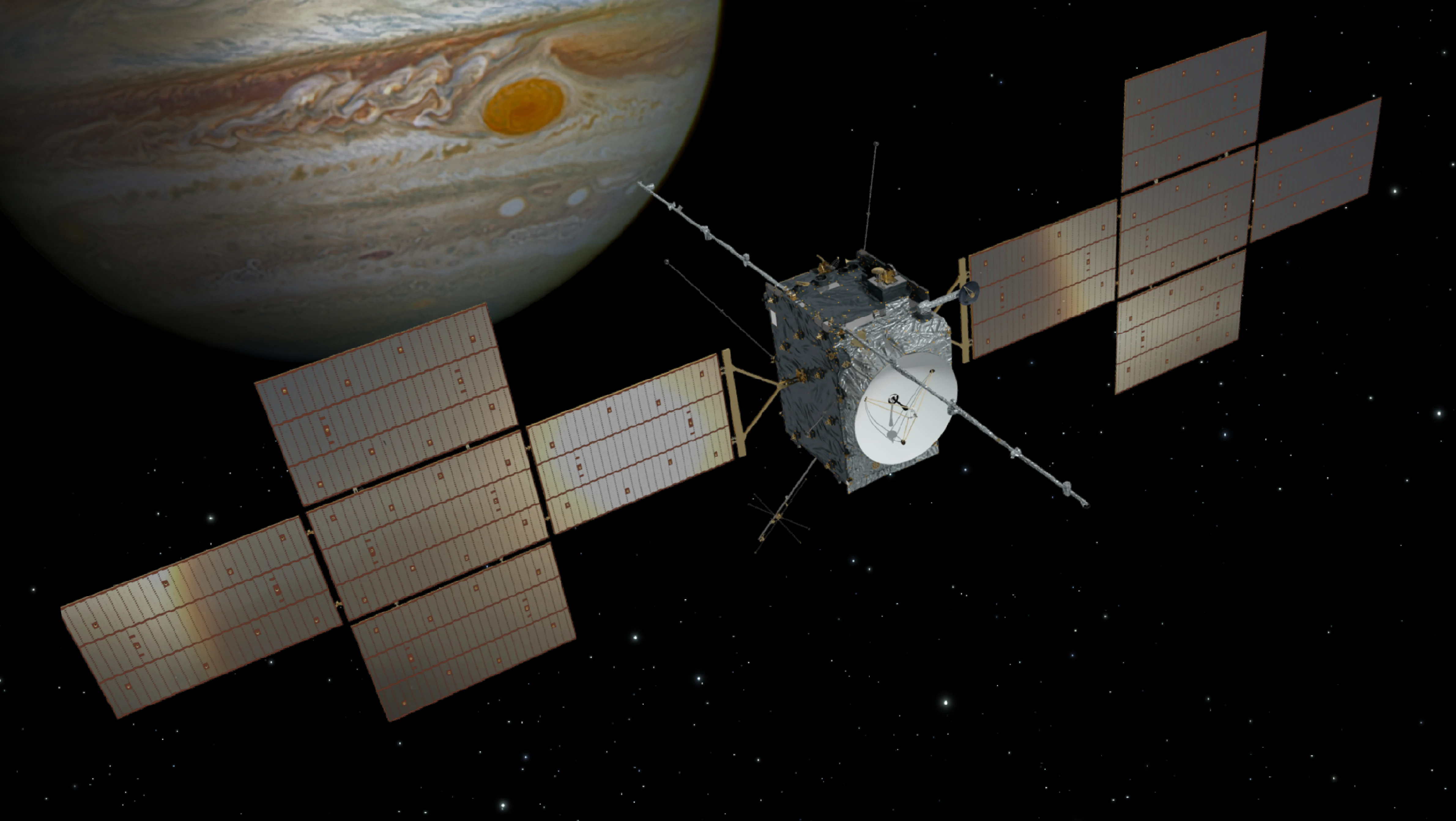
At the end of this month a Jupiter-bound spacecraft is going to thread past Earth to steal a tank of speed it can’t buy any other way. On 29 September 2026, ESA’s JUICE — the Jupiter Icy Moons Explorer — makes its second solo flyby of our planet, a gravity assist that borrows a sliver of Earth’s own motion around the Sun and hands it to the spacecraft for free. No engine burn does the heavy lifting here. Geometry does.
This isn’t a launch, and it isn’t a discovery, so it won’t lead the news the way Roman’s liftoff did a couple of weeks ago. But it’s one of those quiet orbital-mechanics moments I find worth stopping for: a six-tonne machine, already three and a half years into a cruise, using our planet as a pivot. Three things, then: the maneuver itself, whether there’s anything to see from a backyard, and what JUICE is flying toward.
Why a Jupiter probe keeps coming back to Earth
JUICE launched on an Ariane 5 from Kourou in April 2023. Jupiter sits about five times farther from the Sun than we do, and climbing that far out of the Sun’s gravity well takes a lot of energy — more than the rocket could give a spacecraft this heavy in one shot. So instead of flinging JUICE straight at Jupiter, ESA sends it on a looping tour of the inner Solar System, collecting speed one planet at a time.
The trick is the gravity assist, and it’s less mysterious than it sounds. As JUICE swings close to a planet, the planet’s gravity bends its path. Relative to the planet, the spacecraft leaves with almost exactly the speed it arrived with — nothing is created out of nothing. But the planet is itself racing around the Sun at tens of kilometres per second, and by choosing which side to pass, mission designers turn that bent trajectory into a net gain (or a deliberate loss) of speed relative to the Sun. JUICE effectively trades momentum with the planet. Earth slows in its orbit by an amount far too small to ever measure; JUICE speeds up by a useful margin. It’s the same trade the Voyagers used to reach the outer planets, just run in careful sequence.
JUICE’s cruise is built around five of these assists. In August 2024 the spacecraft pulled off a world-first double flyby, skimming the Moon at about 700 km and then Earth at roughly 6,800 km one day apart, threading a corridor only a few tens of kilometres wide. That pass redirected it to Venus, which it reached on 31 August 2025, passing about 5,100 km above the cloud tops. September’s Earth pass is the fourth of the five assists, and its second at Earth alone; a final one, again at Earth, follows in January 2029.
What happens on September 29
ESA’s cruise plan places the closest approach on 29 September 2026. After this pass, the spacecraft will have built up the roughly 11 km/s of transfer speed it needs for the run out to Jupiter — the headline number the mission has been chasing since launch.
There’s a wrinkle, and it’s why JUICE still isn’t done with us afterward. Jupiter won’t be in the right place in its own 12-year orbit to catch the spacecraft yet, so rather than depart immediately it loops around the Sun one more time and returns for that final Earth flyby in January 2029, which raises the far point of its orbit to match Jupiter’s and sets up arrival in July 2031. Reaching Jupiter is as much about timing the rendezvous as it is about raw speed, and this September pass gets the speed right a few years before the geometry cooperates.
ESA has not, as I write this in mid-September, published detailed public geometry for the pass — the exact closest-approach altitude and ground track for 2026 haven’t been circulated the way the 2024 numbers were. If they follow the pattern from the last flyby, the operations team will use the encounter to point JUICE’s instruments at Earth and the Moon as calibration targets. During the 2024 pass they did exactly that, detecting atmospheric molecules, measuring water and ozone in our air, and recording data as the spacecraft crossed Earth’s radiation belts. A planet you already understand is the best possible test object for instruments you’re about to trust at Jupiter.
Can you actually see it?
This is the question I get whenever a spacecraft comes near, so let me be straight about it rather than sell a light show. During the 2024 flyby, ESA openly invited amateurs across Europe and North Africa to try to catch JUICE as a fast-moving point of light in binoculars or a small telescope in the hours around closest approach. It was a genuine target for a patient observer with a good ephemeris — never a naked-eye event, but catchable.
Whether the September 2026 pass offers the same window depends entirely on details ESA hasn’t released yet: how close it comes, which longitudes it’s over at closest approach, and whether that happens in your night or your daytime. A spacecraft roughly the size of a small bus, catching sunlight from thousands of kilometres away, sits at the faint end of what backyard gear reaches, and it crosses the sky fast enough that you need to know exactly where to point. My advice: don’t clear your calendar for it. If you want to try, watch ESA’s JUICE mission page and a satellite-tracking site such as Heavens-Above in the days before the 29th, and only commit if a real ephemeris says it’s above your horizon after dark. For most of us the honest way to “watch” this flyby is to follow ESA’s operations updates and let the trajectory do its quiet work.
There’s a better target in the same story, and it’s the one JUICE visited last year. Venus is riding high as the brilliant evening star right now (I wrote about it reaching its brightest for 2026 this month), and Jupiter, JUICE’s destination, is the same steady point you may have watched share a binocular field with Venus back in June. You can stand on the same planet JUICE is about to use as a slingshot and see both ends of its journey with your own eyes.
What it’s flying toward
The flyby is a means to an end, and the end is worth the six-year detour. When JUICE reaches Jupiter in 2031 it will spend years touring the giant planet’s three big icy moons (Ganymede, Callisto, and Europa) before settling into orbit around Ganymede, which would make it the first spacecraft ever to orbit a moon other than our own.
Those moons draw a flagship mission for one reason: water. Beneath their cracked ice shells, Ganymede and Europa are thought to hold oceans with more liquid water than all of Earth’s seas combined, kept from freezing by the heat of tidal flexing as they orbit Jupiter. JUICE carries ten instruments to test that idea from orbit, including an ice-penetrating radar built to sound the crusts from above and a magnetometer that can infer a salty ocean’s presence from the way it distorts Jupiter’s magnetic field. It works alongside NASA’s Europa Clipper, which launched in 2024 and is on its own cruise to the same system — two spacecraft, built on two continents, converging on the question of whether the outer Solar System has habitable water.
That’s the throughline I keep coming back to as an observer. The ocean moons are places we can’t see any detail on from a backyard — Jupiter’s Galilean satellites are just four dots in a small telescope, the same dots Galileo logged in 1610. Everything we know about what’s under their ice has come from spacecraft, and the next big jump in that knowledge is riding on maneuvers like the one happening on the 29th.
Why this one is worth a note
Nothing about September 29 will look dramatic. There’s no plume, no engine burn you could watch, most likely nothing in the sky you’ll catch without real effort and a printout of coordinates. What there is, is a moment of pure celestial mechanics working exactly as planned: a spacecraft using our planet as a lever, trading a whisper of Earth’s orbital motion for the speed to cross the hundreds of millions of kilometres out to Jupiter. JUICE has three and a half years of cruise behind it and five more ahead. The 29th is one of the pivots that makes the rest of it possible, and I think that’s reason enough to know it’s happening.