We have more than 6,000 confirmed exoplanets and not one confirmed moon around any of them. A preprint that went up on 2026-09-04 didn’t change that count. Columbia’s David Kipping pointed JWST at a temperate super-Earth about 100 light-years away, stacked twelve transits, and came up empty. No moon.
What makes the paper worth reading is the empty part. It’s the most sensitive exomoon search anyone has run, and a clean non-detection is exactly the result the field needed to prove its main tool still works.
Thousands of planets, zero moons
Our own solar system is crowded with satellites: hundreds of them, from our 3,474-km Moon down to the sub-kilometre chips of ice that pad Saturn’s tally past 270. Every giant planet keeps a retinue. Even Mars has two. If moons are that common around the eight planets we can study up close, they should be common around other stars too. Yet the exoplanet catalog, past 6,000 worlds and climbing, still lists zero satellites.
That gap is almost certainly about detection difficulty, not a real shortage of moons. And it’s a gap worth closing. A large moon can stabilise a planet’s axial tilt the way ours steadies Earth’s, which feeds directly into climate. Moons record how a system formed and settled. Some of them, like Europa and Enceladus, are better bets for life than the planets they orbit. Finding the first confirmed exomoon would open all of that on worlds we can’t visit.
Two candidates, both contested
There are candidates. Kipping’s group has produced the two strongest. Kepler-1625 b-i, announced in 2017–2018 from Hubble and Kepler data as a possible Neptune-sized moon around a giant planet, and Kepler-1708 b-i, a smaller candidate reported in 2022. Both orbit big planets on wide orbits, and both are disputed. René Heller and Michael Hippke at the Max Planck Institute for Solar System Research reanalysed the same light curves and argued the moon signals dissolve under stricter noise treatment; Kipping and Alex Teachey answered that the reanalysis discarded too much good data. The argument is still live in Nature Astronomy. The plain summary is that no exomoon has yet cleared the bar.
The enemy is red noise
A moon leaves three kinds of fingerprint on a transit light curve. It can cross the star itself, adding a second, shallower dip beside the planet’s. It can tug the planet so that the planet transits a few minutes early or late from one orbit to the next, a signature called transit timing variation. And it can change how long each transit lasts, a transit duration variation. All three are tiny. A moon a tenth of Earth’s radius blocks roughly 1% of the light the planet does.
Those faint signals sit on top of red noise: slow, correlated drift in the data from starspots rotating across the stellar disk, from flares, and from the telescope’s own thermal breathing. Red noise is the problem because it doesn’t wash out the way random photon noise does when you collect more light. It can invent a moon-shaped bump where there is none, or bury a real one. Strip away the jargon and most of the Kepler-1625 b fight is an argument about red noise.
What Kipping actually did
This is where LP 890-9 c comes in. The star, also catalogued as SPECULOOS-2 or TOI-4306, is an ultracool red dwarf about 100 light-years off: roughly 0.12 solar masses, a surface near 2,900 K, the second-coolest star known to host planets after TRAPPIST-1. Laetitia Delrez’s team at the University of Liège found two small planets there in 2022 using the SPECULOOS telescopes and TESS. The outer one, LP 890-9 c, is 1.367 Earth radii, circles the star every 8.46 days, and sits in the habitable zone. The discovery team ranked it the second-most promising temperate rocky world for atmospheric follow-up after the TRAPPIST-1 planets, which is why twelve JWST transits of it already exist.
Kipping combined those twelve transits and searched the residuals for a moon. The result: nothing larger than about 0.1 Earth radii, at 95% confidence. That’s a radius near 640 km, the size class of Saturn’s Rhea or Uranus’s Umbriel, and it comfortably excludes analogues of our own Moon, Io, and Europa. He calls it “by far the most sensitive search to date,” and the wording is the point. The headline isn’t the missing moon. It’s how small a moon they could have caught if one were there.
Why an empty result is the useful one
The paper’s real claim is that JWST does not hit a red-noise wall. One of the twelve epochs was contaminated by exactly the correlated noise that muddies these searches, and pairing it with a cleaner epoch recovered the sensitivity. That’s the proof of concept the field has been waiting for: combine enough good transits and you can beat the noise down far enough to see a Rhea-sized moon around an Earth-sized planet 100 light-years away. The instrument is no longer the bottleneck.
That flips the usual framing of a non-result. A search that turns up nothing but can’t say how well it looked teaches you little. A search that turns up nothing and can prove it would have seen a 640-km moon has drawn a hard line on the map.
The catch
Here’s the part a careful reader should keep hold of. Finding nothing around this particular planet was partly expected. LP 890-9 c orbits at about 0.04 AU from a very low-mass star, so its Hill sphere, the zone where it can hold a moon against the star’s gravity, is small, and tides would spiral any large moon into the planet within a few billion years. Kipping notes as much: a moon bigger than roughly 0.1 Earth radii probably couldn’t survive there for the system’s age. So the non-detection isn’t a surprise about nature. It’s a demonstration of reach.
The real test comes when the same method is pointed at a cooler giant on a wide orbit, where a big moon could survive for the lifetime of the system. That’s the neighbourhood the Kepler candidates live in, and it’s where a confirmed detection would actually mean something.
Building moons at the other end
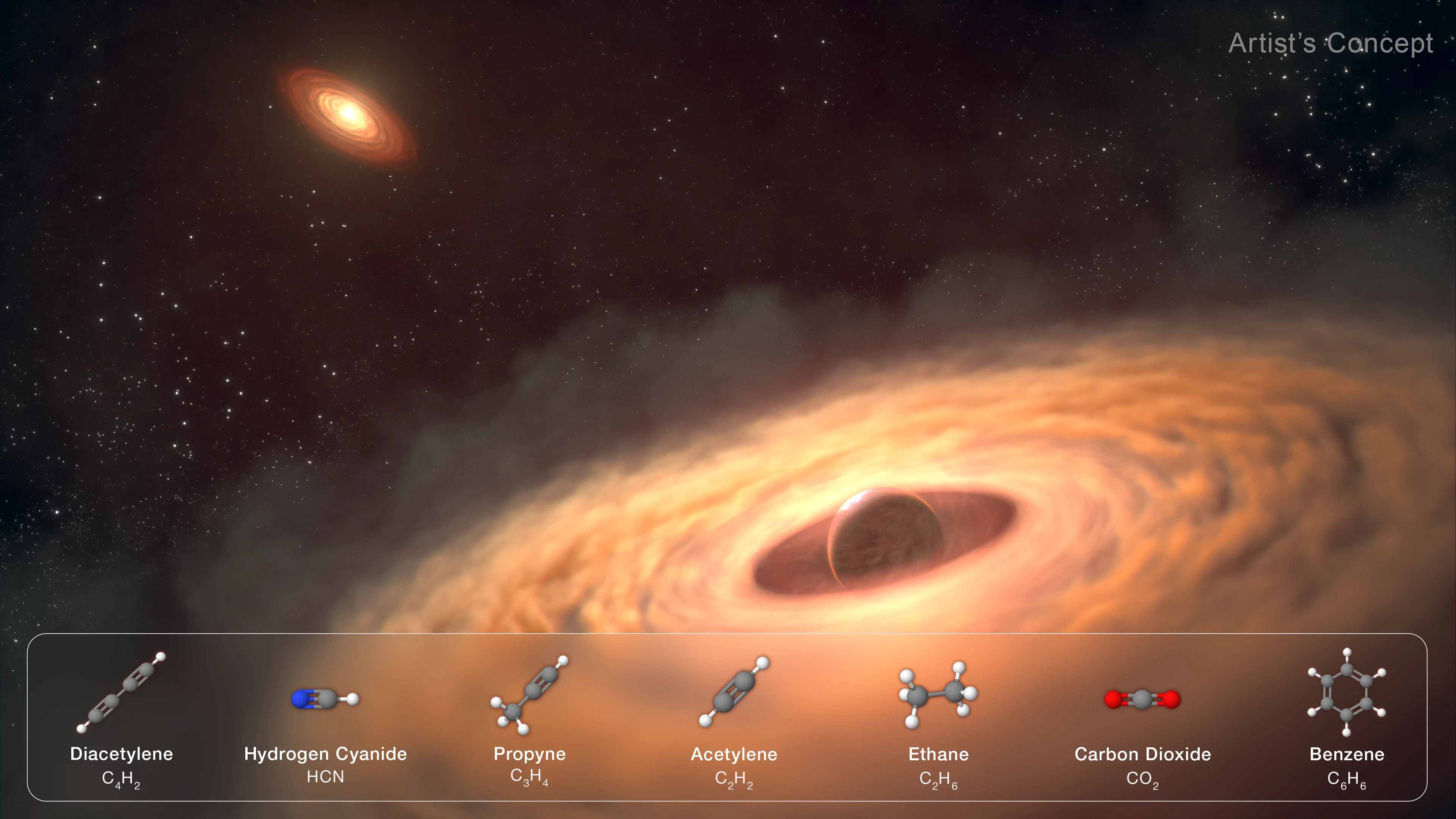
JWST is working this problem from both directions. The illustration at the top of this piece isn’t LP 890-9 c. It’s CT Cha b, a young planetary-mass object 625 light-years away. This year a team led by Gabriele Cugno used JWST’s mid-infrared spectrograph, MIRI/MRS, to measure the disk of gas and dust wrapped around that object and found it stocked with carbon-bearing molecules: acetylene, benzene, hydrogen cyanide, and several more, the raw stock for building moons. No moon there yet either, but it’s the first direct chemical look at a moon-forming environment. Ingredients on one end, a census on the other, and still nothing confirmed in between.
From the balcony
None of this is backyard astronomy. LP 890-9 sits around 18th magnitude (apparent). My Seestar S50, working from a Bortle 7 balcony in Nicosia, tops out four or five magnitudes brighter than that, and even a large Troodos Dobsonian would show the star as a faint point with no hope of a moon beside it. Exomoons are space-telescope work.
The mechanism underneath, though, is the same one hobbyists already run. Watching a star dim by a fraction of a percent as something crosses its face is the transit trick, and amateurs do detect bright exoplanet transits from the ground on hosts like HD 189733 and WASP-33. Kipping’s search is that idea pushed to its physical limit, until a 640-km moon shows up in the leftover scatter of a light curve.
Where it stands
The exomoon field just crossed a line worth marking: it’s method-limited now, not telescope-limited. The next moves are the ones to watch. Whether Kipping’s group turns this stacked-transit approach on a planet with a Hill sphere large enough to keep a big moon, and whether the Kepler-1625 and Kepler-1708 candidates survive another round of reanalysis. When the first exomoon is finally confirmed, this LP 890-9 c paper will be part of how we knew the tools were ready.
Until then, the count holds: more than 6,000 planets, zero moons.