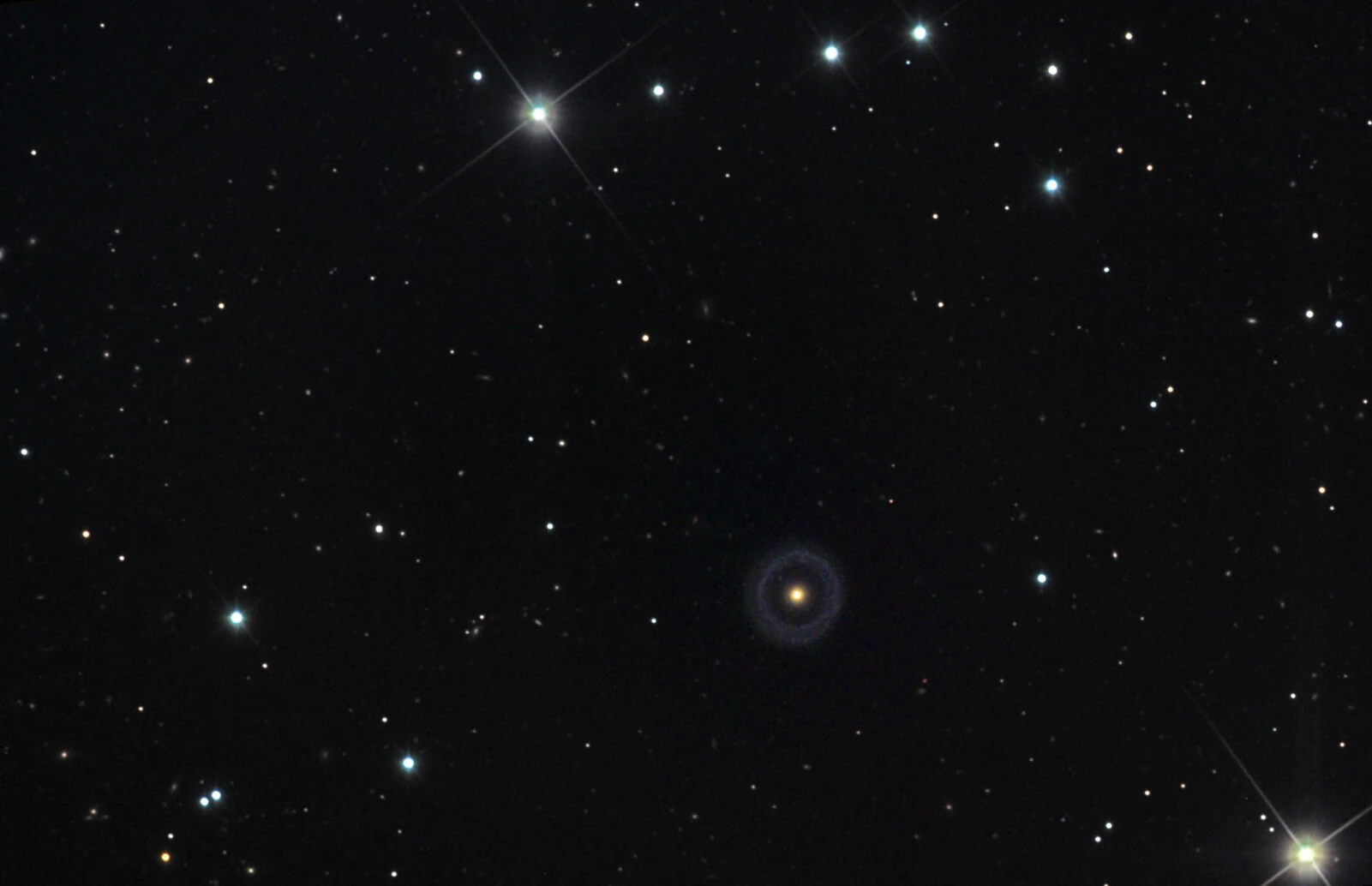
The Dark Energy Camera Legacy Survey imaged about 1.6 billion sources. Even after aggressive quality cuts, that leaves nearly four million galaxies, far more than any team will ever eyeball. The discoveries hiding in a catalog that size are usually not the objects someone built a detector for. They’re the ones nobody thought to name: a galaxy bent into a ring, a gravitational lens that slipped past the catalogs, a pair caught mid-collision. A small family of tools now goes looking for exactly those, and the trick behind all of them is the same. Let one person teach an algorithm what “interesting” means, then let the machine apply that taste to millions of images.
This is anomaly detection, and it’s one of the few corners of machine learning in astronomy where the human isn’t optional. I don’t run any of it from my balcony. A Seestar doesn’t produce a catalog that needs mining. But most of the genuinely new objects that come out of the Vera C. Rubin Observatory over the next decade will be found this way, so it’s worth knowing how the pipeline actually works.
Why you can’t just ask for “something new”
A supervised classifier only knows the classes you labeled. Train it on spirals, ellipticals and mergers, and it will sort every new galaxy into one of those three bins. Hand it a class it has never seen and it doesn’t flag the surprise. It just files the object under whichever known label fits worst, and the discovery disappears into a pile of misclassified spirals. To find the unexpected, you need a method that can say “this one doesn’t look like the others” without being told in advance what the others should be.
Classic unsupervised anomaly detection does that. An isolation forest, for example, ranks every object by how much of a statistical outlier it is in feature space. The problem is that in a real survey, the biggest outliers are junk: cosmic-ray hits, saturated stars, bad flat-fielding, satellite trails. Rank purely by weirdness and you get a list of artifacts. Michelle Lochner’s group put a number on it: running an isolation forest over DECaLS, the top 2,000 most anomalous sources contained exactly one object they judged scientifically interesting. The other 1,999 were noise.
So the machine has to be told what kind of weird you care about. That’s where active learning comes in.
A worked example: Astronomaly on 3.88 million galaxies
Astronomaly (Lochner, Bassett & collaborators, 2021) is the tool that made this practical, and a 2024 paper by Etsebeth and colleagues ran it at survey scale. The pipeline has three stages.
First, features. Each galaxy cutout goes through a pretrained convolutional network (EfficientNetB0), which turns the image into 1,280 numbers describing its appearance. PCA then compresses those to 26 dimensions while keeping 95% of the variance. Every galaxy is now a point in a 26-dimensional space where similar-looking objects sit close together.
Second, a first-pass ranking by the isolation forest — the one that, on its own, mostly surfaces artifacts.
Third, the human. The lead author opened Astronomaly’s interface and started labeling: this one’s interesting, this one’s a defect, next. A “neighbour score” then re-ranks the whole catalog so an object scores high only if it’s both an outlier and sits near things the human flagged as interesting. A few thousand clicks, a few hours of work.
The re-ranked top 2,000 contained 1,635 objects the authors counted as genuine anomalies, against that lone 1 from the raw isolation forest. Among them were 8 strong gravitational-lens candidates (5 already in existing catalogs, the rest worth a follow-up look), roughly 1,609 galaxy-merger candidates, and 18 objects with morphology odd enough that they matched nothing known. The yield flattened out past about 4,000 labels, so the human effort is bounded rather than open-ended. One person, an afternoon, four million galaxies, and a short list of things worth a telescope’s time.
Learning taste, not outlierness
Astronomaly’s newer sibling, Astronomaly Protégé (Lochner & Rudnick, 2024), drops the “outlier” framing entirely. Instead of asking what’s statistically weird, it asks what a particular scientist would rate as interesting. A Gaussian-process regression learns your interestingness score from your ratings, and at each step recommends the ten sources most likely to raise it. The image features this time come from BYOL, a self-supervised network that learns to describe images with no labels at all. It’s the same label-efficiency idea behind the foundation models now reaching supervised accuracy on a fraction of the training data.
Pointed at 6,161 extended radio sources from 115 galaxy clusters in the MeerKAT Galaxy Cluster Legacy Survey, Protégé recovered 56% of the sources a human had rated most interesting (4 or 5 on a five-point scale) after showing only its first 100 recommendations, about a tenth of the evaluation set. It surfaced X-shaped radio galaxies, ring-like sources and diffuse filaments, including some already published as discoveries and some that weren’t.
The shift is subtle but useful. “Interesting” is personal and survey-specific: a radio astronomer hunting bent jets and a galaxy-evolution researcher hunting mergers want different things out of the same catalog. A recommender that learns one person’s taste beats a fixed outlier score for both of them.
Doing it with almost no labels
The bottleneck is always the human labels. AnomalyMatch (Gómez et al., accepted at RASTI), built at ESA, goes after that directly. It treats anomaly hunting as binary classification (anomaly versus normal) and trains a semi-supervised model (the FixMatch algorithm on an EfficientNet backbone) that pulls signal out of a large pile of unlabeled images alongside a tiny labeled set.
The numbers are the interesting part. Starting from five to ten labeled anomalies, it reached an AUROC of 0.89 on the GalaxyMNIST galaxy-morphology benchmark (AUROC is the ranking quality, where 1.0 is perfect and 0.5 is a coin flip). After three rounds of active learning, the same verify-and-correct loop where a human confirms high-confidence hits and kills false positives, 94% of the top 1% highest-scoring galaxies were real anomalies. On a natural-image benchmark the model hit 0.96. Tested against Astronomaly on the “odd galaxies” from the Galaxy Zoo Challenge set, the two came out comparable at around 0.83.
ESA’s interest is scale: AnomalyMatch is wired into the ESA Datalabs platform and aimed at Euclid, whose imaging runs to billions of sources. The code is open on GitHub. Euclid is also where a separate set of neural networks hunts strong gravitational lenses; anomaly detection is the complement to that: the net for everything the lens-finder was never trained to catch.
What this means for the rest of us
You won’t run any of this on a smart telescope. But two things make it worth watching from the amateur side.
The first is where the discoveries come from now. Rubin will push out on the order of ten million alerts a night, and a set of ML brokers already triages that firehose into known variable-star types, supernovae and the like. Anomaly detection is how the genuinely new objects get pulled out of what’s left. When you read “astronomers spotted an unusual something in survey data” over the next few years, this human-in-the-loop pattern is often what happened behind the headline.
The second is that you could be the human. Astronomaly and Protégé are built around one person’s judgment, and their lineage runs straight back through Galaxy Zoo, where hundreds of thousands of volunteers classified galaxies by eye. The modern version doesn’t ask you to look at four million images. It asks you to look at a few hundred and learns a model from your clicks. Lochner, who built Astronomaly, laid the argument out in a 2026 review: the SKA and Rubin have made “look at everything” impossible, and the workable path is a split of labor where the machine handles scale and the person supplies judgment.
One caution is worth keeping in view. Every one of these tools outputs candidates, not confirmed discoveries. The eight lens candidates from the DECaLS run still need spectroscopy to pin down the geometry, and some of the “unusual morphology” objects may turn out to be image defects the network hadn’t seen before. What anomaly detection does is narrow four million objects down to a few hundred worth a human’s attention — and then a spectrograph’s. That’s the whole job, and it’s enough. A weird object in a survey is worthless if no one ever looks at it, and until recently, for catalogs this size, no one could.