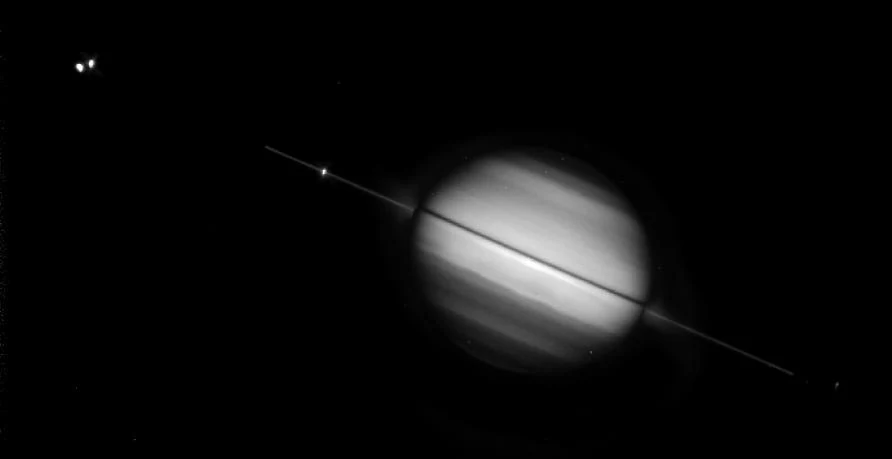
Saturn reaches opposition on October 4, 2026, which is the best night of the year to point anything at it. Around that date the planet sits opposite the Sun in our sky: closest to Earth for the year, brightest for the year at about magnitude 0.3 (apparent), and above the horizon all night. The question I get every autumn is how much telescope you need to actually see the rings. The answer depends entirely on what you mean by “see.”
Here’s the short version. Binoculars won’t show the rings as rings. A cheap 60 mm refractor will. The Cassini Division, the dark gap inside the ring system, needs roughly 100 mm of aperture and a steady night. And this year there’s a twist that changes what you should expect: the rings are barely tilted toward us.
Why October 4 is the date to plan around
Opposition is just geometry. The Sun, Earth, and Saturn fall in a line with Earth in the middle, so Saturn rises at sunset, transits (crosses due south, its highest point) near local midnight, and sets at sunrise. It’s also physically closest to us then, this year at 8.43 AU, about 1.26 billion km. The disk spans 19.7 arcseconds. The rings stretch to a little over twice that.
You don’t need the exact date. The whole window from about September 27 to October 12 gives essentially the same view, so any clear night in that stretch works. Saturn is currently drifting through Cetus, a bit south of the more familiar zodiac path, and from 35° N (my balcony in Nicosia) it climbs to better than 50° above the southern horizon at its highest. That altitude helps: the higher a planet sits, the less air you’re looking through, and the steadier the image.
The catch this year: the rings are nearly edge-on
Saturn’s rings aren’t always presented at the same angle. Over its 29-year orbit the tilt we see swings between about 27° open and fully edge-on, and we passed through the edge-on point (a ring-plane crossing) in March 2025. They’ve been reopening since. In October 2026 the rings are tilted only about 7° from our line of sight, showing their southern face.
Seven degrees is enough to read as a ring the moment you have enough magnification. But it’s a long way from the wide-open, 27° “poster” view, which returns around 2032. The practical consequence: the rings look like a tight, almost closed ellipse, and the Cassini Division is squeezed nearly edge-on, so it’s harder to catch than in a year when the rings are thrown wide. Titan and the other moons don’t care about ring tilt, so those are unaffected.
What each instrument actually shows
Naked eye. Saturn is an easy golden point at magnitude 0.3, brighter than every star near it and holding a steady, non-twinkling light. No rings, no disk, just a steady “star” that happens to be a world with a ring system.
Binoculars (10×50). Still basically a point, maybe a faint oval on a steady night if your hands are propped. Handheld binoculars top out around 10–15×, and that isn’t enough to pull the rings clear of the globe. This is exactly where Galileo got stuck in 1610: his roughly 20× refractor showed Saturn with “ears,” and he never resolved them as a ring.
60–80 mm refractor at 50–120×. This is the payoff instrument. Somewhere past about 30× the planet stops being round, and by 60–80× the rings separate cleanly from the disk with dark sky visible between them. Titan shows up as an eighth-magnitude “star” a few ring-widths off to the side. The Cassini Division usually stays hidden at this aperture, especially this year.
100–130 mm at 120–180×. Now the Cassini Division comes within reach, glimpsed at the ring tips (the ansae) in the steadier moments. A pale band or two crosses the disk. On a good night you can pick out three or four moons: Titan plus Rhea, Tethys, and Dione, all clustered around tenth magnitude.
150–200 mm and up at 150–250×. In good seeing the Cassini Division holds steady rather than flickering in and out, subtle belt shading appears, and five moons are within reach. Above roughly 250× you’re usually just magnifying atmospheric blur, not adding detail.
The arithmetic, quickly
Magnification is the scope’s focal length divided by the eyepiece’s. A 1200 mm scope with a 6 mm eyepiece gives 200×. The useful ceiling is about twice the aperture in millimetres (50× per inch of aperture), so a 60 mm tops out near 120× and a 150 mm near 300× in theory. If you want the reasoning behind eyepiece choice and exit pupil, I wrote that up separately in your first two eyepieces.
Resolution has a hard limit too. The Dawes limit is about 116 divided by the aperture in millimetres, giving a figure in arcseconds, so a 100 mm scope resolves roughly 1.2". The Cassini Division is finer than that as we see it this year, but because it’s a long dark lane rather than a pair of close points, observers routinely catch it at the ansae in a 90–100 mm scope when the air is steady. And size isn’t the problem: at 150× the whole ring system spans close to four full-Moon widths of apparent sky. The limiter is almost never magnification. It’s the atmosphere.
Seeing beats aperture, especially from a balcony
“Seeing” is astronomer shorthand for how turbulent the air is, and on planets it sets your ceiling more than the scope does. From my Bortle 7 balcony in Nicosia, warm air rising off the roof and the building’s stored heat smear the image at 200× on a lot of nights, no matter what aperture I use. Two habits help more than buying glass.
Let the scope cool to the outside temperature first. A tube full of warm air makes its own turbulence, and 30–45 minutes outside usually settles it. Then observe when Saturn is high, near midnight this month, so you’re looking through the least amount of atmosphere. A smaller scope is less punished by bad seeing than a big one, which is worth remembering before you assume more aperture is the fix. Planetary detail tends to arrive in flashes: half a second of steady air, then mush. You wait for the flashes.
Smart telescopes are the wrong tool here
If you own a Seestar S50 or a DWARF 3, this is the one target where they disappoint, and it’s worth knowing why before you get frustrated. The Seestar is a 50 mm, 250 mm focal-length, f/5 system built around a small sensor with 2.9-micron pixels. That works out to about 2.4 arcseconds per pixel, so Saturn’s rings span under 20 pixels in a raw frame: a bright lozenge with a hint of a ring, and no Cassini Division. These are deep-sky machines, tuned for wide, faint nebulae, not tiny bright planets. I went into where the Seestar does and doesn’t earn its keep in my write-up on the discontinued S50.
The sharp amateur Saturns you see online come from a different pipeline: a long-focal-length scope (a Schmidt-Cassegrain or Maksutov), a Barlow lens to stretch the system to around f/20–f/30, a fast planetary camera, and lucky imaging, where you record thousands of frames and stack only the sharpest few percent. That last trick is how amateurs beat the seeing, by throwing away every moment the air was bad.
What I would actually buy
If you only want to see the rings once, and have that first-time moment where they snap clear of the globe, borrow or buy any 70–90 mm refractor and a mid-power eyepiece. That’s the cheapest route to the view people remember, and a decent starter refractor competes well against binoculars for a first instrument.
If you want the Cassini Division and a handful of moons on good nights, aim for 100–150 mm: a small Maksutov or a 6-inch Dobsonian, plus a 6–9 mm eyepiece and a Barlow. If you want to photograph Saturn, skip the smart telescope for this job and put a planetary camera and Barlow on whatever long-focal-length scope you have.
The one thing I wouldn’t do is buy a big 250 mm scope for planets alone if you observe from a hot rooftop or balcony. Seeing, not aperture, is your ceiling there, and you’ll spend the money without seeing the benefit most nights.
Pick a clear evening between now and mid-October, let the scope cool, and wait for Saturn to ride high. The rings are subtle this year at 7°, but the first time you see them detached from the disk, closed to a thin bright ellipse, it lands the same way it did the first time. That view hasn’t gotten old for me in a decade of doing this.