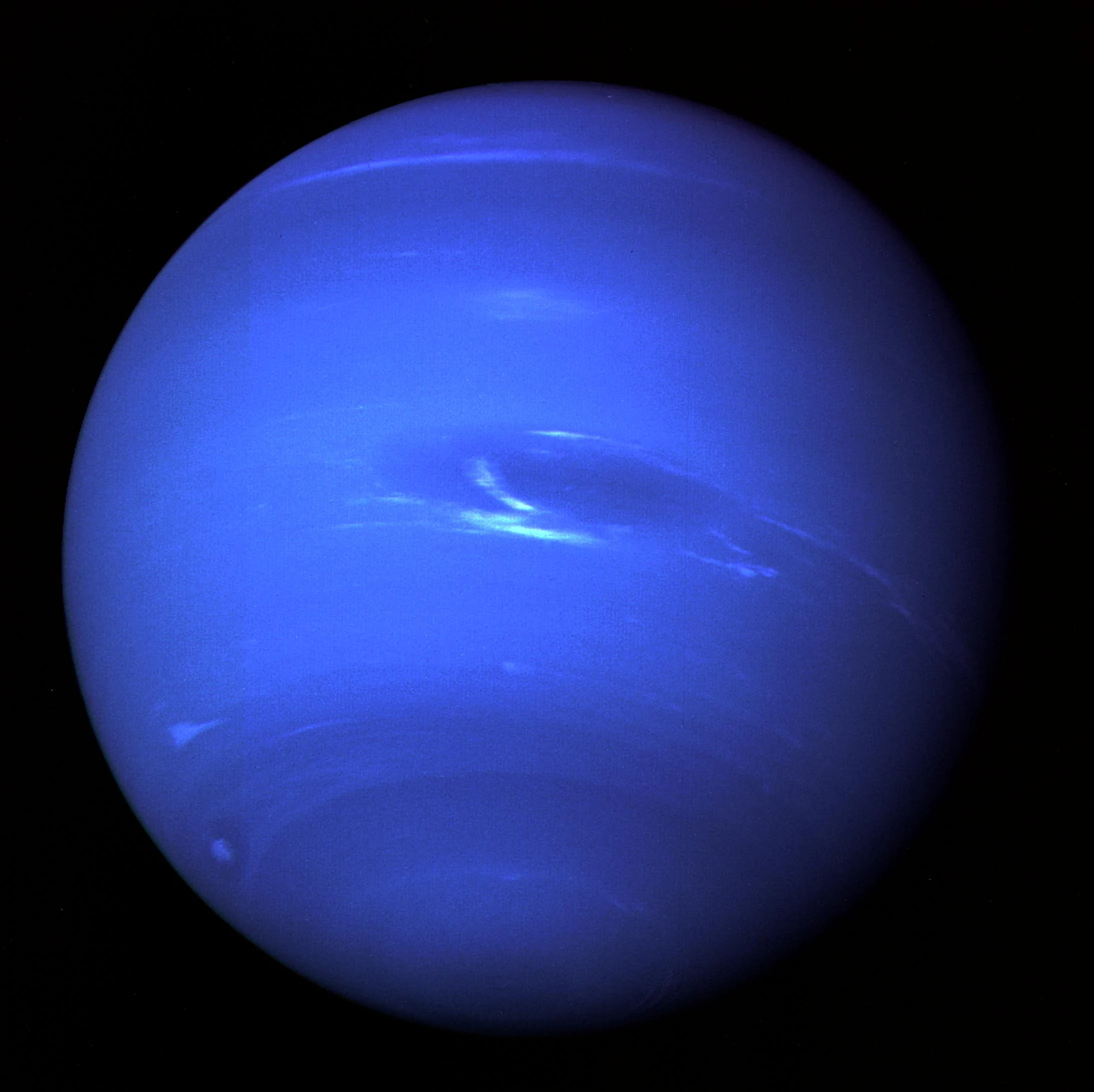
Neptune reaches opposition in the small hours of September 26 (around 00–01 UT), which makes this the best week of the year to track down the solar system’s most distant planet. Opposition just means the planet sits opposite the Sun in our sky: it rises at sunset, climbs highest near local midnight, and stays up until dawn. It’s also as close and as bright as Neptune gets in 2026 — magnitude 7.8, about 28.9 AU away. That brightness still isn’t enough for your eyes alone. Magnitude 7.8 is roughly three times fainter than the dimmest star you can catch with the naked eye under a good sky, so this is a binocular-and-telescope target. What you’re hunting is a single blue-grey point among the faint stars of Pisces, and the whole game is telling it apart from them.
Set your expectations first. Even at its best, Neptune shows a disk just 2.4 arcseconds across — about eight times smaller than Saturn’s disk this month. In most amateur scopes it looks like a slightly soft, faintly blue “star” that never quite snaps to a clean pinpoint. You won’t see the bands, the storms, or the pale cloud streaks Voyager 2 photographed in 1989. You see a dot 4.3 billion km away, and the reward is knowing that’s what you’re looking at.
Why this week, and why there’s no rush
The geometry does three useful things at once. Neptune is at its closest to Earth for the year, so it’s at its brightest and biggest; it’s up all night; and it transits due south, its highest point, around local midnight, when you’re looking through the least amount of atmosphere. From my balcony in Nicosia at 35° N it climbs past 50° above the southern horizon at that hour, which helps steady the view.
There’s a nice coincidence in the date. This opposition falls almost exactly 180 years after Neptune was discovered on 23 September 1846, and it was found by arithmetic before anyone saw it: Urbain Le Verrier worked out where an unseen planet had to be from the way Uranus was being tugged off its predicted path, and Johann Galle in Berlin found it within a degree of that spot the same night. Neptune takes 164.8 Earth years to go around the Sun once, so it only completed its first full orbit since that discovery in July 2011.
Don’t feel you have to observe on the exact date. Neptune barely changes size or brightness for weeks on either side of opposition, so any clear, dark night from now into the middle of October gives essentially the same view.
Start at Saturn, then hop into Pisces
The fastest route to Neptune uses Saturn as a signpost. Saturn is easily the brightest object in that stretch of sky at magnitude 0.3, and it’s heading to its own opposition on October 4. Neptune sits about 9° west-southwest of Saturn — a little less than a fist held at arm’s length, which covers roughly 10°.
If you already know the Great Square of Pegasus, you can come at it from above: drop south from the Square’s lower edge toward the dim ring of stars called the Circlet of Pisces, and Neptune is loitering in that region. Either way, print a detailed finder chart for your exact night or pull one up on your phone. At magnitude 7.8 you’re star-hopping to a specific dot, not aiming at a landmark you can see. The opposition ephemeris on in-the-sky.org is a good starting point for the chart.
What each instrument actually shows
Naked eye. Nothing. Magnitude 7.8 is well past the roughly 6.5 limit of a dark, moonless sky.
Binoculars (10×50). Neptune is in the field, but only as one more faint star. You will not pick it out by eye — you confirm it by matching the star pattern to your chart. This is where a lot of people quit, and that’s fair enough. It’s a puzzle, not a view.
60–90 mm refractor at 100× and up. Still basically star-like. On a steady night you might notice it looks a touch fuzzy, refusing to focus down to the hard point a real star gives you.
150 mm and up at 150–200×. This is where it stops being a star. A 150 mm scope shows the 2.4" disk as a disk: small, blue-grey, obviously not stellar. The blue comes from methane in Neptune’s atmosphere soaking up red light and leaving the cooler tint behind.
200 mm and up. Triton, Neptune’s largest moon at about magnitude 13.5, comes within reach as a faint speck a few arcseconds off the planet. Early October is a good time to try, as it swings out to greatest elongation from the glare of Neptune’s disk.
The small-scope way: let the software find it
My first-reach rig is a Seestar S50, and I’ll be honest about its limits here: a 30 mm aperture will not resolve a 2.4" disk. Nothing that small will. But the smart telescope is still what I point at Neptune first, because the hard part of this target is identification, and plate-solving does that for nothing. Feed it Neptune’s coordinates, let it solve the star field, and it parks the exact spot in the center of the frame. Stack a few minutes and the target holds a faint blue-grey cast the surrounding stars don’t share.
Then confirm it the old way. Sketch or photograph Neptune’s position against two or three nearby stars, come back after a few nights, and watch it move. Neptune drifts retrograde (westward) around opposition, and even its slow crawl is enough to see against the same stars inside a week. The stars stay put; the planet doesn’t. That motion is the same signal Galle used in 1846, and it’s still the most satisfying way to prove to yourself that the dot really is a world. If you’re weighing whether a 30 mm smart scope is enough for targets like this, I got into that in more detail here.
The Moon is a problem this week
One catch worth planning around: opposition night coincides with the Harvest Moon, and the full Moon of September 26 sits in the same half of the sky and floods it with light. For a magnitude-7.8 target that’s a real handicap. Moonlight raises the sky background and drowns the faint stars you need for the hop. My advice is to wait for the first week of October, once the Moon clears out of the evening sky. Neptune is still essentially at its opposition best then, and you’ll have a dark enough background to actually find it. If you can get to a genuinely dark site, all the better.
Is it worth the trouble?
I won’t oversell it. Neptune is a faint dot that takes patience, a chart, and a moonless night. Half the reward is intellectual rather than visual: the light reaching your eye left Neptune about four hours ago, from a world so far out that sunlight there is roughly 900 times fainter than it is here, and no spacecraft has been back since Voyager 2 flew past on 25 August 1989. But there’s a specific satisfaction in nailing it: turning an anonymous speck in Pisces into the eighth planet, the one we found on paper before anyone laid eyes on it. Give it a clear early-October night and a printed chart, and it’s genuinely doable from a city balcony.