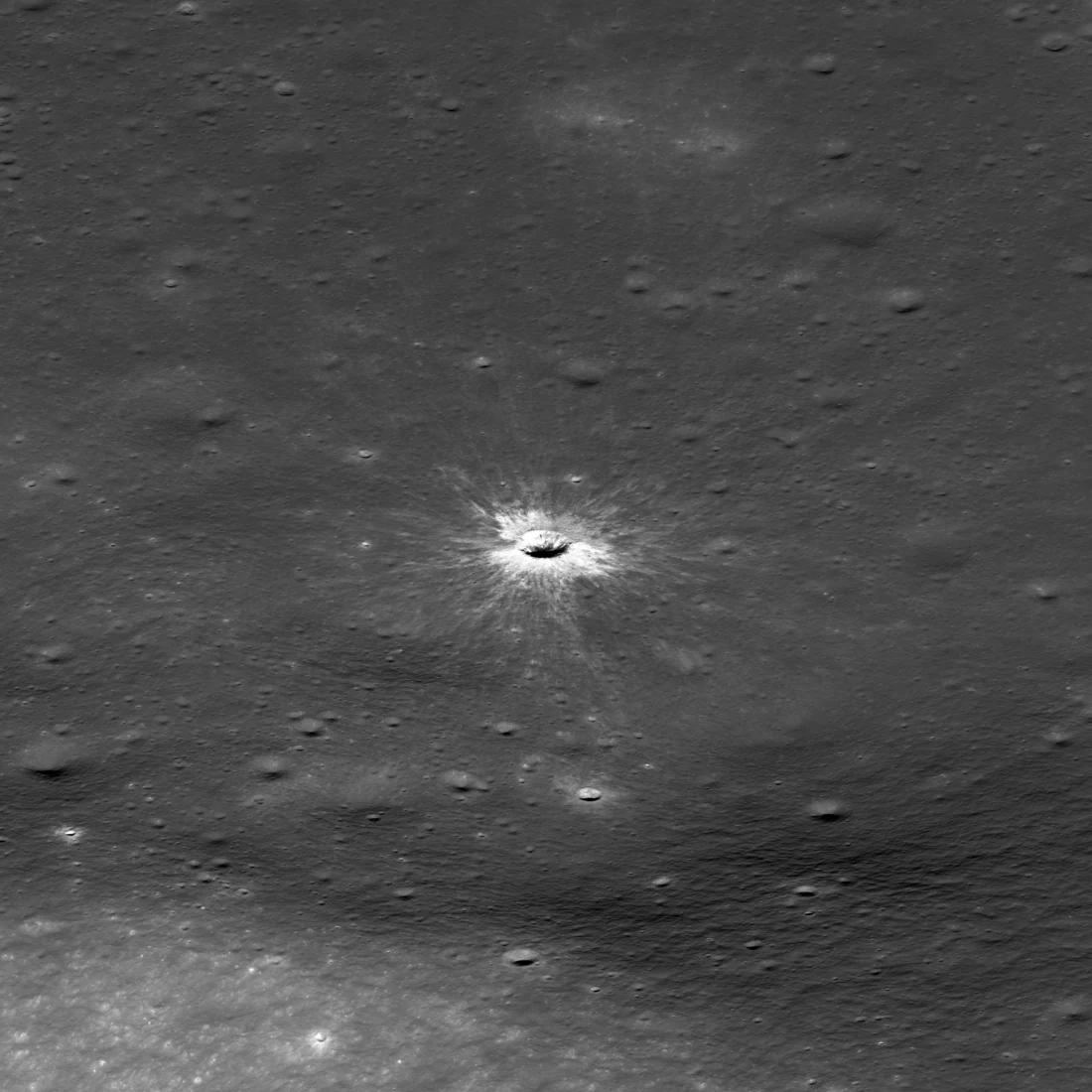
Sometime between 11 April and 22 May 2024, something the size of a three-to-six-storey building slammed into the eastern side of the Moon’s near side and blew out a crater 222 m across and 43 m deep. NASA’s Lunar Reconnaissance Orbiter photographed the aftermath within weeks, but nobody noticed until 2025, and the results only went public this month. The crater, now named McGetchin, is the largest fresh impact crater ever documented anywhere in the Solar System. It released roughly 15 kilotons of TNT-equivalent energy, and no telescope on Earth recorded the flash.
That last part is what got me. The near side faces us permanently, amateurs have been catching lunar impact flashes on video since 1999, and a hit about a thousand times more energetic than the brightest confirmed flash of 2013 still slipped through. I ran the lunar-phase arithmetic on why, and the answer points straight at how amateur flash monitoring works if you want to be watching next time.
What LRO found
Robert Wagner, an image-processing specialist at Intuitive Machines who works on the orbiter’s camera team, spotted it during a routine data-quality check. LRO’s Wide Angle Camera had imaged the same patch before and after the impact, and a ratio of the two frames lit up with a bright spot ringed by a dark halo. “I just stopped, dropped everything, and started looking into what that spot was,” he told NASA. “It was by far the most obvious impact debris pattern I’ve ever seen in one of these images.”
Follow-up with the Narrow Angle Camera, at about a metre per pixel, filled in the shape. According to the LROC team’s write-up, the rim stands 8 m above the old surface, the walls average 24° and steepen to about 40° in places, and the ground is disturbed more than 100 km from the crater, with at least two distinct waves of ejecta. The crater sits at 1.35°N, 67.18°E, just east of the small lava plain Mare Spumans, on the boundary between dark mare basalt and the older, brighter highland crust. The IAU adopted the name in May 2026, after Tom McGetchin, a lunar scientist who worked on crater ballistics in the Apollo era.
Two papers in Science Advances carry the details. Robinson et al. describe the crater and the before-and-after imaging. Paige et al. use LRO’s Diviner thermal radiometer to map a “cold spot” around it, an area about 6.5 km across that runs roughly 9 K (16 °F) colder at night than the surrounding ground. The impact loosened and fluffed the upper regolith, and looser soil holds less heat through the two-week lunar night.
For scale: over 17 years the LRO team has identified at least 1,000 new impact craters, and none comes close. Impacts of McGetchin’s size are estimated to happen on the Moon about once every 132 years.
How big a hit it was
The estimated energy is 6.5 × 10¹⁰ kJ, about 15 kilotons of TNT. Set it next to the two best-documented impact flashes on record, both from 2013:
- On 17 March 2013, NASA’s monitoring cameras recorded a flash in Mare Imbrium that shone at about magnitude 4 for roughly a second, bright enough to see without a telescope if you’d happened to be looking. (Magnitude is the astronomer’s brightness scale: smaller numbers are brighter, and 4 is a faint star from a suburban garden.) NASA estimated nearly 5 tons of TNT. LRO later found the crater it left, 18 m across.
- On 11 September 2013, two telescopes of the MIDAS project in southern Spain, run by José Madiedo and José Luis Ortiz, recorded a flash that peaked at magnitude 2.9 and glowed for over 8 seconds, about 15.6 ± 2.5 tons of TNT. The authors called it the longest and brightest confirmed lunar impact flash recorded up to then.
McGetchin is about a thousand times the September event and about three thousand times the March one, and its crater is twelve times wider than the 18 m hole from March. I won’t put a magnitude on the flash it made. The fraction of impact energy that comes out as visible light (the luminous efficiency) is poorly pinned down, the MIDAS team had to assume a value of 0.002, and I haven’t found a published brightness estimate for McGetchin. Even so, a thousandfold jump in energy puts it well beyond any flash anyone has caught on video.
Why nobody saw it
Earth-based flash monitoring only works on the Moon’s unlit side. Against sunlit ground even a big flash is lost in the glare. So the first question is whether McGetchin’s patch was in darkness at all, and I worked it through with the USNO phase tables for 2024.
At 67° east, the site sees sunrise about two days after new moon and sunset about two days after full moon. The formation window ran from 11 April to 22 May 2024. New moon fell on 8 April (the day of the North American total eclipse), full moon on 23 April, new moon again on 8 May, and full moon on 23 May. That means the Sun was up over McGetchin from the start of the window until about 25 April, and again from about 10 May to the end. The ground was dark only from roughly 26 April to 10 May: about 14 days out of 41.
That’s before you apply the monitoring rules. NASA’s Meteoroid Environment Office runs its telescopes about 10 nights a month, only when the Moon is between 10% and 50% illuminated. Past quarter phase, the sunlit part is big enough that its glare swamps faint flashes. Below 10%, the Moon is too low in twilight. For McGetchin’s dark stretch, the usable phases ran from last quarter on 1 May to around 5 May, when the waning crescent thinned below 10%. That’s about five pre-dawn sessions in a 41-day window, so roughly one chance in eight that the impact landed when a monitoring camera would even have been aimed at that part of the Moon. Then it needed clear sky at the few sites that run these programs, the Moon high enough above their horizon, and a camera actually recording.
There aren’t many such sites. NASA’s runs from Huntsville, Alabama, and MIDAS from southern and central Spain. ESA-funded NELIOTA used the 1.2 m Kryoneri telescope in Greece and validated 192 flashes between 2017 and 2023; the most recent NELIOTA results I can find stop at August 2023. Put together, the arithmetic says the likeliest outcome was always that nobody saw it.
Can you see McGetchin from Earth?
No, and it isn’t close. At the Moon’s average distance of 384,400 km, one arcsecond of sky covers about 1.9 km of lunar surface. A 222 m crater subtends about 0.12 arcseconds, and because it sits 67° toward the limb, foreshortening squeezes it further in the east–west direction. My Seestar S50’s 50 mm aperture has a theoretical resolution of about 2.3 arcseconds, or roughly 4 km on the Moon. A 20 cm Dobsonian on a perfect night gets to about 0.6 arcseconds, or 1 km, still five times too coarse for the crater itself.
You can find the spot, though, and I like knowing where things are. Start at Mare Crisium, the round dark plain near the Moon’s eastern limb (the right-hand edge as seen from the Northern Hemisphere). South of it, close to the limb, sit two small dark patches: Mare Undarum and, just below that, the 140 km Mare Spumans. McGetchin lies off Spumans’ eastern shore, between the craters Stewart and Pomortsev on the IAU location chart. The best time to look is when the Sun is low there. By my arithmetic, sunrise over the site comes around 12 October, so the evening of 13 October, with a three-day-old crescent low in the west after sunset, should put long shadows across that region. Libration can shift this by most of a day, so treat the date as approximate.
How amateurs watch for impact flashes
The first confirmed lunar impact flashes came from the hobby. During the Leonid meteor storm on the night of 17–18 November 1999, observers mobilised by David Dunham of the International Occultation Timing Association, mostly amateurs, recorded at least six Leonid impacts, each seen by at least two independent observers at the same time and place on the Moon. Each flash lasted under 0.02 seconds.
The requirements haven’t changed much since. NASA’s Meteoroid Environment Office observer FAQ and the British Astronomical Association’s guidance agree on the basics:
- Aperture and a wide field. The BAA suggests 20 cm or more at f/6 or faster. NASA runs 35 cm (14-inch) f/8 telescopes with 0.33× focal reducers to get as much of the dark limb into frame as possible.
- A sensitive monochrome video camera running continuously at 25 or 30 frames per second with no dead time between frames. The BAA treats 10 fps as a bare minimum and warns against compressed MPEG recording.
- Accurate timing. NASA wants flash times good to about 0.1 s, from a GPS time stamp at the start and end of each run.
- Detection software, because nobody can scan hours of video by eye. The standard tools are Pete Gural’s LunarScan and ALFI from Aberystwyth.
- A second observer. NASA’s rule of thumb is that a flash at the same spot and time from a station more than about 10 km away rules out cosmic-ray hits on the sensor, electronic noise, glints from satellites, and meteors heading straight at you. The BAA asks for three or more.
My balcony rig is the wrong tool. The Seestar builds images by stacking exposures, and a flash lasting a few hundredths of a second is exactly the kind of single-frame outlier a stack is designed to throw away. A Dobsonian with a fast planetary camera and a GPS timer is closer to the right setup. Even then, expect very few flashes. NELIOTA found that more than 75% of the meteoroids behind its flashes weighed between 1 and 200 grams, so a 1.2 m professional telescope was mostly catching pebbles. A 20 cm amateur scope sees only the brighter end of that. The payoff is scientific: NASA uses the flash counts to model the meteoroid flux that spacecraft and their crews have to be protected against.
If you want to try, the next windows are close. Last quarter falls on 3 October 2026 at 13:25 UT and new moon on 10 October, so the mornings of roughly 4 to 7 October give a waning crescent in the 10–50% range. On those mornings McGetchin’s half of the Moon is the dark half. The waxing crescent from about 13 to 18 October (first quarter is 18 October, 16:12 UT) puts the Moon’s western half in darkness for evening sessions. From Cyprus, a partner in Limassol or Troodos is well over 10 km from Nicosia, which covers the second-observer requirement.
What it changes
The two papers show that a single impact rearranges the surface far beyond its rim, with ejecta disturbing ground more than 100 km away and a thermal scar several kilometres wide. NASA says that could affect how rover wheels interact with the surface, which feeds straight into the planning behind the Moon Base landers.
For observers, the takeaway is less comfortable. The Moon is the closest place where amateurs can catch impacts live, and the biggest one in modern records most likely went unseen because the Sun was up over the site for two-thirds of the window and hardly anyone was recording during the rest. If you want to know when the dark limb faces you, my guide to the lunar cycle has the phase basics. I’ll be pointing the Seestar at the space between Stewart and Pomortsev on the 13th, knowing the crater is far too small to show, just to see where it happened.