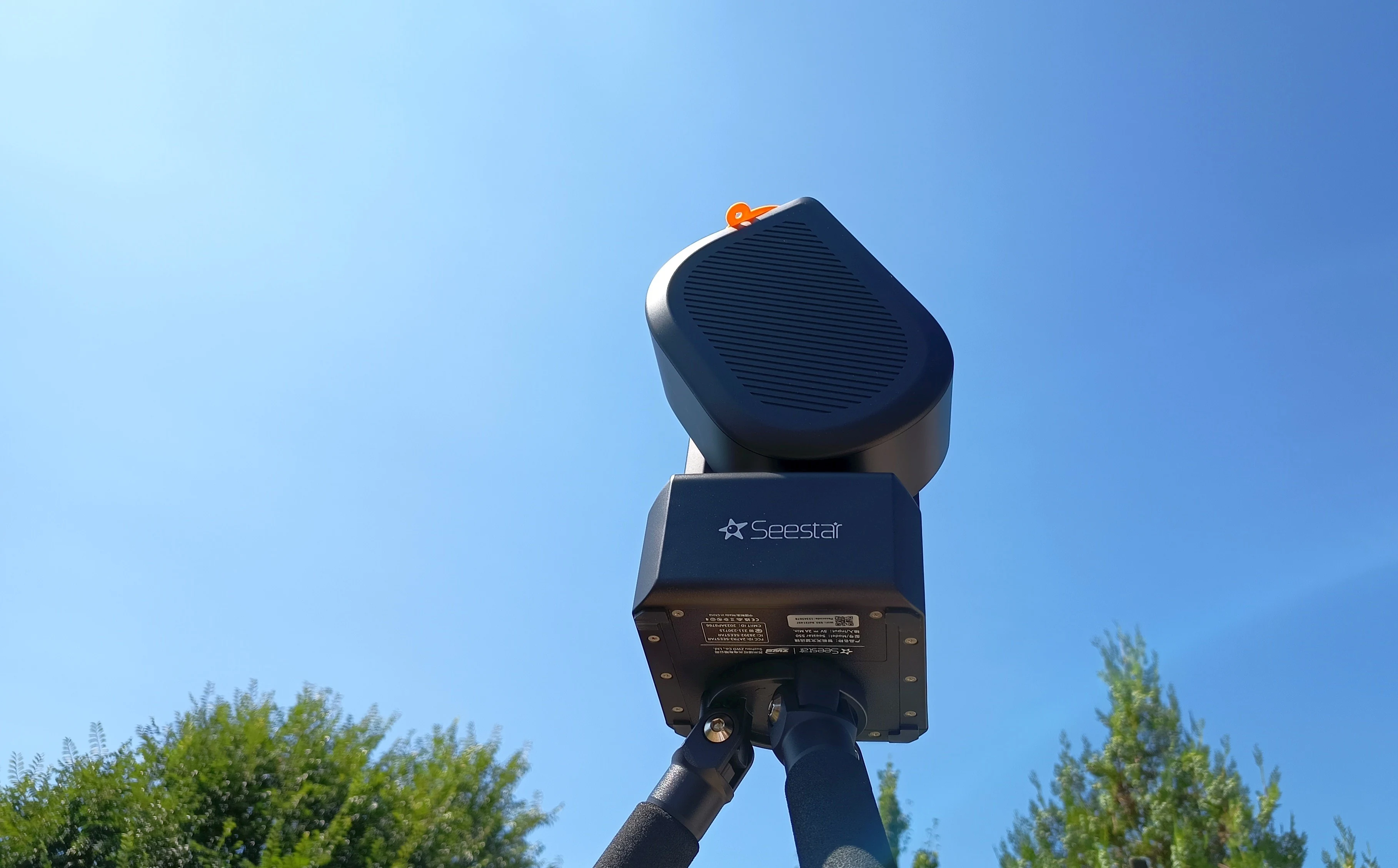
ZWO’s Seestar S50 Pro started shipping on September 1 and now lists at $999 (€999 in Europe) on ZWO’s product page, after an $899 launch price that ended on September 15. I’ve run the original S50 from my Bortle 7 balcony in Nicosia for most of a year, so the question I care about is narrow: if you already own an S50, what does $999 buy you? It buys the same light grasp and the same pixel scale, roughly 3.7 times the sky per frame, a 67% bigger battery, a wide-angle camera, and a main sensor nobody expected. For most S50 owners imaging from a city, I’d hold off. For a few, it fixes the exact thing that’s been annoying them.
A caveat up front: I haven’t had a Pro on my railing. The numbers below come from ZWO’s spec sheet, my own S50 logs, and two hands-on reviews, AstroBackyard’s and ScopeTrader’s 30-day test, which ran the sensor through SharpCap’s analysis tools. Where I’m extrapolating, I’ll say so.
What changed on paper
| Seestar S50 | Seestar S50 Pro | |
|---|---|---|
| Aperture | 50 mm | 50 mm |
| Focal length | 250 mm (f/5) | 260 mm (f/5.2) |
| Optics | 3-element apochromat | 4-element apochromat with ED glass |
| Main sensor | Sony IMX462, 1920 × 1080, 2.9 µm pixels | OmniVision OS08B10, 3840 × 2160, 2.9 µm pixels |
| Field of view | about 1.28° × 0.72° | about 2.45° × 1.38° (2.8° diagonal) |
| Pixel scale | about 2.39″ per pixel | about 2.30″ per pixel |
| Wide-angle camera | none | 6 mm f/1.75, 63° field, 8.3 MP |
| Battery | 6,000 mAh | 10,000 mAh (“up to 9 h”) |
| Storage | 64 GB | 128 GB (about 100 GB usable) |
| Price | $499 at launch, now out of production | $999 / €999 |
The fields of view and pixel scales are my own arithmetic from sensor dimensions and focal lengths, and they agree with the figures in both reviews. The filter set is unchanged in substance: a UV/IR-cut filter, a dark-frame filter, and the dual-band light-pollution filter (OIII 30 nm / H-alpha 20 nm) that makes any Seestar usable from a city. The Pro’s main unit weighs 2.8 kg.
Same aperture, same pixel scale
Start with what didn’t move. Both scopes have a 50 mm objective, so both collect the same number of photons per second from any star or galaxy. Both sensors also use 2.9 µm pixels at nearly the same focal length, so each pixel covers almost the same patch of sky: 2.39 arcseconds on the S50, 2.30 on the Pro.
Put a real target through that. M51, the Whirlpool Galaxy, is about 11.2 arcminutes along its long axis, or 672 arcseconds. On the S50 that spans roughly 280 pixels. On the Pro it’s roughly 290. The 4K sensor doesn’t magnify anything. It adds pixels around the edges of the frame, and around a galaxy that small, the extra pixels land on empty sky.
The slightly slower f/5.2 runs the wrong way, too. For an extended object like a nebula, each pixel gets (5 ÷ 5.2)² ≈ 0.92 of the light it got on the S50, an 8% drop. That’s small enough to vanish into night-to-night changes in transparency, but it isn’t a gain.
So the 90 minutes I needed in my six-month S50 review to pull M51’s spiral arms out of the Nicosia sky won’t shrink much on the Pro. Any improvement on small, faint targets has to come from the sensor, and the sensor turned out to be the surprise.
The sensor isn’t the one in the S30 Pro
When the specs first circulated (1/1.2-inch format, 3840 × 2160, 2.9 µm pixels), almost everyone, me included, assumed ZWO had moved the Sony IMX585 over from the S30 Pro. ZWO’s spec page names an OmniVision OS08B10 instead. It matches the IMX585’s format and pixel size but comes from a different manufacturer, which set off a long Cloudy Nights thread about whether Pro buyers were getting a lesser chip.
The first independent measurements are encouraging without settling it. ScopeTrader’s SharpCap analysis found read noise of 3.34 electrons at gain 0 and 0.61 electrons at high gain, a full-well capacity of 15,745 electrons at gain 0, and 12.2 stops of dynamic range. Low read noise is what you want in a scope that stacks hundreds of 10-second subs. What I haven’t seen yet is a side-by-side with the IMX585 on the number a balcony imager leans on hardest: sensitivity at 656 nm, the H-alpha line that carries most of what gets through the dual-band filter. AstroBackyard’s Trevor Jones says much the same thing, that he’d like to see more independent testing.
It’s also uncooled, like every Seestar. The thermal penalty I measured on the S50 during 30 °C June nights will apply to the Pro as well, and none of the reviews so far were shot in a Mediterranean July.
The field is where the money goes
The Pro’s 2.45° × 1.38° frame covers about 3.4 square degrees, against 0.92 for the S50. That’s 3.7 times the sky per frame, and for an S50 owner it’s the change you’d notice on the first night.
On targets I’ve pointed the S50 at, or wanted to:
- The Triangulum Galaxy (M33, 70.8 × 41.7 arcminutes) fills the S50’s frame with almost no margin, and only if field rotation leaves it lined up. On the Pro it sits comfortably with room to crop.
- The Rosette Nebula, about 1.3° across, never fit the S50. The Pro just holds it in a single frame.
- The Pleiades, about 2° across, still overflow the Pro’s short axis, so you’ll clip the outer members.
- Andromeda, about 3.2° × 1°, fits neither scope. Allowing some overlap between panels, the Pro needs a two-panel mosaic where the S50 needs about six.
In May I wrote that mosaics on the S50 need clear sky across the whole session, which is a gamble here, where high haze drifts in off the sea without warning. Two panels finish in a third of the time six do.
There’s one more comparison an S50 owner should run. The S30 Pro, at around $599, frames about 4.6° diagonally, wider still. If field is your only complaint, the cheaper 30 mm scope solves it more completely, as I worked through in the July piece on the 30 mm Seestars. The S50 Pro is the one to buy if you want a wider field and 50 mm of aperture in the same box.
Battery and storage, with the arithmetic
The S50’s battery was its weakest spec in practice. I logged 2.5 to 3 hours on mild winter nights at 12–15 °C, and a January M27 session died at 2 hours 40 minutes. The Pro’s 10,000 mAh is 1.67 times the S50’s 6,000 mAh. Scaling my own numbers by capacity alone gives roughly 4 to 5 hours on a similar Nicosia night. Treat that as a back-of-envelope figure, since the Pro powers a bigger sensor and a second camera from the same pack. ScopeTrader reports about seven hours under normal stacking, and AstroBackyard calls ZWO’s nine hours a best case that cold nights will cut.
Either way it’s a real improvement, and also one you can buy today for the price of a USB power bank. I’ve had one zip-tied to my railing since spring.
Storage doubles, but frames quadruple. If you export raw subs, and you should for anything you plan to process yourself, each uncompressed 16-bit Pro frame is about 3840 × 2160 × 2 bytes ≈ 16.6 MB, four times the size of an S50 frame. ZWO quotes about 100 GB usable, which works out to roughly 6,000 raw subs, or around 17 hours of 10-second exposures. That’s comfortable for a few long nights. You’ll still be offloading files every week or two in a clear spell.
EQ mode and the wide camera
Equatorial mode shows up in the Pro’s launch materials, but S50 owners already have it. I’ve run EQ mode with 60-second subs on mine since the spring. The Pro’s change, per ZWO and ScopeTrader, is a “near-zero-backlash” drive, which should mean fewer trailed and rejected frames in long subs. Neither review measured that against an S50 on the same wedge, and the wedge is still sold separately. I’d count it as a minor improvement until someone does.
The wide-angle camera is the new hardware that changes what the box can do: a 6 mm f/1.75 lens with a 63° field on an 8.3-megapixel sensor. From a Bortle 7 balcony it’s a framing aid and not much more, because there’s no Milky Way over Nicosia to shoot. Up at Troodos it earns its place. ZWO pitches it for Milky Way panoramas, star trails and time-lapses, which turns one 2.8 kg box into a deep-sky scope and a wide-field camera on the same night out. If you already carry a camera and a star tracker up the mountain, it duplicates gear you own.
Who should upgrade, and who should skip it
Upgrade if framing is your recurring frustration and you want to keep 50 mm of aperture. M33 and the Rosette go from tight squeezes or mosaic projects to single frames.
Upgrade if you regularly drive to dark sites. Under a Bortle 3 sky the aperture works harder, the bigger battery can mean three targets in a night instead of one, and the wide camera finally has a sky worth pointing at.
Skip it if your target list is mostly small, faint galaxies. Same aperture plus same pixel scale means M51 at 90 minutes will look much the same on either scope.
Skip it if battery life is your main complaint. A power bank fixes that for a small fraction of $999.
Skip it if what you mostly want is more sky. Keep the S50 for compact targets and add an S30 Pro for the big nebulae; the pair costs less than one S50 Pro, and the workflow on both is identical.
And skip it, or at least wait, if you image through hot summers. The uncooled-sensor ceiling doesn’t move, and the OS08B10 hasn’t been tested in that heat yet.
What I’m doing
I’m keeping my S50 through this winter. My two complaints with it were framing and battery. The power bank already dealt with the second, and before I spend $999 on the first, I want to see the OS08B10 and the IMX585 shoot the same emission nebula through the same dual-band filter. If the OmniVision chip holds its own at 656 nm, the S50 Pro becomes the one Seestar I’d buy for both the balcony and Troodos. Until then, if you already own an S50 and image from a city, keep in mind that your scope collects exactly as much light as the new one. Spend the next few clear nights using it.