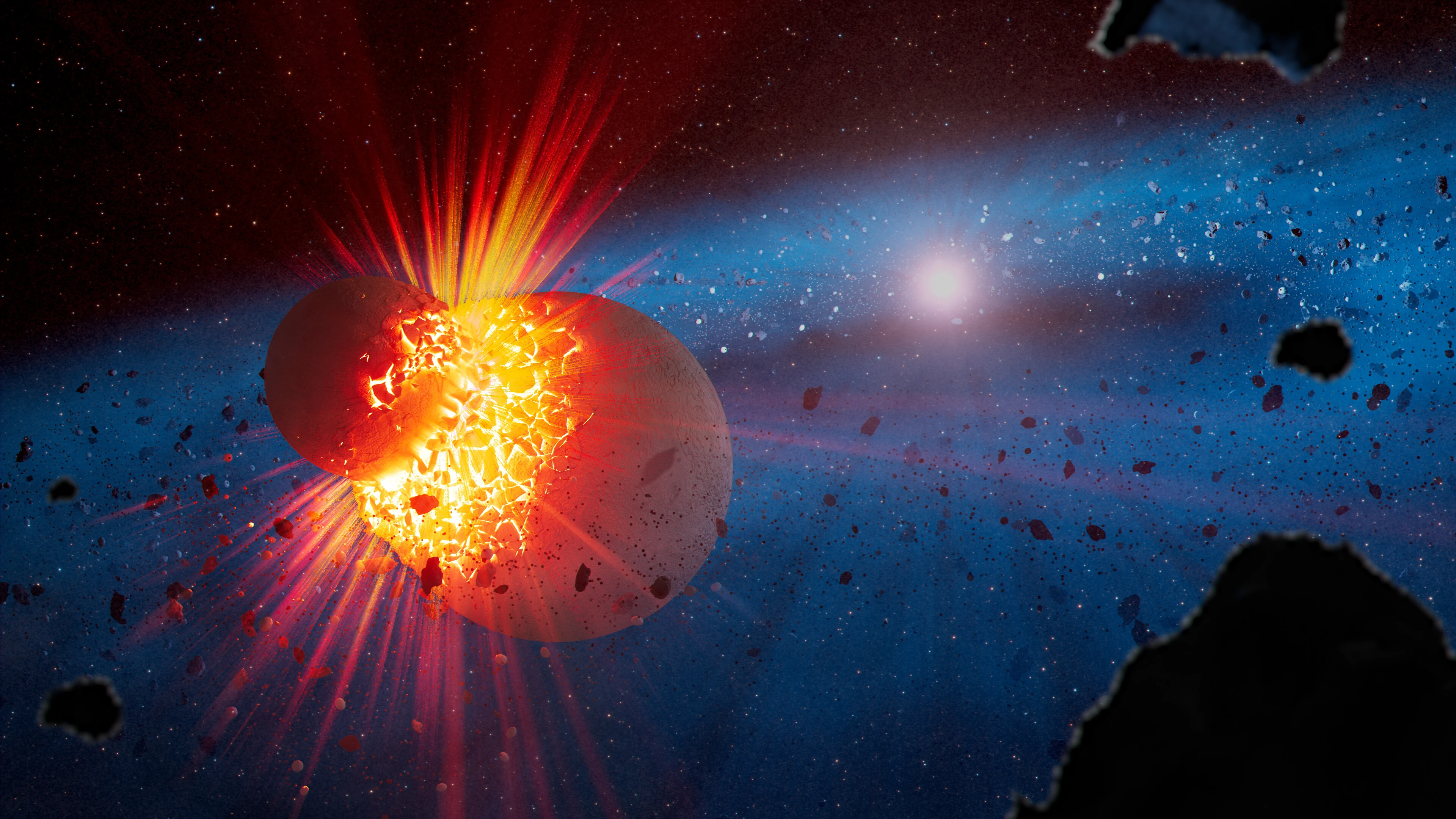
The leading explanation for our Moon is a crash: something roughly the size of Mars hit the young Earth, and the debris that stayed in orbit pulled itself together into the Moon. Nobody was around to watch that, but a new study shows we can watch the same kind of event around other stars through the dust it leaves behind. Kate Su of the Space Science Institute in Boulder and nine co-authors combined JWST and Spitzer mid-infrared spectra of 21 “extreme debris disks”, rare systems where planet-sized bodies are colliding right now. The dust chemistry splits them in two. Silica-rich disks point to violent crashes between Mars-sized embryos, and they turn up only around stars younger than about 300 million years. Silica-poor disks point to Moon-sized impacts, and they also appear around much older stars. The paper is accepted in The Astrophysical Journal (preprint: arXiv:2607.06684), and NASA and ESA/Webb released it on 2026-10-01.
The Moon is the template
The giant-impact picture goes like this. A body usually called Theia, about the size of Mars, struck the proto-Earth. Enough rock melted and vaporized to throw a disk of debris into orbit, and the Moon assembled out of that disk. NASA’s release puts the event at roughly 100 million years after the Sun formed.
For scale, Mars is 6,779 km across and the Moon 3,474 km, and Mars has about 8.7 times the Moon’s mass. Those two sizes end up as the dividing line in the new paper.
Our own impact’s dust was cleared out billions of years ago, and what survives is locked in lunar and terrestrial rock. To see the dust itself, you need a younger system where the crashes are still happening.
What makes a debris disk “extreme”
A month ago I wrote about how planet-forming disks lose their gas. Those are protoplanetary disks: gas-rich, a few million years old, the place where planets get built from scratch. A debris disk comes after that gas is gone. Its dust is second-generation, made by collisions between rocks, asteroids and larger bodies that already exist. Vega and Fomalhaut, the comparison cases in the ESA/Webb release, host well-studied debris disks whose dust is mostly cold and far from the star, closer in spirit to our Kuiper belt.
An extreme debris disk (EDD) is a different beast. The paper defines one by three traits:
- it re-emits more than about 1% of its star’s total light in the infrared, an enormous amount of dust;
- the dust is warm, at least a few hundred kelvin, so it sits in the zone where rocky planets orbit;
- its infrared brightness changes irregularly over time.
They’re rare. The paper finds them around only about 1% of debris disks of similar age around relatively young stars. NASA’s release phrases it as about 1% of young stars, which isn’t quite the same claim, so I’d go with the paper’s wording.
Variability is what gives them away. Su’s group reported the textbook case in 2014: ID 8, a young Sun-like star in the cluster NGC 2547 in Vela, came back into Spitzer’s view in January 2013 noticeably brighter in the infrared, then faded over the following months. The team read it as the aftermath of a large impact (Meng et al. 2014, Science; preprint arXiv:1503.05609). ID 8 is in the new sample too.
What Webb actually measured
Sixteen of the 21 systems were observed with JWST’s MIRI instrument in its medium-resolution spectroscopy (MRS) mode, which records a continuous spectrum from 4.9 to 27.9 µm. For 12 of them it’s the first complete spectrum across that range. The other five come from archival Spitzer spectra; Spitzer was switched off in January 2020, so archival data is all there will ever be. The JWST time came from three programs: 1206 (PI Rieke), 1282 (PI Henning) and 3189 (PI Su).
The mid-infrared is where warm silicate dust leaves its fingerprints. Silicate minerals produce a broad emission bump around 10 µm, and its shape tells you what the grains are made of and roughly how big they are. The team’s main yardstick is the strength of that 10 µm feature, which they call W₁₀. It tracks how much optically thin dust the system holds: dust thin enough that you see through it, so every grain adds its own light.
Three results came out of the spectra:
- EDDs carry far more of that small, optically thin dust than typical protoplanetary disks or ordinary debris disks.
- The grains are mostly submicron, smaller than a thousandth of a millimetre.
- The silicates are highly crystalline, and many disks are rich in silica. Both point to material that was heated, melted or vaporized at some stage.
Together with the variability, the authors take those traits as the signature of dust generated by large collisions between Moon- and Mars-sized bodies. In the NASA release, Su puts it this way: “This is the first time we have gathered enough systems to truly understand this subclass that we call extreme debris disks.”
Two kinds of crash: silica and forsterite
This is where the Moon comes back in. Eight of the 21 disks are silica-rich, which the paper gives as 38% with an uncertainty of +11/−9 percentage points (the releases round it to “about one-third”). Silica is SiO₂, the compound in quartz and in volcanic glass. The rest are silica-poor and show forsterite instead: Mg₂SiO₄, the magnesium-rich end of the olivine family.
The two minerals record different histories. The authors propose that silica forms by condensing straight out of rock vapor after a high-energy impact. For HD 172555 and HD 15407, two classic silica-rich EDDs, the paper notes that obsidian and fused quartz are the materials that reproduce the observed spectra. Both are glasses, which is what you get when silicate rock is melted or vaporized and then cools fast. Forsterite-rich dust shows less sign of shock. The team reads systems like ID 8 as dominated by thermally annealed grains, heated but never pushed through a vapor phase.
From there the paper’s interpretation follows. Silica-rich EDDs tend to come from collisions between large planetary embryos about the size of Mars. Silica-poor EDDs come from collisions between smaller, roughly Moon-sized bodies. (Planetary embryos are the Moon-to-Mars-sized bodies that merge into rocky planets.) NASA’s release adds that the gentler silica-poor cases include grazing impacts. The sizes are inferred from mineralogy; nobody resolved a colliding body. But the chain is physically sensible: a bigger impactor means more impact energy, more vaporized rock and more silica condensing out of the vapor.
The release compares forsterite to the green sand on some Hawaiian beaches. My nearest reference is closer to home. Around the summit of Mount Olympus in Troodos, the mountain I drive up for dark skies, the Troodos ophiolite exposes actual mantle rock: harzburgite and dunite, both made mostly of olivine, though seawater circulating through it has altered much of that olivine to serpentinite (Batanova & Sobolev 1999 on Troodos mantle peridotites). Mantle olivine sits close to the forsterite end of the series. The rock under my tripod is the same mineral family Webb is tracing in silica-poor debris disks, just without the collision.
The age split is the cleanest result. Silica-rich EDDs turn up only around stars younger than about 300 million years, and the older stars in the sample host only silica-poor disks. If our own Moon formed around 100 million years in, the young silica-rich systems are the nearest analogue we have to the inner solar system at that moment. That comparison is mine, and it’s why I’ll keep following this sample.
The old ones are a different story
The sample includes three EDDs older than 300 million years, past the era when rocky planets should still be assembling. The oldest is listed at about 5.5 billion years, older than the Sun. All three are silica-poor, with very strong 10 µm features, so they hold a lot of small dust.
Collisions that late in a system’s life need a trigger. The authors interpret these three as signs of a late dynamical instability: planets migrating and rearranging an already-built system through planet–planet and planet–planetesimal interactions, which sends smaller bodies into the inner zone. They compare it to proposals for a Late Heavy Bombardment in our own solar system, when the giant planets may have migrated outward and stirred up the small bodies. Whether that bombardment really was a sharp spike is still argued over, so “proposals” is the right word.
The variability ties in here. Systems with the strongest 10 µm features (W₁₀ above about 12.5 µm, all of them silica-poor) tend to vary more in the infrared; the paper puts the difference at about a factor of 5, comparing median values. The team reads that as ongoing collisional activity, and suggests silica-poor, high-W₁₀ EDDs could serve as markers for planetary systems that are going through a major rearrangement right now.
Can you see any of these stars?
Two of the host stars are amateur targets. The dust isn’t. Warm dust at a few hundred kelvin shines in the mid-infrared, the 5–28 µm range MIRI recorded, at wavelengths far longer than any hobby camera can detect, so in visible light these look like ordinary stars.
HD 172555, the textbook silica-rich case, is an A-type star of apparent magnitude 4.8 (magnitude measures how bright a star looks from here; lower is brighter, and 4.8 is naked-eye under a dark sky). Its Gaia parallax of 34.7 milliarcseconds puts it about 94 light-years away, and the paper adopts an age of 20 million years. It sits at declination −65°, so from Nicosia at 35° N it never rises; at its highest it’s still 10° below my horizon. It’s a southern-hemisphere target.
V488 Per is the one I can reach. It’s a K-type dwarf of magnitude 12.8 in the Alpha Persei cluster (Melotte 20), the loose group of bright blue-white stars around Mirfak, and this paper newly classifies it as silica-rich. It’s also one of the dustiest stars known: the paper lists a fractional dust luminosity of 16.4%, meaning roughly a sixth of the star’s output is absorbed by dust and re-emitted as infrared. The paper adopts an age of 80 million years, about where NASA’s round number puts our own Moon-forming impact.
V488 Per lies 1.4° from Mirfak toward the south-southeast (position angle about 151°). From Nicosia in early October the pair is about 31° up in the northeast at 22:00 local time (EEST, UTC+3), passes 50° around midnight and reaches about 70° by 02:00. A magnitude 12.8 star is easy for the Seestar S50 on my balcony even through Bortle 8 skyglow. The one snag is the field: 1.4° is wider than the S50’s long frame edge of about 1.28°, so Mirfak won’t fit in the same frame. I’ll centre on V488 Per and let the fainter cluster members fill in around it. What I expect is a warmer-coloured dot among bluer neighbours, with nothing in the image to show that a sixth of its light is coming back out of a crash zone.
What to keep in mind
Twenty-one systems is the largest EDD sample yet, but it’s still 21, which is why the 38% silica-rich fraction carries an error bar of about ten percentage points. The 300-million-year boundary rests on stellar ages, and young field stars are hard to date; cluster members like ID 8 and V488 Per are better anchored than the rest. The Mars-sized versus Moon-sized split is an interpretation of mineral signatures, and impact simulations matched against these spectra are the obvious next test.
The variable, silica-poor systems are the ones I’d watch. If the paper is right, each is a planetary system being rearranged right now, and continued infrared monitoring is how we’d catch the next big impact as it happens.