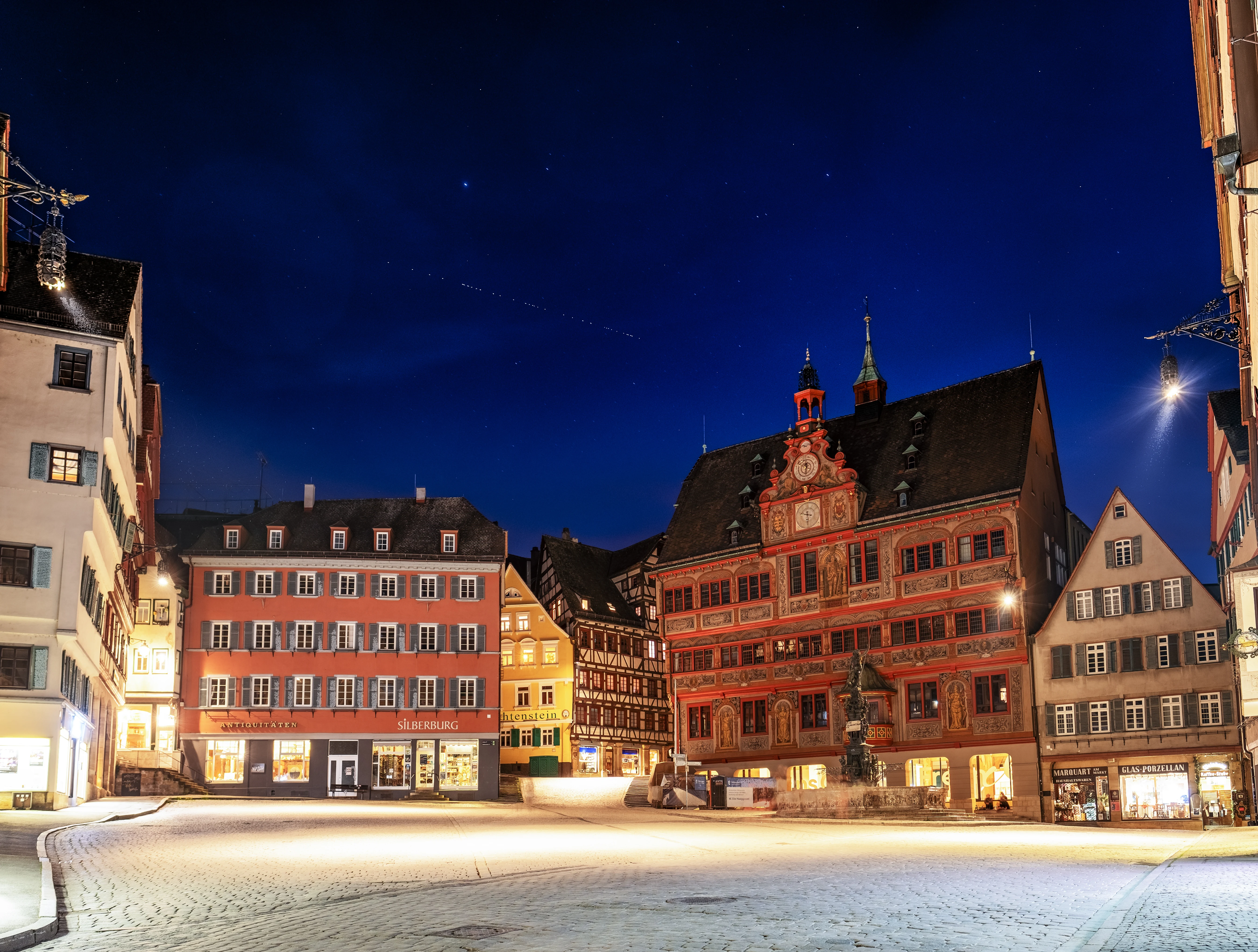
A point of light is sliding across the sky, silently, and you want to know what it is. You can almost always answer that in about ten seconds with four checks. Look at whether it blinks, whether it moves in a dead-straight line at an even pace, whether it fades out in the middle of the sky, and how long it lasts. No gear needed, and a free pass-prediction website will confirm your guess afterwards. The key below is the one I use from my balcony in Nicosia; the sections after it explain each line.
| What you see | Most likely |
|---|---|
| Flashing white or red light, maybe a red and a green point side by side | Aircraft |
| A bright, steady light that hangs almost still for a minute or two, then drifts | Aircraft flying toward you |
| A steady point moving in a straight line at an even pace, no sound | Satellite |
| Steady, brighter than any star, takes several minutes to cross | ISS or China’s Tiangong station |
| A row of evenly spaced dots following the same path | A recently launched Starlink batch |
| Moves like a satellite but brightens and dims every few seconds | Tumbling rocket stage or dead satellite |
| A streak that’s over in about a second | Meteor |
| Doesn’t move against the stars at all | Star or planet |
Blinking lights mean an aircraft
Aircraft lights are regulated. Under the US certification rules for airliners, the forward position lights must be red on the left side and green on the right, with a white light at the rear. On top of those steady lights sits an anti-collision system, aviation red or white, with an effective flash rate of 40 to 100 cycles per minute. That’s one flash every 0.6 to 1.5 seconds.
The strobes give a plane away long before you can make out red or green. In the first hour after dark most of the moving lights I see from the balcony are aircraft, and two or three flashes are enough to call one.
The trap is an aircraft flying roughly toward you with its landing lights on: a single bright white light that barely moves for a minute or more, like a star that wasn’t there a moment ago. Keep watching. Within a few minutes it turns, the strobes come into view, or you hear it.
A steady pace in a straight line means a satellite
A satellite carries no lights of its own. You see sunlight reflecting off it, the same way you see the Moon, so it shines steadily and follows a smooth path across the sky. It’s fastest near its highest point and slower near the horizon, and it never turns. NASA’s Spot the Station page describes the ISS as looking like an airplane or a very bright star, “except it does not have flashing lights or change direction.”
Speed is a poor clue. NASA gives the ISS’s speed as about 28,000 km/h. The station’s orbit currently runs 416–425 km up, according to the Heavens-Above orbital elements for 4 October. On a pass straight overhead, that works out to about 1.1° of sky per second. An airliner cruising at 900 km/h and 11 km up, also straight overhead, covers about 1.3° per second. The ISS is roughly 38 times higher and 31 times faster, and from the ground those two factors nearly cancel. (Those rates are my own arithmetic; on a low pass both objects look slower because they’re farther away.)
What gives a satellite away is its steadiness: no flashing, no turning, no colour change, no sound.
A light that fades out mid-sky is a satellite entering Earth’s shadow
This is my favourite tell, and it’s pure geometry. You can only see a satellite while it’s in sunlight and you’re in darkness. After sunset the Sun keeps shining on anything a few hundred kilometres up. Eventually the satellite slides into Earth’s shadow and disappears, often turning orange-red in its last seconds as it passes through sunlight filtered by the atmosphere.
For a satellite directly overhead at the ISS’s height, that happens when the Sun is about 20° below your horizon. For a Starlink satellite in a 550 km shell, the figure is about 23°. Both numbers are my calculation, arccos(R/(R+h)) with Earth’s radius R = 6,371 km and orbital height h, and they ignore the slight blurring of the shadow edge by the atmosphere.
From Nicosia this week the Sun sets at about 18:26 local time (EEST, UTC+3) and reaches 20° below the horizon at about 20:00. That leaves a window of roughly an hour and a half after sunset for overhead passes. In the evening, satellites fade out part-way across the sky, usually toward the east. In the morning it runs in reverse, and they switch on mid-sky. Aircraft never do either, because they carry their own lights.
The same geometry explains why NASA says all ISS sightings happen “within a few hours before or after sunrise or sunset.” At local midnight in October, the ISS, Tiangong and Starlink are all in Earth’s shadow as seen from Cyprus.
The two bright ones: the ISS and Tiangong
A quick word on brightness first. Astronomers use apparent magnitude, where lower numbers mean brighter, and each step is a factor of about 2.5. Sirius, the brightest star in the night sky, is magnitude −1.5. Under a dark sky the faintest stars you can see are around magnitude 6. In a city the limit is a magnitude or two brighter.
If a steady moving light outshines every star and takes several minutes to cross, it’s very likely one of the two crewed space stations. The ISS orbits at an inclination of 51.6° (its orbit is tilted that far from the equator). NASA points out that north or south of 51.6° it never passes directly overhead. China’s Tiangong orbits lower, 386–388 km, at an inclination of 41.5°, according to the Heavens-Above elements. At Cyprus’s 35°N, that lower tilt brings Tiangong high over us often.
The week I wrote this, the two stations could hardly have looked more different from here. For Nicosia, Heavens-Above lists only two visible ISS passes between 5 and 14 October, both low before dawn:
- 13 October: magnitude −1.5, highest at 05:51 local time, 25° up in the southeast.
- 14 October: magnitude −0.8, highest at 05:04, 14° up in the southeast.
Tiangong gets twelve visible passes over the same ten days, all in the pre-dawn sky. The best one is on 12 October. It appears in the west-northwest at 06:04, climbs to 80° in the south-southwest at 06:07 and reaches magnitude −2.2, while the Sun is still about 9.5° below the horizon. The pass on the 13th is a good demonstration of shadow geometry: Tiangong appears out of nowhere 52° up in the east-northeast at 05:08. That’s the moment it leaves Earth’s shadow.
Visible passes come in runs. You’ll get a stretch of evening passes, then a gap, then a stretch of morning ones, depending on how the orbit lines up with sunrise and sunset over your location. If the ISS has gone quiet for you, check again in a couple of weeks.
A row of dots is a fresh Starlink batch
A line of evenly spaced points following one another along the same path is a batch of Starlink satellites launched together. The cover photo, taken over Tübingen, shows one. SpaceX releases them into a low orbit, and over the following weeks they raise themselves to their working altitude. They spread out along the orbit as they climb, so the tidy line dissolves after the first days.
That low phase is when they’re brightest. Anthony Mallama and colleagues measured Starlink V2 Mini satellites during orbit raising. They found a mean apparent magnitude of 2.68 for satellites below 357 km and 6.46 for those above it (arXiv:2405.12007). The authors infer that 357 km is the height where SpaceX starts applying brightness mitigation. On station, in that mitigated mode, the same group measured a mean of 7.06 ± 0.10 (arXiv:2306.06657). That’s fainter on average than the naked-eye limit even under a dark sky, though individual satellites scatter around it. Their sky-distribution study found that the largest areas of sky holding Starlinks brighter than magnitudes 6 and 7 occur during twilight. It also catalogues brief brightness surges, which the authors call flares.
The first 26 satellites of the new V3 generation launched on Starship Flight 14 on 28 September. Nobody has published brightness measurements for them yet, so I won’t guess. If you spot a train, Heavens-Above has a page that predicts passes for every object from a given Starlink launch, which lets you match it to its launch group. For what the constellation’s growth means for observers, see my piece on SpaceX’s IPO and the night sky.
Slow pulsing means something is tumbling
A light that moves exactly like a satellite but brightens and dims in a slow rhythm every few seconds is usually tumbling. Spent rocket stages and dead satellites rotate freely, and different faces catch the Sun as they turn.
Older guides tell you to look for Iridium flares. Those were sudden, predictable brightenings that happened when sunlight glinted off the original Iridium satellites, and you can stop looking for them. Iridium deorbited the last working satellite of its original constellation on 5 December 2019, an event the company billed as the “Final Flarewell”. The Iridium NEXT replacements were designed to avoid producing flares.
Over in a second is a meteor
A meteor shows up as a streak. According to the American Meteor Society, meteoroids enter the atmosphere at about 11–72 km/s, and most visible meteors appear 80–120 km up. Most of the ones I log are gone in well under a second. A slow fireball can run a few seconds and sometimes leaves a fading trail. If you caught it out of the corner of your eye and it was gone when you turned, it was almost certainly a meteor.
The next good chance is the Orionids, which peak on the night of 21–22 October at a zenithal hourly rate of about 20. That’s the rate under an ideal dark sky with the radiant overhead, so expect fewer in practice. My first meteor shower guide covers how to watch one with no gear.
Not moving at all: a star or a planet
If it holds its position against the stars, it’s a star or a planet. A planet usually twinkles less than the stars around it unless it’s low on the horizon, and it shifts only slowly from night to night. This month the obvious example is Saturn, which reached opposition on 4 October. It’s the steady, yellowish, magnitude-0.3 light in Cetus, rising in the east as the sky darkens. My Saturn’s rings guide covers what a small telescope shows.
Confirm it with your phone
I check guesses two ways.
First, a pass predictor. The Heavens-Above website covers the ISS, Tiangong, Starlink and thousands of other satellites. NASA’s Spot the Station app covers only the ISS but will alert you before a good pass. Enter your location, then compare the time, the direction it appeared from and the maximum altitude. My stargazing apps guide covers the sky-chart apps that pair well with these.
Second, the phone camera. Brace the phone against something solid and take a 10-second exposure in a manual or pro mode where you set the shutter speed yourself. An aircraft records as a dashed line, because the strobes fire during the exposure, often with red and green tracks alongside. A satellite records as one smooth, continuous line. Overhead, the ISS moves about 11° in those ten seconds, roughly the width of your fist held at arm’s length. A meteor leaves a short line that often brightens and fades along its length.
On a clear evening this week, give it an hour after sunset, count what moves, and sort each light with the key above. If you’re in Cyprus, set an alarm for 05:50 on 12 October and watch Tiangong climb almost straight overhead.