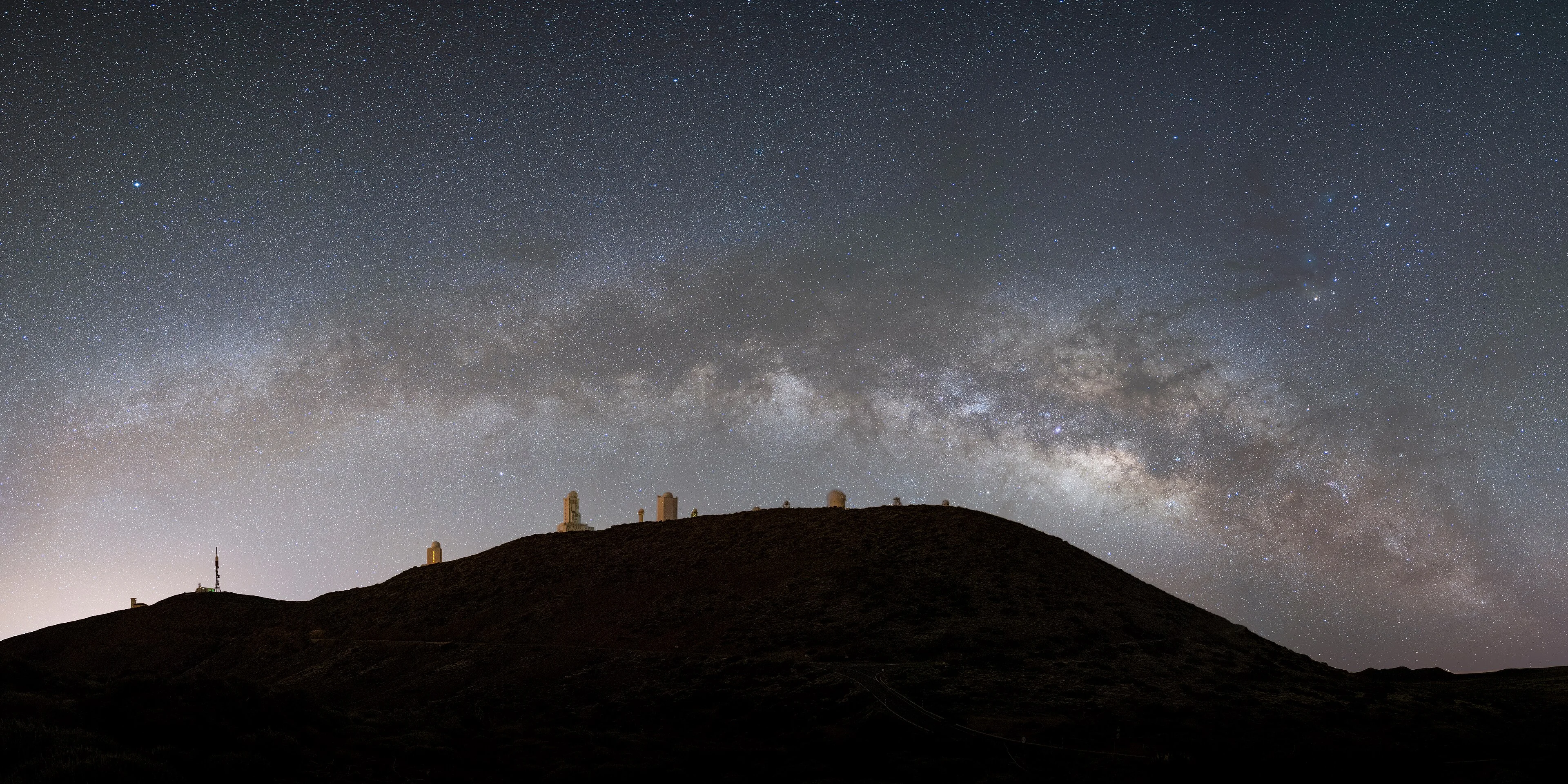
Tenerife is the easiest high-altitude sky in Europe to get to: two international airports and a paved road up to the Teide cable car’s base station at 2,356 m. The catch is in the photometry. The professional observatory on the Izaña ridge measures its moonless zenith at 21.20 magnitudes per square arcsecond, half a magnitude brighter than La Palma’s Roque de los Muchachos, about 144 km to the west-northwest. Below I go through where that extra light comes from, which caldera viewpoints to use, what the guided tours cost, and what a winter trip to 28° north shows you that Cyprus can’t.
I haven’t observed from Las Cañadas yet. It’s the trip I’m pricing for this winter, so this guide is built from the observatory’s own measurements, a 2020 light-pollution model of the island and 30 years of weather records from the AEMET station at Izaña, with my home sky on Troodos as the yardstick.
What the meter says
The Instituto de Astrofísica de Canarias (IAC) runs two observatories: Teide Observatory at 2,390 m on Tenerife and the Roque de los Muchachos on La Palma. Its night-sky background page lists the zenith brightness in the V band (a green-yellow filter close to the eye’s peak sensitivity) as 21.20 mag/arcsec² at Teide and 21.70 at La Palma, citing a 2018 report by the IAC’s Sky Team. Sky brightness runs backwards like stellar magnitudes, so the bigger number is the darker sky, and every 1.0 mag is a factor of 2.5 in brightness.
Half a magnitude works out to a factor of 1.58. A separate set of all-sky camera measurements from April 2019, in the paper I get to below, gives almost the same gap: 21.06 at Teide against 21.52 at La Palma, a difference of 0.46 mag, or 1.53×. Both put the sky directly over Izaña at about one and a half times the brightness of the sky over the Roque.
For a reference point I know well, the central Troodos reads around SQM 21.3–21.4 at zenith. A Sky Quality Meter has a wider passband than the IAC’s filtered cameras, so I wouldn’t rank the two sites on that comparison. Call it the same ballpark, which surprised me. The difference on Teide is everything around the zenith. Izaña is 438 m higher than the summit of Mount Olympus and 7° further south, and the trade-wind cloud layer often sits below the ridge.
One caveat on location. The observatory sits on the island’s central ridge above the Orotava valley. The caldera floor, where most visitors stand, lies to the southwest past El Portillo, and I couldn’t find published photometry for it. I won’t guess whether it’s darker.
Where Tenerife’s light comes from
In 2020, Martin Aubé of Bishop’s University in Québec and four co-authors, three of them at the IAC, ran the Illumina v2 radiative-transfer model over the archipelago to work out which lamps brighten the sky over Teide Observatory (arXiv:2005.14160). Their abstract says the island’s sky darkness was “severely degraded by growing light pollution”, and their introduction gives the consequence: the big optical telescopes that came later went to La Palma.
The breakdown of artificial light at the zenith, in the V band, is the useful part for a visitor:
- 97% comes from Tenerife itself. Gran Canaria is a distant second and La Gomera third, and La Palma’s share is negligible.
- La Orotava, the municipality the national park belongs to, supplies about 17%, the largest single share. Güímar, on the east side of the island, adds about 11%.
- Santa Cruz, the capital, contributes only about 7%.
- Los Cristianos and Playa de las Américas, the densest resort strip on the island, contribute about 2%.
The resort glow around the south coast looks the worst and adds the least overhead. The authors make that point themselves: our sense of light pollution comes from the domes on the horizon, which say little about the zenith.
They also ran the hypotheticals. Switching off every light on Tenerife would darken the Teide zenith by 0.427 mag in V, enough to match La Palma. Converting all the island’s street lighting to LEDs under the rules in force would gain about 0.3 mag.
Those rules come from Spain’s Sky Law (Law 31/1988). According to the IAC’s sky-protection office, the law regulates outdoor lighting on all of La Palma but only on the part of Tenerife directly visible from La Palma. In the model, that protected western side produces about 43% of Teide’s zenith skyglow and the unprotected remainder about 54%. One detail in the paper is worth planning around: across the whole island, lighting output after midnight is cut to 65% of the evening level. The darkest hours on Teide are the small hours.
These are 2020 model results built on the lighting inventory of that time. The LED conversion has been under way since, and I haven’t found a newer published measurement for Izaña, so treat 21.2 as a baseline that may be pessimistic.
Why astronomers came anyway
The mountain has drawn astronomers since 1856, when Charles Piazzi Smyth hauled his equipment up by mule to test Isaac Newton’s idea that the steadiest air would be found “on the tops of the highest Mountains above the grosser Clouds”. He camped first on Guajara, about 2,700 m by his own barometric readings, then at Alta Vista, around 3,300 m on Teide’s eastern slope. Dust layers kept blotting out his horizon, though the zenith stayed clearer than at Edinburgh. Cyprus gets the same Saharan dust, so I know that problem from Troodos. In the Canaries a dust event is called a calima, and the transparency drops whatever the cloud forecast says.
The University of Bordeaux put the first telescope at Izaña in 1964, to study the zodiacal light. The observatory is now mostly solar. It hosts GREGOR, a 1.5 m solar telescope, and the IAC calls it the birthplace of helioseismology, which started there in 1979. Teide 1, the first confirmed brown dwarf, turned up in January 1994 images of the Pleiades taken with the 0.8 m IAC-80, and the discovery paper ran in Nature on 14 September 1995.
Where to stand in Las Cañadas
Teide National Park covers 189.9 km² of caldera and volcano, and the viewpoints with parking are mostly along the TF-21 that crosses it. The Tenerife tourist board’s list of stargazing spots picks these:
- The Parador de Las Cañadas del Teide is the only hotel inside the park. It has a public café and a large car park. Staying here means you can observe past midnight without driving the mountain road down afterwards.
- Mirador de La Ruleta, next to the Roques de García, has room to set up a telescope.
- Llano de Ucanca, at the foot of the TF-21, opens onto a wide plain.
- Tabonal Negro, also beside the TF-21, has a small car park, with Guajara behind you as you face Teide.
From the Aubé numbers I’d pick spots on the southern half of the caldera floor. There, the 3,715 m cone of Teide stands between you and the Orotava valley, the biggest single contributor, and the caldera wall blocks much of the south coast.
That same wall is the catch for southern targets. Guajara rises to 2,715 m, several hundred metres above the floor, so a site close under it can lose the bottom few degrees of the southern sky. Check the horizon in daylight, or in a planetarium app’s horizon view, before you pick a spot for Canopus.
On etiquette, the Canary Islands tourism site asks visitors to switch off headlights and not use torches at the viewpoints. Use a dim red light and give your eyes the half hour they need.
Tours and the observatory
The cable-car company, Volcano Teide, runs the best-known guided sessions with Starlight-certified guides and sets up its telescopes at the base station. On its stargazing page, checked on 10 October 2026, the night tour without the cable car starts at €77, and the sunset-plus-stargazing tour, which takes the cable car up for sunset on the path to the Pico Viejo viewpoint, starts at €159. The same page says the park’s sky has held the Starlight Foundation’s “Tourist Destination” certification since 2014.
Visiting the observatory itself takes planning. The IAC asks for prior authorisation, and the outreach centre is a converted telescope dome with seats for 40. If you want to see the solar towers up close, book early.
When to go: what winter trades away
The AEMET station at Izaña (2,369 m) has 1981–2010 averages that show what a winter trip costs at altitude:
| Month | Cloudless days | Fog days | Mean min (°C) | Frost days | Snow days |
|---|---|---|---|---|---|
| October | 11.7 | 11.2 | 6.9 | 0.6 | 0.2 |
| November | 9.4 | 9.8 | 4.5 | 3.8 | 0.6 |
| December | 10.8 | 11.3 | 2.4 | 8.3 | 1.6 |
| January | n/a | 9.4 | 1.1 | 12.3 | 2.4 |
| February | 12.7 | 10.2 | 1.3 | 10.3 | 2.5 |
| July | 27.0 | 0.4 | 14.0 | 0.0 | 0.0 |
“Cloudless days” is a daytime count at the station, so it’s only a proxy for nights, but the pattern is plain. Summer is the clear season by a wide margin. In winter the cloud deck climbs to the ridge on roughly a third of days, and nights drop toward freezing. Snow can close the park roads, so check before you drive up.
What winter gives back is darkness by the hour. At 28° N, astronomical night lasts about 10.9 hours at the December solstice against 6.9 hours in June. With roughly a dozen cloudless days a month, I’d book five nights to get two good ones.
The new moons this season are 9 November (07:02 UT), 9 December (00:52), 7 January (20:24) and 6 February (15:56), from the US Naval Observatory. The Geminids peak on 13–14 December with a ZHR of about 120 (zenithal hourly rate, the ideal-sky count; real rates run lower). The Moon is only a few days past new by then, a crescent that sets in the evening, well before the radiant climbs high after midnight.
What 28° north shows you
Latitude is the part Cyprus can’t copy. Canopus, the second-brightest star in the night sky at apparent magnitude −0.74, sits at declination −52.7°. From Nicosia at 35.2° N it peaks just 2.1° above the horizon, which from my balcony means never. From Izaña it reaches 9.0°. It crosses the meridian around 01:55 local time in mid-December, 23:50 in mid-January and 21:45 in mid-February (Canary Islands time equals UTC in winter, two hours behind Cyprus). Nine degrees is still low, so a clear southern horizon decides whether you see it. For much more of the southern sky, the Atacama is the next step.
Omega Centauri, the brightest globular cluster in the sky, gets to 14.2° from Tenerife against 7.4° from Nicosia. It’s a spring object, crossing the meridian around 03:00 UTC in mid-March and 01:00 UTC in mid-April.
The zodiacal light, which is sunlight scattered by interplanetary dust and the target of that first 1964 telescope, also benefits. At its steepest, the ecliptic meets the horizon at 85° from Tenerife against 78° from Nicosia. The faint cone stands straighter and clears the horizon haze sooner. Look for it in the east before dawn in October and November, and in the west after dusk in February and March.
Getting there
Fly into Tenerife South (TFS) or Tenerife North (TFN) and rent a car. The TF-21 crosses the park, and the TF-24 runs along the ridge past Izaña to meet it at El Portillo. At these heights pack as you would for a January night on Troodos, then add a layer. Even for its June open days, the IAC tells visitors to bring at least a jacket, sun protection and water, because the observatory sits at 2,400 m.
Tenerife or La Palma?
If darkness is the whole point, La Palma wins by half a magnitude and a law that covers every streetlight on the island. Tenerife wins on everything around the darkness: two airports, a hotel in the middle of the caldera, telescope sessions from €77 and a sky most people can reach by rental car. My plan is five nights at the Parador around the 7 January new moon, with Canopus near midnight if the southern horizon allows it. I’ll also bring an SQM, so the next version of this guide has a reading from the caldera floor.