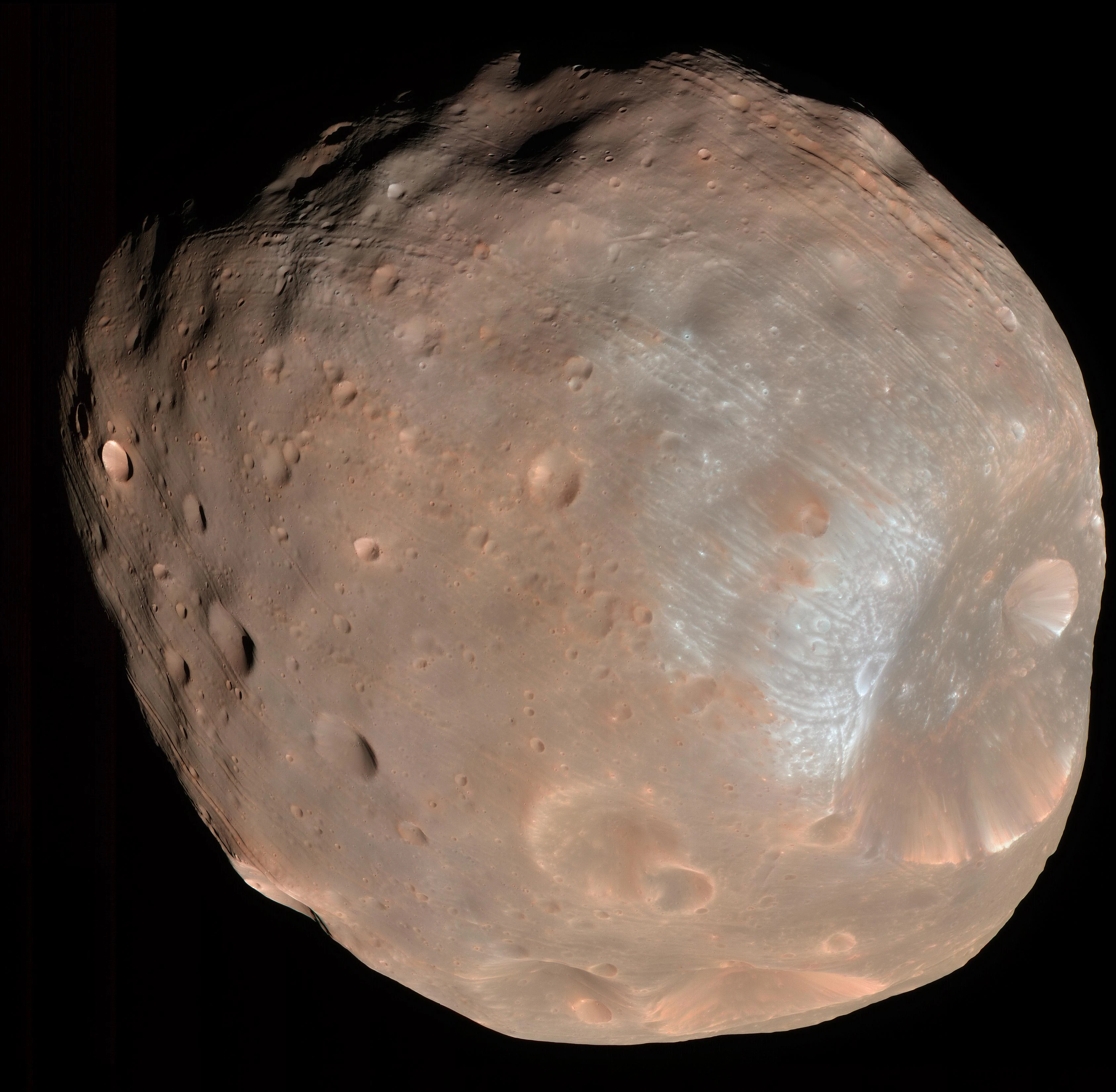
JAXA’s Martian Moons eXploration spacecraft, MMX, is scheduled to lift off on an H3 rocket from Tanegashima at 04:41:03 Japan time on 20 October 2026. That’s 19:41:03 UTC on Monday 19 October, or 22:41 here in Cyprus, where we’re still on summer time for one more week. If the weather or the rocket says no, there’s a backup period running to 7 November, with a separate launch time for each day (JAXA launch notice). The goal is to bring more than 10 grams of Phobos, the larger of Mars’ two moons, back to Earth in JAXA’s fiscal year 2031.
Ten grams sounds like nothing. On paper it’s enough to close an argument that has been running since the Viking era: whether Phobos and Deimos are captured asteroids or debris from a giant impact on Mars. Below is why half a century of orbital spectra hasn’t settled it, what the sample has to show, and what Phobos itself will look like from a backyard when Mars reaches opposition in February. I’ll be trying for it from my balcony, with low expectations.
H3 flight 10, and the rocket’s record
MMX rides the four-booster H3-24 version of Japan’s new launcher. That configuration has flown once, carrying the HTV-X1 cargo ship to the ISS in October 2025. MMX will be the first H3 payload sent away from Earth instead of into orbit around it.
The H3’s record so far is nine flights and two failures: the maiden flight in March 2023, when the second-stage engine didn’t ignite, and the Michibiki QZS-5 launch on 22 December 2025, where JAXA suspects the structure holding the satellite failed just after fairing separation. The rocket returned to flight in June 2026, and on 11 August (Japan time) it put Michibiki No. 7 into orbit on a flight JAXA says went as planned. MMX goes up with two clean flights behind it.
Tanegashima is on the far side of Asia from us, so this is a livestream evening. JAXA’s MMX news page is where broadcast details and any schedule change will appear first.
Two origin stories for one dark moon
Phobos is a lumpy body with a mean radius of 11.08 km. It orbits 9,375 km from Mars’ centre, less than 6,000 km above the surface, and goes round in 7 hours 39 minutes, faster than Mars rotates. Tides are pulling it inward by about 1.8 m per century, and at that rate NASA expects it to hit Mars or break up into a ring in roughly 50 million years (NASA). Deimos, with a mean radius of 6.2 km, orbits farther out. JPL lists bulk densities of 1.87 g/cm³ for Phobos and 1.47 g/cm³ for Deimos (JPL Solar System Dynamics), about half the density of solid silicate rock. Either they’re riddled with voids, or they hold ice, or both.
The capture case comes from what the moons look like. Viking’s close-up images in the 1970s showed two irregular bodies about as dark as asteroids thought to be carbon-rich. Their visible and near-infrared spectra are reddish and nearly featureless, close to the D-type and T-type asteroids, which are thought to be volatile-rich and to have formed out near Jupiter’s orbit. The low densities fit too. Two primitive bodies from beyond the snow line drift inward and get caught by Mars.
The orbits don’t cooperate. A captured body can arrive from almost any direction, so it should end up on a tilted orbit, the way the irregular moons of the giant planets do. Phobos and Deimos sit on near-circular orbits almost exactly in Mars’ equatorial plane, and Mars’ tides are too weak to have flattened them from a random start.
The giant-impact case flips the problem. Tides push Phobos inward and Deimos outward, so both probably started near Mars’ co-rotation radius, about 6 Mars radii from the planet’s centre, where an orbit keeps pace with the planet’s spin. Simulations of an impact on the scale of the Borealis basin, the proposed giant basin under Mars’ northern lowlands, throw out a debris disc that can build exactly that arrangement: a large inner moon that later falls back onto Mars, and two small survivors on circular equatorial orbits (Rosenblatt et al. 2016; Hyodo et al. 2017; Canup & Salmon 2018, whose title puts the impactor between Vesta and Ceres in size). These models predict moons made of impactor and Martian material mixed roughly 50:50 in Hyodo’s version and 20:80 in Canup and Salmon’s, with volatiles baked out by the heat of the impact. Their weak points: nobody has shown how that material ends up with Phobos’ asteroid-like spectrum, and no clear geological trace of the fallen inner moon has been found on Mars.
The MMX team’s own 2022 mission paper (Kuramoto et al.) states it plainly: “the origin of the Martian moons is still controversial to date.”
Why fifty years of spectra haven’t decided it
A spectrometer in orbit measures sunlight bounced off the top layer of regolith, which solar wind and micrometeorites keep weathering. The mission paper calls Phobos’ spectra almost featureless. The best existing data, from CRISM on NASA’s Mars Reconnaissance Orbiter, resolve 120–350 m per pixel and lack reliable coverage around 2.7 μm, the wavelength where hydroxyl and water molecules absorb. A hydrated-mineral signature in fresh bedrock at that wavelength would be strong evidence for capture, and nobody has been able to look for it properly.
The cover of this post shows the weathering problem in one frame. In HiRISE’s colour composite, material along the rim of Stickney, the 9 km crater at lower right, looks bluer than the rest of Phobos, which NASA’s caption reads as possibly fresher, younger surface. Spectral maps split Phobos into a “red unit” and a “blue unit”, and it’s still open whether they’re different rock or the same rock weathered to different degrees.
MMX attacks this from orbit before it ever lands. The French-built MIRS infrared spectrometer and the OROCHI camera are designed to pick up the hydroxyl bands at about 2.7 μm and 0.7 μm, mapping Phobos at resolutions of order 10 m. NASA’s MEGANE gamma-ray and neutron spectrometer measures elements such as silicon, iron, hydrogen and potassium in the top few tens of centimetres. One of its targets is a neat test. Chondritic meteorites have Si/Fe ratios between 1.1 and 2.0, while Mars’ mantle sits at 2.9–3.7. If Phobos is partly made of Mars, its Si/Fe should come out more than 20% above the chondritic range.
That’s still an average over a weathered surface. Rock you can put under a microscope is a different class of evidence.
What 10 grams buys
The 2022 plan calls for landings at two sites, ideally one in each colour unit. A coring sampler on a robotic arm is designed to bring up material from deeper than 2 cm, below the depth that solar wind penetrates. A NASA-supplied pneumatic sampler on a landing pad, working on the same principle as OSIRIS-REx’s sampler, blows shallower regolith into a container. Phobos’ regolith grains are expected to be mostly 0.3–2 mm across, so 10 g works out to somewhere between 10³ and 10⁵ grains. That’s enough to sort Phobos’ own material from contamination statistically.
Then the questions get specific. If the grains look like chondrites, carrying hydrous minerals and organics, that points to capture. If they show textures from high-temperature melting and partial vaporisation, that points to the impact. Isotopes identify the source: once chromium is included alongside oxygen, the pattern of isotope anomalies separates almost every known meteorite group and planetary body. Measuring ⁵³Cr/⁵⁴Cr to the one-part-per-million precision needed takes a grain of a few milligrams, about 1 mm across. No instrument in orbit can do that.
There’s a bonus in the dirt. Impacts on Mars throw debris that lands on Phobos, and Hyodo et al. (2019) estimated it makes up about 0.1% of the moon’s surface regolith (an older estimate allowed up to several percent). My own arithmetic: at 0.1%, a 10 g sample carries about 10 mg of Mars. JAXA’s mission page puts the first-ever angle simply: “Nothing has ever been returned from the Martian sphere before.”
The schedule, per JAXA: about a year of cruise to arrive in 2027, then three years in the Mars system from 2027 to 2030, covering Phobos observations and landings plus Deimos flybys. MMX leaves in 2030 and the return capsule comes home in FY2031. Before the main spacecraft touches down, it releases Idefix, a small rover built by CNES and DLR, which drops from 40–100 m onto Phobos in early 2029 for about three months of driving (DLR). It’s JAXA’s third sample-return mission, per DLR. The earlier attempts at Phobos, the Soviet Phobos 1 and 2 in 1988 and Russia’s Phobos-Grunt in 2011, all failed; only Phobos 2 sent back some data from near the moon.
Can you see Phobos in February?
Mars is a morning object right now. On launch day, at 05:30 local time just before morning twilight begins, it stands about 54° up in the east-southeast from Nicosia: magnitude +1.0 in Cancer, and only 6.1 arcseconds across (all positions here are from JPL Horizons). It reaches opposition, directly opposite the Sun, on 19 February 2027 and is closest on the 20th at 0.678 AU, or 101 million km. At that point it shines at magnitude −1.3 in Leo. This is a poor opposition. Mars’ disc will be 13.8 arcseconds across, slightly smaller than in 2012 (13.9″) and just over half the 25.1″ of August 2003.
For the moons, Horizons gives Phobos magnitude +12.1 and Deimos +13.2 around opposition. On its own, a +12 point is an easy catch in a mid-sized amateur telescope. The trouble is where they sit. At this opposition Phobos never gets more than 19.3″ from Mars’ centre, which is 12.4″ from the limb, less than one Mars diameter away, and Mars outshines it about 230,000 times. Deimos swings out to 47.7″, about three Mars diameters beyond the limb, but it’s roughly 630,000 times fainter than Mars.
Pete Lawrence’s Sky at Night guide lays out the method. Observe near elongation, when a moon is farthest east or west of the planet. Phobos, with its 7 h 39 min orbit, gives you several elongations a night, while Deimos (30.3 h) can take a few nights to line up. The free WinJUPOS software shows where both are. At the eyepiece, stick a thin strip of aluminium foil across the field stop as an occulting bar, turn it north–south and hide Mars behind it. With a camera, overexpose Mars only as much as you need, so the glare doesn’t spread over the moons. His guide was written for the much closer 2020 opposition, when he gave Phobos as +10.7; February’s moons are about 1.4 magnitudes fainter and huddled closer to the planet. For scale, Asaph Hall found both in August 1877 with the US Naval Observatory’s 26-inch refractor.
My Seestar S50 is the wrong tool and I know it. At 2.39″ per pixel, Mars will be under 6 pixels wide, with Phobos at most 8 pixels from its centre and Deimos at most 20. I’ll still point it at Deimos near an elongation in February, using the shortest exposures it allows, mostly to measure how far the glare reaches. My bet is beyond 20 pixels. If you own a large Dobsonian or SCT, February is worth a few nights of trying, and the same seeing-versus-aperture trade I went through for Saturn’s rings applies: the steady half-second counts for more than the extra inches.
What I’ll be watching
First, 22:41 Cyprus time on Monday 19 October, assuming the date holds. The answer itself is five years out. If the grains come back chondritic and wet, Phobos is a primitive body from beyond the snow line that Mars somehow captured onto an equatorial orbit, and the orbital puzzle becomes the open question. If they come back baked and Mars-like, Phobos is a piece of the planet’s own early history, and the spectrum is what needs explaining. Both camps have had fifty years of remote data to work with. A handful of millimetre grains is the best chance anyone has had to end it.