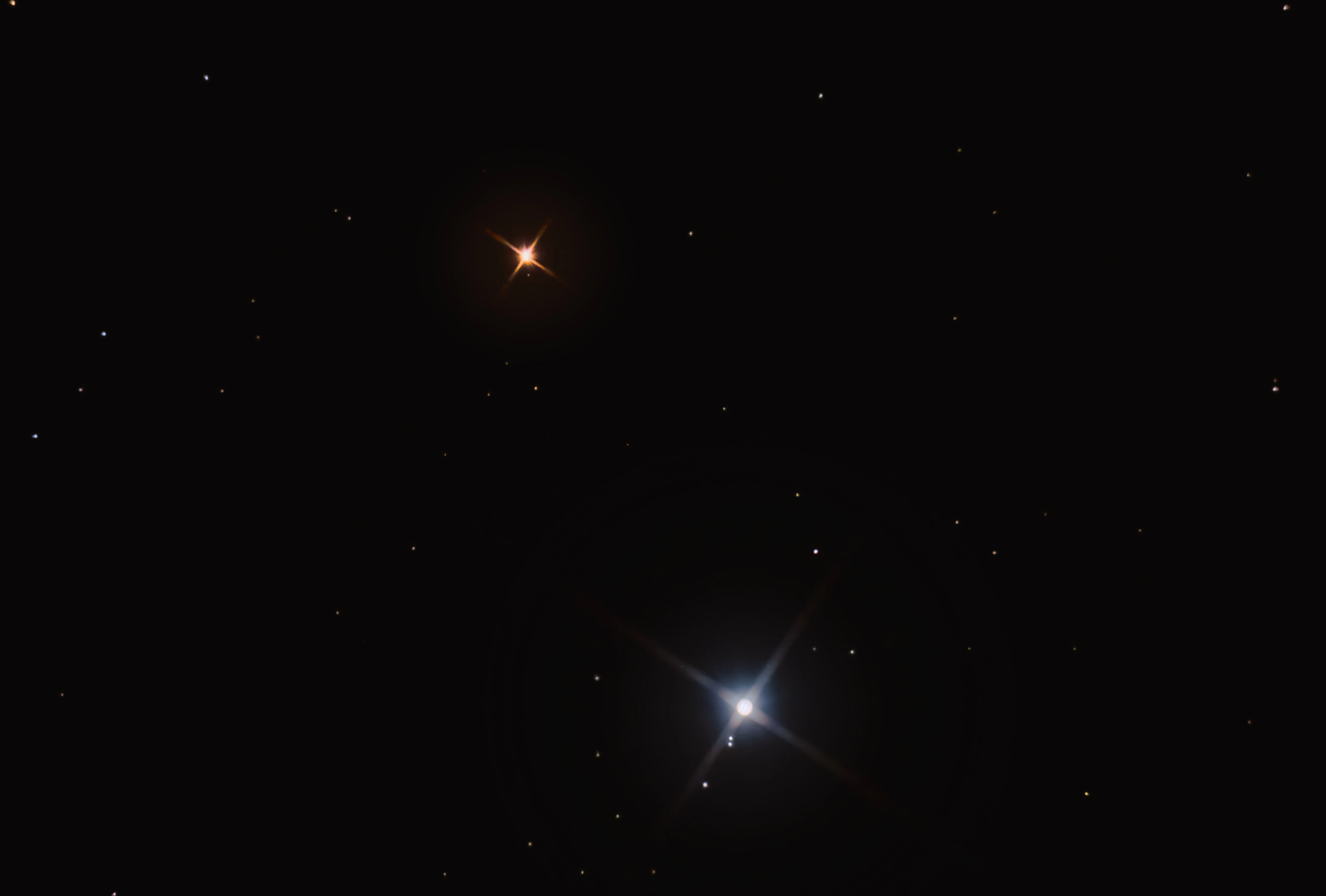
Two bright planets are up before dawn right now, and the gap between them shrinks every morning for the next month. This morning Mars and Jupiter are 12.7° apart, a bit more than a fist held at arm’s length. By the morning of November 16 that gap is down to 1.19°, a little over two full-Moon widths. Closest approach is around 02:00 UT on the 16th, which is 04:00 in Cyprus, with both planets riding high in the south-east. You don’t need any equipment for this one. Pick a morning each week, note how far apart the two points are, and watch Mars catch up. Binoculars add Jupiter’s moons. Around the 16th, a small telescope at its lowest power can just about hold both planets in a single field.
All positions, magnitudes and times below come from JPL Horizons, calculated for Nicosia (35.2° N) unless I say otherwise. From anywhere in Europe or the Mediterranean the arrangement looks almost the same. Only the altitudes and clock times shift.
Where to look this week
Look east before dawn. These nights Mars rises at about 01:00 local time and Jupiter at about 02:00 (22:00 and 23:00 UT the evening before; Cyprus is on summer time, UTC+3, until October 25). At 05:00 local, about two hours before sunrise, Mars stands 47° up in the east and Jupiter 35° up, lower and slightly to its left.
You can’t mix them up. Jupiter is magnitude −1.9 this month, brighter than any star in the sky. Apparent magnitude is the brightness scale as seen from Earth, and lower numbers are brighter, so the negative values belong to the brightest objects. Mars is magnitude +1.0 and noticeably orange. It’s sitting in the faint stars of Cancer, and it crossed the Beehive Cluster (M44) on October 11–12, passing about a quarter of a degree from the cluster’s centre. This morning it was still only 1.4° east of the cluster, so for a few more mornings binoculars show the orange point beside the Beehive’s loose scatter of stars.
Jupiter is already in Leo, and Leo’s brightest star, Regulus (magnitude 1.4), sits 8.4° below it. Mars crosses into Leo on October 30. From then until early December all three form a shifting group that tightens as November goes on.
The gap, morning by morning
Here’s how far apart the two planets are as Mars catches up, at 00:00 UT on each date. These are angular separations, measured from planet centre to planet centre.
| Date (2026) | Mars–Jupiter gap | Mars mag | Jupiter mag |
|---|---|---|---|
| Oct 14 | 12.7° | +1.0 | −1.9 |
| Oct 20 | 10.4° | +1.0 | −1.9 |
| Oct 26 | 8.0° | +0.9 | −2.0 |
| Nov 1 | 5.8° | +0.8 | −2.0 |
| Nov 7 | 3.6° | +0.8 | −2.0 |
| Nov 10 | 2.5° | +0.8 | −2.1 |
| Nov 13 | 1.6° | +0.7 | −2.1 |
| Nov 16 | 1.19° | +0.7 | −2.1 |
| Nov 19 | 1.6° | +0.7 | −2.1 |
| Nov 22 | 2.4° | +0.6 | −2.1 |
| Nov 28 | 4.4° | +0.5 | −2.2 |
| Dec 4 | 6.3° | +0.4 | −2.2 |
The close approach is shallow. Before dawn on the 15th and the 17th the gap is about 1.25°, within 0.06° of the minimum, so all three mornings show nearly the same picture. If the 16th clouds over, you’ve lost very little.
At closest approach Mars sits north of Jupiter and slightly east, so the pair lines up almost north–south (Mars about 15° east of due north from Jupiter). From Cyprus at 04:00 local on the 16th they’re 56° up in the east-south-east. They keep climbing until they cross the meridian, due south and 69° up, around 06:00, by which time twilight is well along. Sunrise that morning is at 06:21. The pair rises together at about 23:15 local the night before, so if you’re a night owl you can catch them low in the east before bed.
Why Mars is overtaking Jupiter
Both planets are moving eastward against the background stars, but at very different rates. In mid-November Mars covers about 0.45° of right ascension per day and Jupiter only about 0.09°. Mars is catching up because it’s heading towards its own opposition on 19 February 2027, the point where Earth passes between it and the Sun. As Earth closes in, Mars’ apparent motion changes fast, and it brightens. Its distance falls from 1.57 AU today to 1.31 AU on the 16th. I went through that opposition in more detail in the MMX launch piece: a fairly poor one, with Mars reaching only 13.8 arcseconds across.
Jupiter is slowing down. Its eastward drift stalls around December 13, when it reaches its stationary point, and then it reverses into retrograde motion ahead of its own opposition on February 11, 2027. Mars keeps going east, so after the 16th the gap opens again. By December 4 it’s back to 6.3°, and Mars passes about 1.7° north of Regulus on November 26 on its way out.
This is the second time this year I’ve watched Jupiter pair up with a faster-moving neighbour. In June it was Venus, about 1.5° from Jupiter in the evening sky. The November pair is fainter and very different in colour, and it’s in the morning. It’s also much better placed: 56° up in a dark sky beats a twilight pair low in the west.
Dates worth a look
- Now through about October 16: Mars near the Beehive Cluster. Best in binoculars.
- October 30: Mars crosses from Cancer into Leo.
- Morning of November 2: the waning Moon (47% lit) sits about 6° from Mars at 05:00 local.
- Morning of November 3: the Moon (36% lit) moves on to Jupiter. When it rises just after midnight it’s about 1° from the planet, and by 05:00 local the gap has opened to about 3°. Seen from Cyprus, the closest point comes before the pair has risen.
- November 9: new moon. From here to the conjunction the mornings are dark. On the 16th the Moon is a 37%-lit evening crescent, long set before the planets are high.
- Mornings of November 15–17: closest approach, 1.19° at about 02:00 UT on the 16th.
- November 26: Mars passes 1.7° north of Regulus.
What you’ll see with eyes, binoculars, and a telescope
With the naked eye you get two bright points about two Moon-widths apart, one cream-white and one clearly orange. At conjunction Jupiter is 2.8 magnitudes brighter than Mars, which works out to about 13 times the light. The contrast in colour is the point. Your eyes need some time in the dark to see Mars’ colour properly, so give them the twenty to thirty minutes before deciding it looks pink.
In binoculars it gets better. A typical pair of 10×50s shows a field 5–6.5° wide, so from early November both planets fit in one view, and over the following week you can watch the gap shrink inside the field. Brace the binoculars on a railing or a car roof and Jupiter’s four Galilean moons appear as faint points strung in a line. On November 16 Regulus is only 4.3° from Jupiter and 4.7° from Mars, so a wide binocular field can take in all three. If you’re deciding between binoculars and a telescope, mornings like this are the case for binoculars first.
A telescope needs a wide field to frame a 1.19° pair. Use your longest-focal-length eyepiece; the eyepiece primer explains how to work out true field. A short refractor of 400–600 mm focal length frames both planets easily. An 8-inch f/6 Dobsonian (1,200 mm) with a 32 mm Plössl gives about 1.3°, so there the pair only just fits. The size difference is the surprise. On the 16th Jupiter’s disc is 37.4 arcseconds across and Mars’ is 7.2, so Jupiter looks about five times wider even though it’s four times farther away: 5.27 AU against 1.31. Jupiter is about 21 times Mars’ diameter, and the extra distance only takes some of that back. The light reaching you from Jupiter left it about 44 minutes earlier. Mars’ light is about 11 minutes old.
At these magnifications Mars shows a small orange disc and nothing more. You’d need high power and steady air to pick out a polar cap or a dark marking at 7 arcseconds, and that’s a project for the opposition in February. Jupiter shows its two main cloud belts at 50×.
Measuring the gap yourself
You can follow this whole approach with nothing but your hand. At arm’s length a closed fist covers roughly 10°, three fingers about 5°, and your little finger about 1°. The exact values vary a bit from person to person, but the rule works if you use the same hand every time. Check it against the table on the first morning. Then go out once or twice a week, measure Mars to Jupiter, and write it down. By November 10 you’re measuring the gap in fingers rather than fists, and around the 16th it’s just over one little-finger width.
For a phone record, any of the planetarium apps will show the moons’ positions and let you check your estimate. They’re also the easiest way to find out which Galilean moon is which on a given morning, which I haven’t tried to list here because it changes hour to hour.
My plan from Nicosia
The balcony faces the right way for this, and the pair is high enough by 04:00 that the light dome over the city doesn’t hurt much. I’ll take the gap reading weekly by hand from the balcony and check each one against Horizons. It’s a good test of how well my fist actually covers 10°.
For the conjunction morning I’ll try the Seestar S50. Its field is 1.28° × 0.72°, with a diagonal of 1.47°. The 1.19° pair fits in one frame only if the line between the planets runs within about 35° of the frame’s long side. Whether it does depends on how the frame sits on the sky that morning. If it doesn’t fit, I’ll shoot two frames and join them. At 2.39 arcseconds per pixel, Jupiter will cover about 16 pixels and Mars about 3, so the picture will look like the cover photo above: two coloured points and a row of moons. Planetary detail isn’t on offer.
If the weather forecast for the 15th or 16th is clear, I’ll drive up to Troodos instead. A 1.2° pair at 56° altitude in a dark sky, with Regulus nearby and only binoculars needed, is an easy morning to plan for.