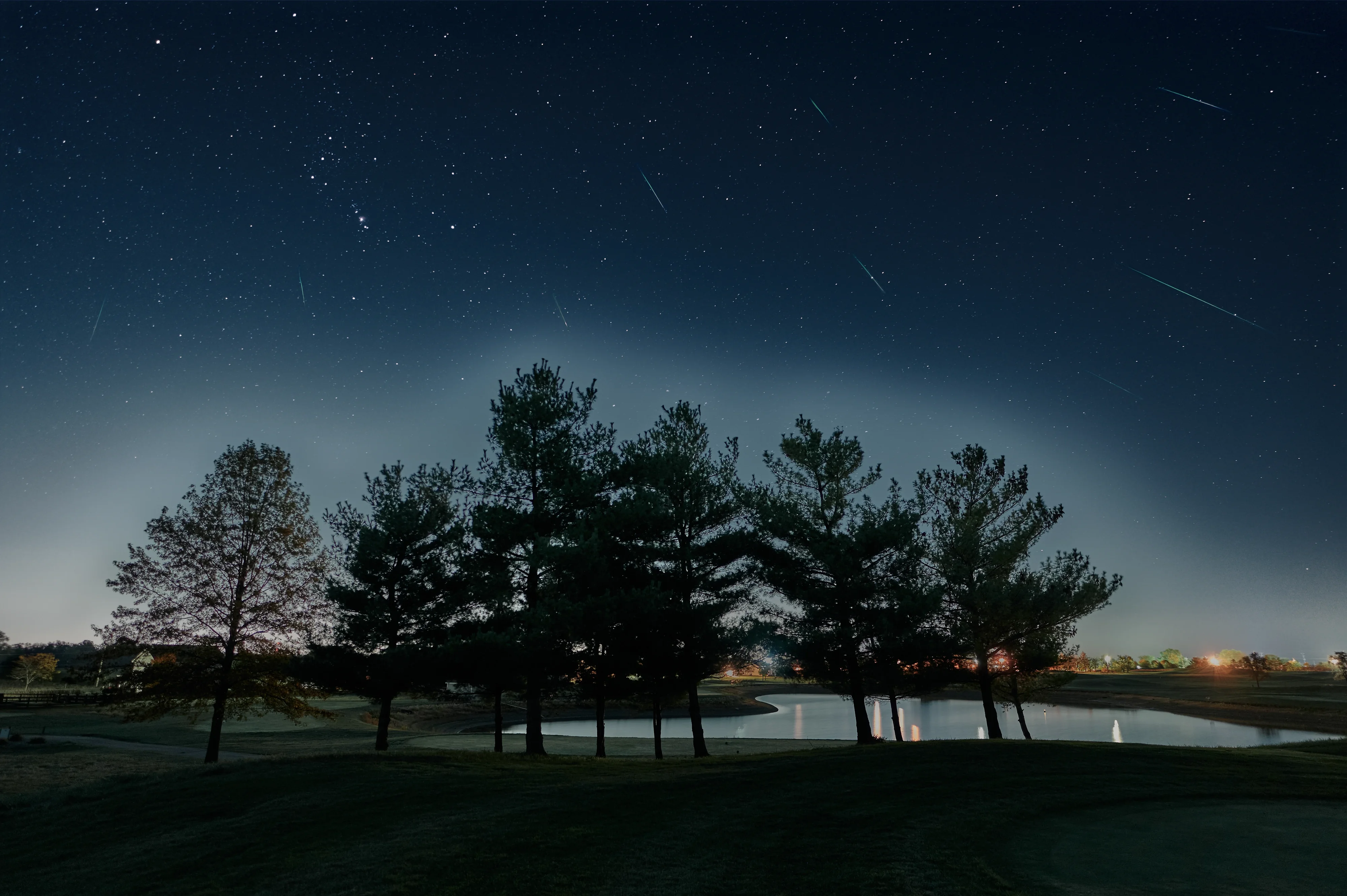
The Orionid meteor shower peaks on the night of October 21–22, 2026, and this year the Moon decides when you go out. A waxing gibbous Moon, about 80% lit, hangs over the evening sky and doesn’t set until 02:55 local time in Cyprus (23:55 UT) on the peak morning. After that you get roughly two and a half hours of properly dark sky before dawn starts at 05:34. Those happen to be the hours when the Orionid radiant is highest anyway. Set an alarm for 03:00, look south, and expect around 10–12 meteors an hour from a dark site, fewer from a town. No equipment needed.
All times below are for Nicosia (35.2° N) and come from JPL Horizons. Cyprus is still on summer time (UTC+3) until October 25. From elsewhere in Europe and the Mediterranean the pattern is the same: the Moon sets in the small hours, and the dark stretch before dawn is the window.
The 2026 numbers
The Orionids are active from October 2 to November 7, with the peak on the night of October 21–22, according to the American Meteor Society’s 2026 calendar. The zenithal hourly rate (ZHR) is about 20. ZHR is the count one observer would make under a perfectly dark sky with the radiant directly overhead. You never get those conditions, so real counts are always lower.
The shower’s facts, per NASA’s Orionids page:
- Parent: comet 1P/Halley
- Entry speed: about 66 km/s, among the fastest of the major showers
- Radiant: just north of Betelgeuse; the catalogue position is RA 06h21m, Dec +15.6°
- Typical rate under dark skies: 10 to 20 per hour
The maximum is broad. Rendtel’s long-term analysis of visual data, summarised in Egal et al. (2020), puts the average peak ZHR at about 20 to 25 across several nights rather than one sharp spike. Missing the 21st–22nd because of cloud doesn’t cost you much.
The Moon problem, morning by morning
The Moon is past first quarter and setting about an hour later each night, so the darkness before dawn shrinks fast. Here are the three mornings around the peak from Nicosia:
| Morning | Moonset (EEST / UT) | Moon lit | Astronomical dawn begins | Dark window |
|---|---|---|---|---|
| Wed Oct 21 | 01:53 / 22:53 (Oct 20) | 71% | 05:33 | ~3 h 40 min |
| Thu Oct 22 (peak) | 02:55 / 23:55 (Oct 21) | 80% | 05:34 | ~2 h 40 min |
| Fri Oct 23 | 03:57 / 00:57 | 88% | 05:35 | ~1 h 40 min |
“Astronomical dawn” is when the Sun climbs to 18° below the horizon and the sky starts to brighten measurably. Sunrise itself is around 07:00.
Because the maximum is broad, Wednesday morning (the 21st) is worth considering too. You’d be a night early, but you’d get an extra hour of dark sky, which more than makes up for a slightly lower ZHR. If I can only do one night, I’m watching the weather for both and picking the clearer one. Friday morning is the weakest option: the dark window is short, and the Moon is up until almost 04:00.
You can watch before moonset, but an 80% Moon washes out the faint majority of meteors even at a dark site. You’ll catch the occasional bright Orionid, and that’s it.
Where to look
The radiant is the point the meteors appear to come from, and for the Orionids it sits about 10° north-east of Betelgeuse, toward Gemini. It rises at about 22:25 local time and climbs all night:
| Local time (EEST) | Radiant altitude | Direction |
|---|---|---|
| 01:00 | 32° | East |
| 03:00 | 56° | South-east |
| 05:00 | 70° | Due south |
That 70° at 05:00 is as high as it gets from 35° N. It’s the main reason the pre-dawn hours win even in a year without a Moon. Rates scale with the sine of the radiant’s altitude, so a radiant at 70° gives you 94% of the overhead rate, while one at 20° gives you a third.
Don’t stare at the radiant itself. Meteors near it are foreshortened into short stubs. Face roughly south or south-east, lie back, and centre your view about 40–50° up and some 30–40° to one side of Orion. Every Orionid you see, traced backwards, points to that spot north of Betelgeuse.
There’s a bonus in the same part of the sky. At 05:00 on the peak morning, Jupiter (magnitude −2.0, in Leo) is 39° up in the east and Mars (+1.0, in Cancer) is 49° up just above it, the pair 9.6° apart and still closing. I covered that approach in detail in last week’s Mars–Jupiter article. Jupiter will be the brightest point in the sky while you count. Don’t mistake it for anything else.
How many you’ll actually see
The field estimate I used for the Perseids recap works here too:
observed rate ≈ ZHR × sin(radiant altitude) × dark-sky factor
The dark-sky factor depends on how faint your sky goes and on the shower’s population index r, which sets how quickly the number of meteors grows as you go fainter. For the Orionids, visual studies give an average of r ≈ 2.4 (Egal et al. 2020, citing Dubietis 2003). In plain terms: every magnitude of sky darkness you lose divides your count by about 2.4.
With ZHR 20 and the radiant between 56° and 70° (the 03:00–05:00 window), that gives:
- A good mountain sky, naked-eye limit around magnitude 6.0: about 11–12 per hour
- A decent rural sky, limit 5.0: about 5 per hour
- A city balcony, limit 4.5 or worse: about 3 per hour, all of them bright ones
Those are averages. Meteors arrive in clumps, so you can wait ten minutes for nothing and then get three in a minute. Give it at least 45 minutes of continuous watching before you judge the night.
Fast meteors, old dust
The Orionids hit the atmosphere at 66 km/s. That’s more than twice as fast as the slow Taurids active at the same time of year. You can see the difference: an Orionid is a quick, sharp scratch, over in a fraction of a second. The fast ones sometimes leave a train, a glowing trail of ionised air that hangs for a second or two after the meteor has gone, occasionally longer. NASA’s page notes that the shower can also produce the odd fireball.
The particles come from Halley’s Comet, but not from its 1986 visit. Earth passes near the comet’s orbit twice a year, in May for the Eta Aquariids and in October for the Orionids. The dust we run through was shed over many earlier orbits. The Egal et al. modelling paper puts the age of the Eta Aquariid stream at somewhat more than 5,000 years and finds that the Orionids contain a larger share of even older material. Halley itself passed aphelion, the far end of its orbit beyond Neptune, in December 2023. It’s falling back toward a 2061 perihelion.
Some Orionid years are much better than others. From 2006 to 2009 the AMS reports peak rates of 50–75 per hour, comparable to the Perseids. Those outbursts trace back to dust trapped in a 1:6 resonance with Jupiter: the meteoroids complete one orbit for every six of Jupiter’s (about 71 years), so Jupiter’s repeated tugs keep them bunched together instead of letting them spread along the orbit. The same modelling found an 11.8-year cycle in Orionid peak rates and predicts no significant Orionid outburst through 2050, with yearly maxima in the 20–40 range. So 2026 should be an ordinary Orionid year. I haven’t seen any published 2026-specific outburst prediction, so treat an “Orionid storm” headline with suspicion.
Orionid or Taurid?
You’ll see meteors that don’t belong to the shower. Late October is busy. The Southern Taurids are active from September 20 to November 20, and the Northern Taurids from October 20, both according to the AMS calendar. The AMS notes that the Taurids are rich in fireballs, especially when both branches overlap in late October and early November.
Telling them apart is a two-step check:
- Trace the meteor backwards. An Orionid leads back to the spot north of Betelgeuse. A Taurid leads back to the Taurus–Aries direction, well to the west of Orion.
- Check the speed. A Taurid drifts across the sky by comparison and stays visible noticeably longer. An Orionid is quick.
Then there are sporadics, the random background meteors that belong to no shower. They come from any direction at any speed, and they’ll pad your count a little whichever way you face.
My plan
From my balcony in Nicosia (Bortle 7, limiting magnitude around 4.5 on a good night) I’ll get a handful of bright Orionids at best. Rates like that won’t justify an alarm clock. For the peak I’ll drive up to Troodos, using the same Mount Olympos pull-off at about 1,700 m from the Troodos guide. The timing works out better than it sounds. I leave Nicosia around 00:45, I’m set up before moonset at 02:55, and the moonlit wait doubles as dark adaptation. The Limassol light dome that sits low in the south there is no problem this time: by 05:00 the radiant is 70° up, far above it.
Kit is the same as August: a reclining chair, a red headlamp, warm layers (Troodos at 03:00 in late October is properly cold, so bring more than you think) and a camera on a fixed tripod. The Seestar stays at home. Its field of view is about a degree wide, which is useless for meteors that can streak 30° across the sky. For photography, the fixed-tripod setup I described for the Perseids works unchanged. Aim a wide lens 30–40° away from the radiant with Orion in one corner, and run continuous 15-second frames from moonset to dawn. A fast lens helps more than usual with 66 km/s meteors: each one sweeps across the frame quickly, so it leaves less light on each pixel than a slow Taurid of the same brightness.
If you’re new to all this, the first-meteor-shower guide has the full no-gear routine: dark adaptation, why your phone screen ruins it, and how long to give it.
Quick reference
- Peak: night of October 21–22, 2026 (Wednesday night into Thursday morning). The night before is nearly as good.
- Watch window (Cyprus): 02:55 moonset to 05:34 dawn on the 22nd; 01:53 to 05:33 on the 21st.
- Look: south to south-east, 40–50° up, offset from Orion
- Rates: ZHR ~20; about 11–12 per hour from a mountain site, 3 from a city
- Speed: 66 km/s, quick streaks, some with trains
- Also up: Jupiter (−2.0) and Mars (+1.0) in the east, 9.6° apart
- Equipment: none. A chair and a jacket.