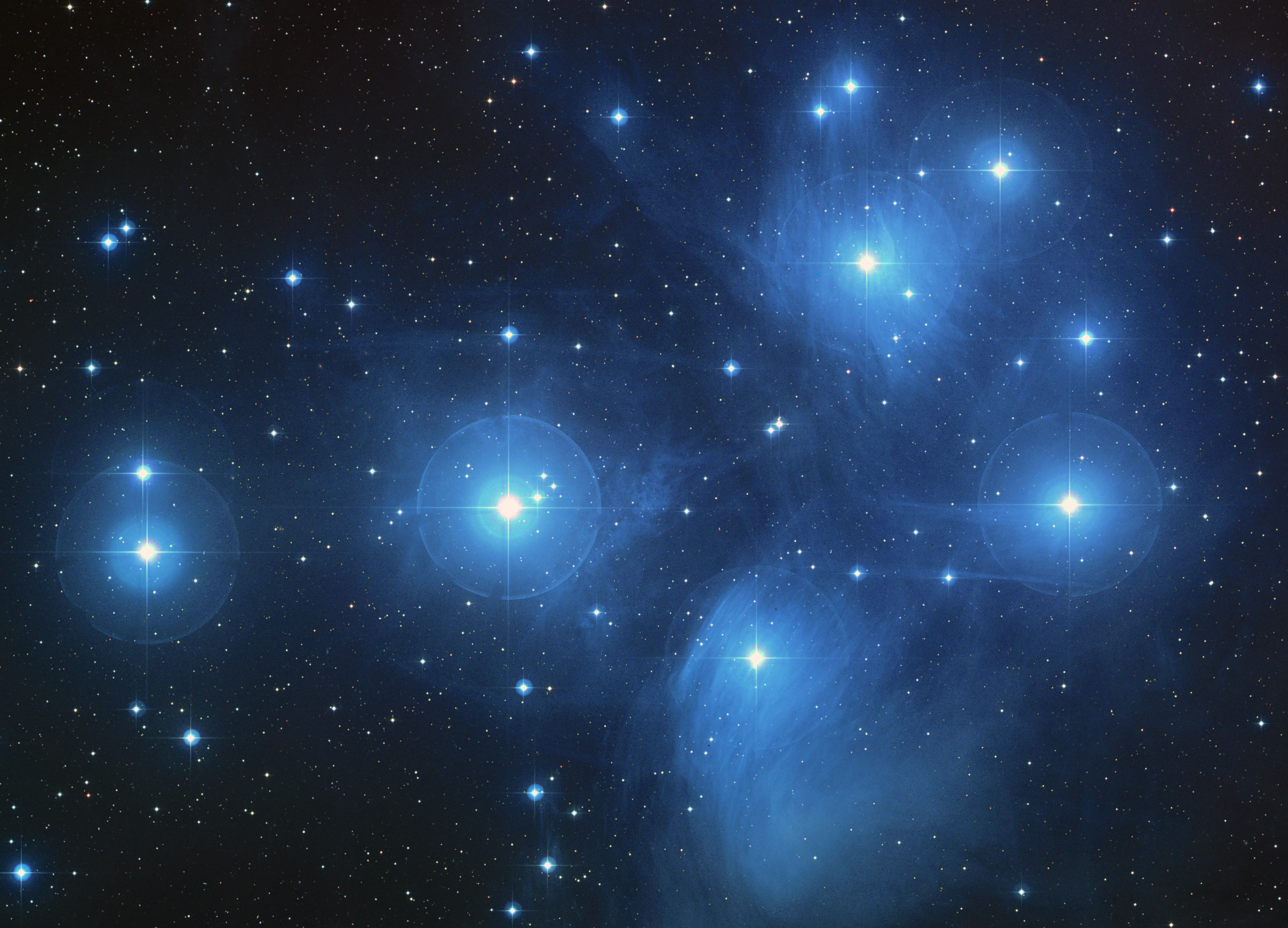
Look east-northeast a couple of hours after dark this week and you’ll find a small, tight knot of blue-white stars climbing out of the horizon haze. Most people take it for a smudge the first time they see it, and some take it for the Little Dipper. That’s the Pleiades, the Seven Sisters, Messier 45, and from now until spring it’s the easiest star cluster in the sky. You need nothing but your eyes to find it. Once you have, it doubles as a dark-sky test: count how many stars you can pick out of the knot and you have a rough reading of how good your sky is that night.
Below: when it rises from the Mediterranean, three ways to land on it, how to count it, and what you’re actually looking at.
When to look
From Nicosia (35°N) the Pleiades clear the horizon at about 19:35 local time tonight (16:35 UT), almost exactly as astronomical twilight ends. They rise in the east-northeast, about 60° round from north. They don’t come into their own until they’re out of the murk, around 20° up, which this week is roughly 21:20 local. They culminate at 02:45 local, 79° above the southern horizon, close enough to overhead that you’re looking through almost the least air possible.
Like every star, the cluster rises about four minutes earlier each night, so it moves up by roughly two hours a month. Cyprus also drops back to winter time on Sunday, October 25, which pulls every clock time an hour earlier on top of that. On November 1 the cluster is 30° up by 20:15 local. By mid-November it’s 30° up at 19:20 and crosses the meridian just before midnight. In December it’s high in the east as soon as it’s dark. This is the start of a long season: the Pleiades stay in the evening sky until about April.
Moonlight hurts a faint cluster far more than it hurts a bright planet. Over the next few evenings it’s a waxing gibbous that sets around midnight, so wait until it’s gone (23:53 local tonight, 00:50 tomorrow night, about an hour later each night after that). Full Moon is October 26, and on the night of October 27–28 a 95%-lit Moon passes within about 0.8° of Alcyone, the brightest Pleiad. Skip that week. The cluster drowns. The good window is roughly November 2 to 13, around the November 9 new Moon, when the evening sky is moonless or holds only a thin crescent that sets early. The Moon phases guide explains why those dates move by a few days each month.
How to find it
Just look
The cluster is about 2° across, roughly the width of your thumb held at arm’s length, and nothing else in that part of the sky looks like it. Face east-northeast, let your eyes adjust, and scan about a third of the way up from the horizon. If you see a misty patch that turns into a little cup of stars when you look slightly to one side, that’s it. The six brightest stars make a tiny dipper shape with a short handle, which is why so many people misname it the Little Dipper. The real Little Dipper hangs off Polaris in the north and is many times larger.
Wait for the follower
About an hour after the Pleiades rise, an orange first-magnitude star comes up below and to the right of them. That’s Aldebaran, the eye of Taurus the bull, at apparent magnitude 0.75–0.95. (Apparent magnitude is the brightness scale as seen from Earth: smaller numbers are brighter, and each step of 1 is about 2.5× in brightness.) Its name comes from the Arabic al-Dabarān, “the follower”, because it trails the Pleiades across the sky every night. Once you know Aldebaran, the cluster is always the small knot that leads it, about 14° away.
Aldebaran sits in front of a loose V of fainter stars, the Hyades, but it isn’t one of them. It’s about 67 light-years away and the Hyades are about 153. The Pleiades and the Hyades sit on either side of the ecliptic, the Sun’s yearly path across the sky, so the Moon and planets regularly pass between them.
Use Orion, later in the season
Orion rises around 22:30 local this week, and by about 20:00 in mid-November. Run a line from Orion’s three belt stars up and to the right. About 23° along it you reach Aldebaran, and roughly 14° beyond that you reach the Pleiades. Through the winter that’s the route most people learn. If you’re up for the Orionids this week, the cluster is the knot high in the west-southwest, up and to the right of Orion, in the hours before dawn.
If you want to be sure, any stargazing app will confirm it in a few seconds, but the Pleiades don’t look like anything else, and after the first night you won’t need one.
Count the sisters: a free sky meter
The cluster is called the Seven Sisters, but most people count six. The six easy ones, with their apparent V magnitudes from the cluster’s bright-star table, are:
| Star | Magnitude |
|---|---|
| Alcyone | 2.86 |
| Atlas | 3.62 |
| Electra | 3.70 |
| Maia | 3.86 |
| Merope | 4.17 |
| Taygeta | 4.29 |
The seventh is the problem. Pleione is a variable star that swings between magnitude 4.8 and 5.5. It sits less than 5 arcminutes (a twelfth of a degree) from Atlas, which outshines it nearly fourfold, so to the unaided eye it usually merges into Atlas’s glare. One proposal, which Ray and Barnaby Norris set out in a 2021 chapter, is that the “lost sister” stories that turn up in cultures around the world date from 100,000 years ago, when Pleione was farther from Atlas and easier to separate. It’s a lovely idea, and it can’t be proven.
Past the seventh star, the next tier sits between magnitude 5.4 and 5.7: Celaeno (5.44), HD 23753 (5.44), Asterope (5.64) and 18 Tauri (5.66). Below that come four more between 6.2 and 6.6. That makes the cluster a ready-made test of your limiting magnitude, the faintest star your eye can detect from where you’re standing:
- 4–5 stars: bright suburban or city sky, or haze, or eyes that aren’t dark-adapted yet.
- 6 stars: you’re seeing to about magnitude 4.5, a typical suburban sky.
- 7–9 stars: you’re reaching about magnitude 5.5. That’s a decent rural sky, or keen eyes.
- 10–11 stars: limiting magnitude near 5.7 or better. A properly dark site.
- 12 or more: you’re past magnitude 6, at a very dark site and on a very good night.
Treat these as rough bands. The faint members sit close to brighter ones, so they’re harder to pick out than an isolated star of the same magnitude, and eyesight varies a lot between people. Wikipedia’s article on the cluster puts the practical naked-eye maximum at up to 14 stars, depending on conditions and visual acuity.
Two habits make a big difference. First, give your eyes the full 30 minutes to dark-adapt before you count, with no phone screen in between. Second, use averted vision: look a little to one side of the cluster rather than straight at it. The rod cells that do faint-light work are off-centre on your retina, and the faint sisters pop in and out as you shift your gaze.
From my Bortle 7 balcony in Nicosia (Bortle is the 1–9 scale of sky darkness, 9 being an inner-city sky), I get the six on a clear night and lose one or two when the summer dust hasn’t settled yet. Up at Troodos the knot fills in, and the count tells me more about the night’s transparency than any forecast app does. It works as a companion to the Great Square of Pegasus count: the Square gives you an overhead reading in autumn, and the Pleiades take over as winter comes.
What you’re looking at
The Pleiades are a real cluster, a family of stars born together from the same cloud. John Michell made the statistical case that they couldn’t be a chance line-up in 1767, long before anyone could measure a star’s distance. A 2023 Gaia DR3 membership study identified 958 member stars, and older work counts more than 1,000 once fainter members are included. Your eye sees the hot, blue B-type stars at the top of the list. Most of the rest are fainter, redder stars, plus a large population of brown dwarfs, objects too low in mass to sustain hydrogen fusion.
The cluster is about 444 light-years (136 parsecs) away, though getting there took two decades of argument. In the late 1990s the Hipparcos satellite’s parallaxes put it at about 118–120 pc, well short of the ~135 pc that other methods gave. In 2014 a radio-interferometry parallax measured 136.2 ± 1.2 pc and called the Hipparcos number an error. Gaia has since agreed: the Gaia DR3 analysis gives 135.74 ± 0.10 pc. The Pleiades are close enough to anchor the lower rungs of the cosmic distance ladder, so a 13% disagreement over this one cluster fed into the stellar models used to measure distances and ages for many other clusters.
It’s also young. A May 2026 preprint by González-Ramírez and colleagues fits the lithium left in the cluster’s lowest-mass members and gets an age of 124.5 (+3.3/−2.7) million years. That’s consistent with earlier lithium-based estimates, and it hasn’t been peer-reviewed yet. Either way, the cluster formed in the Early Cretaceous, when dinosaurs had already been around on Earth for more than 100 million years.
The blue haze in long-exposure photos like the cover image is a reflection nebula: dust scattering the blue light of the hot stars. It looks like leftover birth material, but at this age that would have been blown away long ago. Gibson and Nordsieck (2003) modelled it as an unrelated dust cloud the cluster happens to be passing through. You won’t see it with the naked eye. Under very dark, clear skies, binoculars or a small telescope can show a hint of it around the brightest stars, Merope’s patch especially.
Binoculars and small scopes
If you own binoculars, this is one of the targets they’re best at. A typical 10×50 shows five to seven degrees of sky, so the whole cluster fits with room around it, and the six become a few dozen stars arranged in chains and pairs. Galileo pointed one of the first telescopes at the cluster and drew 36 stars in Sidereus Nuncius in 1610. A modern pair of binoculars beats his count easily. If you’re weighing binoculars against a first telescope, the Pleiades are a fair argument for binoculars.
A telescope at low power works too, but the cluster is wider than many eyepiece fields. Use the longest-focal-length eyepiece you own. For smart telescopes, the nine named stars span about 1° east to west and 0.6° north to south, so they just fit the Seestar S50’s 1.28° × 0.72° frame. That’s only if the frame’s long side lines up east–west on the sky, which in alt-az mode depends on the hour. To get the outer nebulosity, plan on a mosaic.
A sailing-season star
The name probably comes from the ancient Greek verb plein, “to sail”. In the Mediterranean, the sailing season traditionally opened when the Pleiades first reappeared in the dawn sky in late spring, and it closed when they set at dawn in late autumn. The cluster turns up in Hesiod, in Homer, and on the Bronze Age Nebra sky disc. Its Japanese name, Subaru, means “to cluster together” and is the source of the car maker’s six-star logo.
Watching from an island in the eastern Mediterranean in late October, I like knowing that the cluster climbing out of the east at dusk once marked the end of the season for people sailing these same waters. Go out on a clear, moonless evening in early November, give your eyes half an hour, and count. Write the number down. Next time you’re somewhere darker, count again.