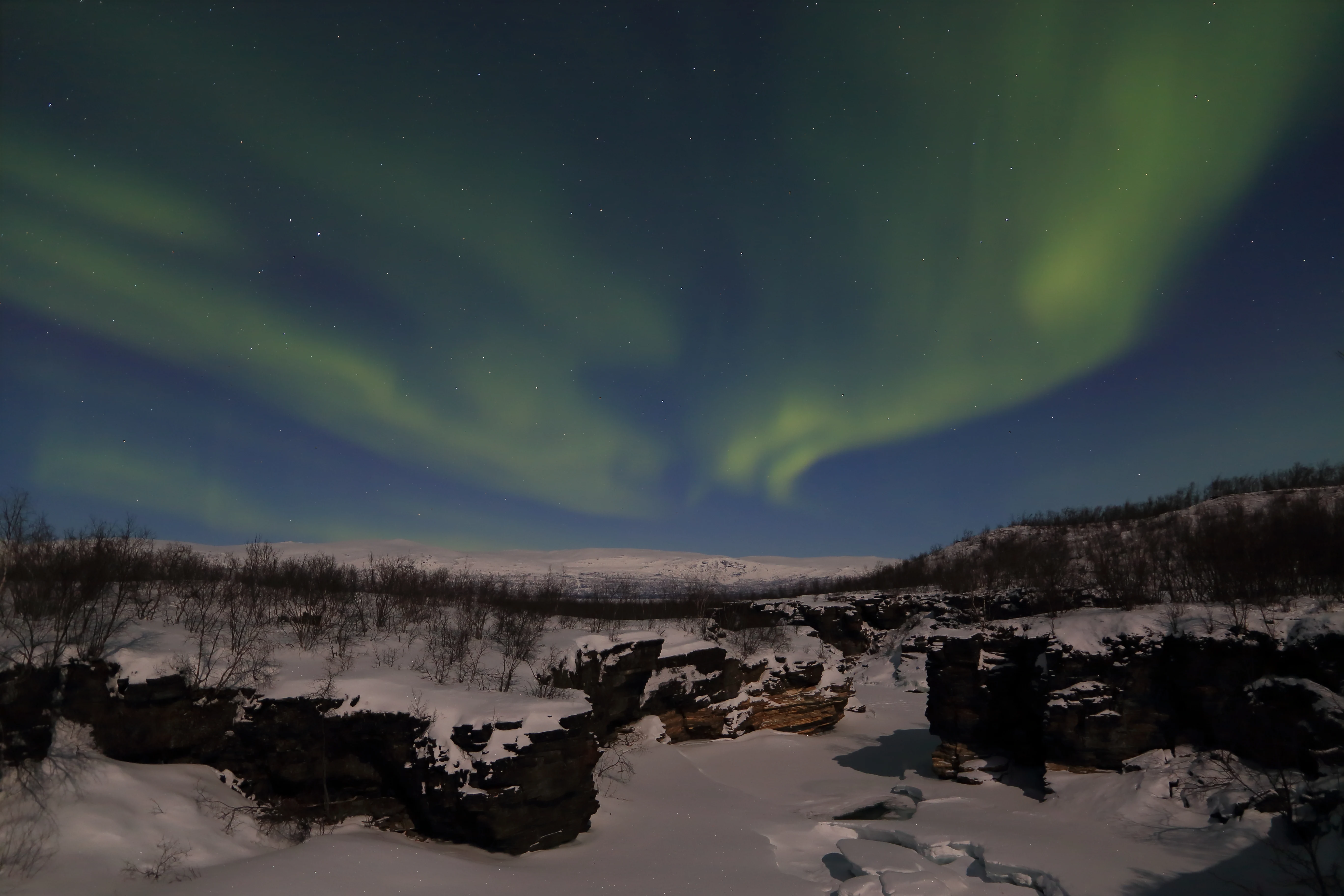
If you want to see the aurora from Europe this winter, Abisko in Swedish Lapland is the place I’d shortlist first. It sits at 68.35° north, roughly 195 km inside the Arctic Circle and under the auroral oval itself, so you aren’t waiting for a once-a-cycle storm to push the lights down to you. The Aurora Sky Station on Mount Nuolja runs its 2026–27 evening season from 19 October to 27 March 2027. The hard part is clouds, and Abisko’s famous “blue hole” is the reason most people pick it. This guide covers what that rain shadow actually does and what it doesn’t, then works through the darkness and Moon calendar for this season, the costs, and how to get there.
Some context on where I’m writing from. Nicosia is at 35° north, and I have yet to see an aurora from Cyprus. Abisko is 33 degrees of latitude further north, and at that latitude the aurora is ordinary night-sky weather rather than a news event.
Why Abisko, in one paragraph
The aurora forms when charged particles guided by Earth’s magnetic field slam into the upper atmosphere. The common green glow is atomic oxygen emitting at 557.7 nm, roughly 100–150 km up; the rarer deep red comes from oxygen higher still. The particles come down in a ring around each magnetic pole, the auroral oval, and Abisko sits inside that ring. On a quiet night, someone in Scotland or northern Germany needs the oval to swell south before they see anything. In Abisko you need clear sky, darkness and a bit of patience. When I checked this morning, NOAA’s 3-day forecast had a maximum Kp of 3 through 28 October, “below NOAA Scale levels”. That’s a non-event from Cyprus, but it’s a perfectly normal hunting night under the oval.
The blue hole: what the data supports
The usual story: prevailing westerly winds push moist Atlantic air into the mountains along the Norwegian border, the air dumps its moisture on the windward side, and it arrives over the Torneträsk basin drier, leaving a gap in the cloud. Space.com describes a “10–20 square kilometer ‘Blue Hole’” over the village, and National Geographic repeats an often-quoted 88% chance of seeing the aurora on a three-day visit. I couldn’t find a methodology behind either number. Both come from tourism coverage, so treat them as claims.
The rain shadow itself is easy to verify, because Sweden’s weather service publishes the data. Using SMHI’s 2002–2020 averages:
| Station | Annual precipitation | October–March total |
|---|---|---|
| Abisko | 349 mm | 135 mm |
| Katterjåkk (by the Norwegian border, near Riksgränsen) | ~876 mm | ~450 mm |
Abisko figures from the SMHI table reproduced on Wikipedia’s Abisko page; Katterjåkk totals are my sums of its monthly SMHI values.
Over the aurora months, the station a short drive west of Abisko gets about three times as much precipitation. With an annual total of 349 mm, Abisko is one of the driest places in Sweden. That gap is real, and it comes from the mountains.
Precipitation isn’t cloud cover, though. A rain shadow strips out the thick, precipitating cloud that’s been forced up over the mountains. It does much less about high cirrus coming in on a weather front, or low stratus sitting in the valley on a still, cold night. Wikipedia’s Abisko article goes as far as calling the village “very cloudy by Swedish standards” despite the dryness, but it doesn’t source the comparison, so I’m not putting weight on it either way. I haven’t found a published multi-year night-time cloud statistic for Abisko, and I’m not going to invent one. My working conclusion: the blue hole improves your odds against the big Atlantic systems that soak the coast, and the weather can still beat it. Plan three or four nights.
How dark it gets, month by month
At 68° north, darkness isn’t the problem in winter, and it disappears entirely in summer. I ran the Sun’s altitude for Abisko through the season and checked the twilight times against the US Naval Observatory’s calculator (they agree to within a minute):
| Date | Sun’s highest altitude | Hours with Sun below −12° | Hours below −18° (full astronomical darkness) |
|---|---|---|---|
| 1 Sep 2026 | 29.8° | 3.0 h | 0 |
| 1 Oct 2026 | 18.4° | 8.7 h | 6.2 h |
| 26 Oct 2026 (today) | 9.1° | 11.9 h | 9.7 h |
| 15 Nov 2026 | 3.1° | 14.0 h | 11.8 h |
| 21 Dec 2026 | below horizon | 15.8 h | 13.4 h |
| 1 Feb 2027 | 4.6° | 13.4 h | 11.2 h |
| 1 Mar 2027 | 14.1° | 10.1 h | 7.8 h |
| 1 Apr 2027 | 26.2° | 5.2 h | 0 |
Three dates frame the season:
- 13 September 2026 brought the first night with any full astronomical darkness this autumn.
- 6 December 2026 to 6 January 2027 is polar night. With a flat horizon, the Sun doesn’t rise at all for this stretch. USNO has the last sunrise on 5 December (11:13–11:57 local time) and the first one back on 7 January. Even at midwinter you get about five hours of civil twilight around noon (09:09–14:17 CET on 21 December), so midday is a long blue dusk.
- On 30 March 2027 astronomical darkness ends for the year. STF closes the evening Sky Station season on 27 March, and its own page says the lights can be seen “from late August to April”, with the best chance between mid-November and mid-March.
The aurora is bright enough to see in nautical twilight, so the −12° column is the realistic hunting window. The −18° column is the one to plan around if you also want the Milky Way in your frames.
The Moon calendar for 2026–27
The aurora survives moonlight much better than the Milky Way does. A strong display is still obvious under a full Moon, and moonlit snow makes for better landscape photos than a black foreground. Faint, diffuse aurora is a different story: it gets washed out. At this latitude the Moon behaves oddly too. On the full Moon of 24 November and again on 24 December, USNO shows it staying above Abisko’s horizon for the entire day, so there’s no moonless window at all on those dates.
New Moons this season (UT, from USNO):
- 9 November 2026, 07:02
- 9 December 2026, 00:52
- 7 January 2027, 20:24
- 6 February 2027, 15:56
- 8 March 2027, 09:29
If I were booking one trip, I’d take a 4–5 night window around the 9 December new Moon, which falls inside the polar night with about 13 hours of full darkness. As a second choice, I’d go around 6 February or 8 March. Those come with more daylight for hiking, shorter but still long nights, and the statistical bonus of the equinox season: geomagnetic activity tends to run higher in the months around the equinoxes (the Russell–McPherron effect, from the tilt of Earth’s magnetic field relative to the solar wind’s field).
Is solar maximum over?
Mostly, and for an Abisko trip that changes less than the headlines suggest. The Belgian solar data centre SIDC reports that the smoothed sunspot number peaked in October 2024 and has been declining since. In the same update it lists two near-extreme geomagnetic storms, in November 2025 and January 2026, both with aurora seen as far south as Belgium. It also notes that the planetary Ap index (a measure of how disturbed Earth’s magnetic field is) was still climbing to a new high for the cycle, and it expects “further episodes with very enhanced solar and geomagnetic activity” over the next two years. That fits the familiar pattern. The declining phase brings fewer sunspots but plenty of recurring high-speed solar wind streams, and those reliably produce moderate activity.
For a mid-latitude observer, the decline means fewer of the big storms that reach Cyprus or Spain. At Abisko you lose very little, because you’re already under the oval on ordinary nights.
Where to stand
You don’t need to go far. With 85 residents in the 2005 census and Kiruna more than an hour away by road, artificial light isn’t the limit here. Your limits are the Moon, the clouds and the aurora itself, which can light the sky up a lot on an active night. I haven’t found an SQM survey of Abisko I’d quote. The National Park (77 km², protected since 1909) starts right at the village.
Aurora Sky Station. STF runs a chairlift up Mount Nuolja to a station at 900 m with an outdoor terrace and café. The ride takes 20–40 minutes in open two-seat chairs. Per STF’s current pages, the guided Night Visit is from 1,295 SEK and includes the guide, the lift and warm overalls and boots. There are 40 places a night, with evening access until 01:00. A plain chairlift ticket is from 260 SEK. In severe weather the visit moves to a wood-fired lavvu (a Sámi-style tent) down in the national park, and STF won’t refund for weather. The 900 m height gets you above valley fog and gives a wide view over Torneträsk and the U-shaped Lapporten valley. On a windy −20 °C night it’s also the coldest spot you could have picked.
Torneträsk shore. The lake (330 km²) gives you a wide, flat horizon to the north, which is where weaker arcs sit. National Geographic’s piece mentions guided tours from the Torneträsk pier. You can walk to the shore from the village.
The Abiskojåkka canyon. This is the river gorge on the cover, close to STF’s Turiststation. Its snow-covered rock walls give a much better foreground than an empty sky.
On an active night the aurora won’t stay in the north. At this latitude it often fills the whole sky, with green curtains directly overhead. Find somewhere with an open view in every direction, give your eyes the full 20–30 minutes to dark-adapt, and keep white light off.
Cameras and cold
SMHI’s January averages for Abisko are a −10.5 °C daily mean and a −14.6 °C average daily low, with the coldest night of a typical January dropping to about −26 °C. Batteries lose capacity fast at those temperatures. Carry spares in an inside pocket and swap them out rather than fighting a dying one.
For photos, a tripod and a wide, fast lens cover almost everything. Start around f/2.8, ISO 1600–3200 and 2–8 s exposures. Use shorter exposures for fast-moving curtains, because a 20 s exposure smears the structure into a green fog. A modern phone’s night mode on a small tripod gets surprisingly far. My phone Milky Way guide covers the same settings logic. If you bring a lens heater, it’s for frost rather than dew at these temperatures, and the dew-heater logic still applies.
Two live tools I’d keep open on the phone: NOAA’s 30-minute aurora forecast, which shows the modelled oval in near real time, and the Swedish Institute of Space Physics’ Kiruna all-sky camera, which shows what the sky over the region is actually doing.
Getting there and staying
From Cyprus it’s a minimum of two flights. Larnaca to Stockholm, then Stockholm to Kiruna. Space.com puts Kiruna just over an hour from Abisko by car or train, along the E10 or the Ore Line railway.
Check the rail situation this winter before you book. The direct Stockholm–Narvik sleeper, the classic way into Abisko, was cut back to Boden in April 2026. According to Wikipedia’s summary of Swedish press reports, the through service to Narvik is planned to return in December 2026 under a new state contract with SJ. Meanwhile, a daily SJ train still runs the Ore Line between Luleå and Narvik via Kiruna and Abisko. Abisko has two stations: Abisko Östra for the village, and Abisko Turiststation for STF and the national park.
STF Abisko Turiststation is the default base. It has hotel rooms, a hostel and cabins, two restaurants, and a 10-minute walk to the chairlift. Abisko Mountain Lodge is the other well-known option. Lights over Lapland runs guided aurora photo tours around Abisko if you’d rather have someone else handle the logistics at −20 °C. I don’t have an affiliate arrangement with any of them.
Bottom line
For a European observer, I think Abisko is the most dependable aurora bet you can reach without a car. You’re under the oval, the rain shadow measurably cuts the precipitation the Atlantic sends inland, the Sky Station gives you a high, staffed site with a café, and there’s a railway station a few minutes’ walk from your bed. It can’t promise clear skies. The blue-hole percentages come from tourism coverage, and what the SMHI data actually supports is “fewer of the big Atlantic weather systems”, which still leaves plenty of cloudy nights. Book four nights, choose a new-Moon week, and watch the 30-minute forecast rather than the Kp headline.
If you only fly once this winter, the 9 December new Moon is the window I’d circle. You get the polar night, about 13 hours of full darkness and no Moon to compete with.
Climate figures are SMHI 2002–2020 averages. Darkness hours are my own calculation for 68.35° N, 18.78° E, checked against USNO. Prices and dates are from STF’s pages as of 26 October 2026; check them before you travel.