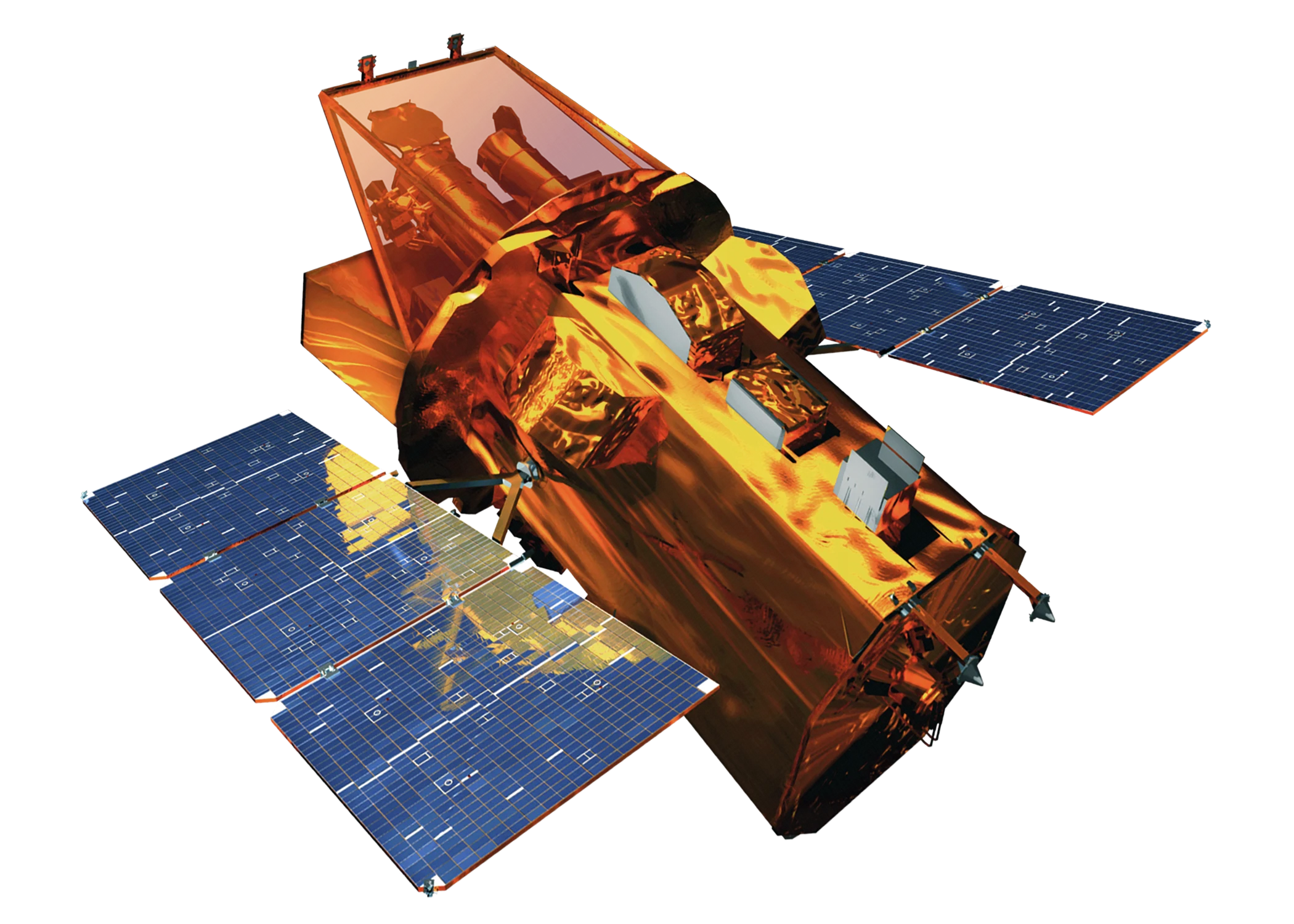
NASA’s Neil Gehrels Swift Observatory made its last observation on 20 October 2026, and the agency announced the end of the science mission on the 23rd. The spacecraft had dropped below 275 km, where atmospheric drag stops its telescopes from holding steady on a target. As of 27 October its orbit was 249 × 254 km (Heavens-Above), and NASA expects re-entry “in the next few weeks.”
You were never going to see Swift itself from Europe, and I’ll show why below. What amateurs lose is less visible: the satellite that, for 22 years, turned a gamma-ray flash into an arcminute-sized box on the sky fast enough for a backyard telescope to point at it. Here’s what Swift did for the hobby, who issues the alerts now, and what a small telescope can still contribute.
How it came down
Swift launched on 20 November 2004 for a two-year primary mission. Its orbit decayed slowly for most of those two decades, then fast, as the Sun’s activity peaked around 2024 and heated, puffed-up upper atmosphere dragged harder on everything in low orbit. In February 2026 NASA paused most science operations to lower drag and buy time for a rescue.
The rescue was LINK, a 425 kg servicer that Katalyst Space Technologies built in under a year after NASA contracted it in September 2025. It launched on 3 July 2026 on the last Northrop Grumman Pegasus XL, an air-launched rocket dropped from an L-1011 over Kwajalein (Gunter’s Space Page). By late July two of its three reaction wheels were out and it had gone into a multi-axis spin. Katalyst brought the spin down to 1.47° per second by 5 August and uploaded new flight software on the 11th, but stopping the spin had used up propellant. On 19 August NASA and Katalyst concluded LINK couldn’t safely capture and boost Swift. It still flew a demonstration, coming within 12–15 km of Swift in the first week of September and deploying its three robotic arms, then re-entered on 25 September after 85 days in orbit (CNN).
The Swift team turned instruments back on for a last stretch of science, even though that sped the descent. On 20 October the spacecraft reached about 275 km, went into safe mode and couldn’t counter the drag any more.
Can you watch it fall?
Not from Cyprus, and not from anywhere in Europe. Swift’s orbit is inclined 20.5° to the equator, so its ground track never goes north of 20.5°N. From Nicosia, at 35.2°N, that keeps it below or barely above the southern horizon. Heavens-Above lists no visible passes from Nicosia between 28 October and 7 November. The re-entry will happen somewhere along that tropical band. Swift masses about 1,452 kg, and LeoLabs told CNN that some hardware may survive, with a “very small” chance of harm and the ocean or uninhabited land as the most likely landing spots.
What Swift did for backyard observers
NASA’s tally: more than 2,000 gamma-ray bursts, more than 1,400 supernovae, and data in about 7,000 papers. Most of that was professional work, but in at least four places Swift’s work fed straight into amateur observing.
It made gamma-ray bursts chaseable
A gamma-ray burst (GRB) is a seconds-to-minutes flash of gamma rays from a collapsing massive star or a neutron-star merger, followed by an afterglow that fades through X-rays, ultraviolet and visible light over hours to days. Gamma rays don’t reach the ground, so someone in orbit has to say where the burst was.
Swift’s Burst Alert Telescope found the burst to within a few arcminutes, broadcast the position, and swung the spacecraft round so its X-ray and UV/optical telescopes could pin the afterglow down further. Principal investigator Brad Cenko puts the whole sequence at “about a minute.” The resulting error box was smaller than the field of view of a typical amateur imaging setup. My Seestar covers about 1.3° × 0.7°, and a 3-arcminute circle is a speck in that.
The GRANDMA network built its citizen-science arm, Kilonova-Catcher, around this. In an eight-week campaign in spring 2022, GRANDMA chose Swift bursts because their localisations “were generally smaller than the GRANDMA telescopes’ field of view.” Seventeen professional telescopes and 17 amateur astronomers between them detected three afterglows (Tosta e Melo et al. 2024, A&A).
Once in a while an afterglow was bright enough for no telescope at all. GRB 080319B, a Swift detection, peaked at about magnitude 5.6 according to Swift’s own release, for a source billions of light-years away. A Polish wide-field camera system, Pi of the Sky, recorded it.
It looked at the supernovae amateurs found
On 19 May 2023 Koichi Itagaki, a Japanese amateur, discovered SN 2023ixf in M101 (Hiramatsu et al. 2023, where Itagaki is a co-author). Swift observed it heavily from the first days. It also had something nobody else did: nearly two decades of archival X-ray, UV and optical images of M101 from before the explosion. Panjkov and colleagues used them to rule out any luminous precursor outburst, and found the supernova’s own soft X-rays turning on about 4.25 days after first light (Panjkov et al. 2023). That was the usual pattern. An amateur finds a supernova, a professional spectrum classifies it, and Swift adds the ultraviolet and X-ray light curve within a day or two.
It measured water in comets
Swift’s UV/Optical Telescope (UVOT) is a 30 cm Ritchey–Chrétien, roughly the aperture of a 12-inch Dobsonian. From above the atmosphere, though, it could see the hydroxyl (OH) emission band near 308.5 nm, right at the atmosphere’s ultraviolet cutoff, where ground telescopes fight heavy absorption. OH comes from water molecules broken apart by sunlight, so UVOT gave comet water production rates. Its best-known recent result: OH from interstellar comet 3I/ATLAS on 31 July and 1 August 2025, at 3.51 au from the Sun. The team estimated (1.35 ± 0.27) × 10²⁷ water molecules per second, about 40 kg/s, and noted that the figure depends heavily on an assumed dust colour (Xing et al. 2025). It was the first sign of water activity in 3I/ATLAS, and it came from a telescope the size of a large backyard Dob.
It took requests
Swift’s planning system accepted target-of-opportunity requests that could be commanded “in as little as a few minutes,” and handled up to 75 targets a day. When a nova erupted or a blazar flared, getting X-ray and UV coverage alongside the ground-based optical photometry was routine. No other single mission has taken over that combination of turnaround and flexibility.
Who issues the alerts now
The gamma-ray sky isn’t unwatched. Three missions carry most of the load.
SVOM, a China–France mission launched in June 2024, is the closest thing to a Swift successor. Its ECLAIRs coded-mask camera triggers on bursts, and the spacecraft slews so its X-ray (MXT) and optical (VT) telescopes can follow. Two days ago, at 06:09:37 UTC on 26 October, ECLAIRs triggered on GRB 261026A and put it inside a circle of 7.22 arcminutes radius (GCN Circular 46030). For GRB 261011A on 11 October, the onboard circle was 2.17 arcminutes, and MXT then tightened it to about 1 arcminute (GCN 45895). Those boxes are tight enough for an amateur field.
Einstein Probe, the Chinese Academy of Sciences’ wide-field X-ray mission (launched January 2024, with ESA, MPE and CNES contributions), finds fast X-ray transients that often turn out to be GRB relatives. It’s the satellite behind the shock-breakout supernova I wrote about in August.
NASA’s Fermi, with its Gamma-ray Burst Monitor, sees a large share of the sky, but its localisations are typically several degrees across. That’s fine for a big survey camera and hopeless for a 50 mm telescope.
The pieces that are gone are Swift’s fast X-ray and UV follow-up and its quick-turnaround requests. Kilonova-Catcher’s report on GRB 250818B, an SVOM burst from August 2025, shows what that means. Two telescopes run by Kilonova-Catcher volunteers, a CDK17 in Chile and a TEC 160 mm refractor, caught the afterglow at r = 19.47 ± 0.07 about five hours after the burst and r = 20.17 ± 0.16 at 7.5 hours. Among the dozen independent confirmations they cite are Swift/XRT and Swift/UVOT. The next SVOM burst won’t get those two. NASA says it will lean on “current missions to help fill the gap” while it explores “fast-to-orbit commercial capabilities” and new missions. No replacement has been named.
What a small telescope can still do
I’ll be blunt about my own setup first. The Kilonova-Catcher detection at r = 20.2 came from a 160 mm aperture, which collects (160/50)² ≈ 10 times the light of my Seestar S50’s 50 mm, or about 2.5 magnitudes’ worth. Add a Bortle 7 balcony sky in Nicosia, and a 20th-magnitude afterglow is out of reach for me. If you have a 200 mm or larger scope on a tracking mount, or a dark site, it isn’t out of reach for you, and the timing still favours amateurs. A burst happens at a random hour, and the network wants someone, somewhere, whose sky is dark at the time.
If you want in:
- Get the alerts. NASA’s General Coordinates Network sends circulars by email, and SVOM, Einstein Probe and Fermi all post there. The free Astro-COLIBRI app turns the alerts into push notifications on your phone.
- Join a structured programme instead of imaging alone. Kilonova-Catcher hands amateurs observing plans and runs the photometry through a single pipeline, which is what turns your frames into a GCN circular.
- Do photometry. A calibrated magnitude with an error bar and a time stamp is what a light curve needs, and a nicely stretched colour image adds nothing to it.
- Use the archive. NASA says Swift’s public dataset runs to about 12 TB, including more than 1.5 million UVOT images. If you’re following a variable star, a comet or a galaxy you’ve imaged for years, there’s a good chance Swift looked at it too.
Supernova hunters lose less. Discovery and classification never ran through Swift. What goes is the early ultraviolet and X-ray coverage that told professionals how the star died, and that loss lands on the science more than on the hobby.
What I’m watching
Two things. The first is the re-entry date, which will firm up in the last few days and land in the tropics, well out of my sky. The second, and the one that will decide how much amateurs lose, is what NASA actually puts in Swift’s place. Until something flies, SVOM’s arcminute boxes are the best targets a backyard telescope will get. I’ll keep the GCN emails coming, and the next time a burst goes off over a dark Troodos sky with an SVOM box overhead, I’ll at least try.