The two Taurid meteor showers peak a week apart this year, the Southern Taurids around November 5 and the Northern Taurids around November 12, and the new Moon lands on November 9, right between them. That’s about as good as the Taurid calendar gets. Rates are low: expect a handful of meteors an hour from a dark site, fewer from town. What makes the Taurids worth a cold night is the speed and size of what does come in. These are slow meteors, and the stream carries enough large debris that the American Meteor Society describes early November as the time for “a couple of Taurid fireballs each night.” The radiant is up from early evening, so you don’t need a 3 a.m. alarm. Go out after 20:00, face east or overhead, and give it an hour.
Times below are for Nicosia (35.2° N), from JPL Horizons. Cyprus went back to winter time on October 25, so local time is now UTC+2. Elsewhere in Europe and the Mediterranean the pattern holds; shift the clock times to your own longitude.
The 2026 numbers
The figures that matter come from the International Meteor Organization’s 2026 shower calendar:
| Southern Taurids (STA) | Northern Taurids (NTA) | |
|---|---|---|
| Active | Sep 20 – Nov 20 | Oct 20 – Dec 10 |
| Maximum | Nov 5 | Nov 12 |
| ZHR | 5–10 | 5 |
| Radiant at maximum | RA 52°, Dec +15° | RA 58°, Dec +22° |
| Entry speed | 27 km/s | 29 km/s |
| Population index r | 2.3 | 2.3 |
ZHR, the zenithal hourly rate, is the number one observer would count with the radiant straight overhead under a perfectly dark sky (naked-eye limit magnitude 6.5). Real counts are always lower. The population index r describes how quickly the meteor count grows as you go fainter; I’ll use it to turn those ZHRs into real-world numbers below.
The AMS 2026 calendar agrees on the dates, giving the peak nights as November 4–5 and November 11–12. Neither peak is sharp. The IMO notes that earlier results suggested Northern Taurid rates stay on a plateau for about ten days in early to mid November, and the Southern Taurids also had an earlier maximum, ZHR around 5, near October 13. Both branches are active together for most of the window, so any clear night between about November 3 and 14 gives you Taurids from both radiants at once, with the Moon either absent or a thin crescent for most of the dark hours.
Moon and darkness, night by night
The Moon is a waning crescent in the first week of November and reaches new on the 9th. The two peak nights from Nicosia:
| Night | Astronomical darkness begins | Moon | Astronomical dawn begins | Dark window |
|---|---|---|---|---|
| Wed Nov 4 → Thu Nov 5 (STA peak) | 18:16 | rises 02:16, about 18% lit | 04:46 | ~8 h moonless, then a thin crescent |
| Thu Nov 5 → Fri Nov 6 | 18:16 | rises 03:18, about 12% lit | 04:46 | ~9 h moonless |
| Wed Nov 11 → Thu Nov 12 (NTA peak) | 18:12 | sets 17:54, about 5% lit | 04:52 | the whole night |
“Astronomical darkness” starts when the Sun drops 18° below the horizon; dawn is the reverse. On the Southern Taurid peak the crescent Moon only rises at 02:16, after the radiant has passed its highest point, and an 18% crescent low in the east costs you very little anyway. The Northern Taurid peak has no Moon at all. The IMO’s calendar makes the same point: the new Moon “allows undisturbed optical observations especially in the period between the dates given as maxima of the two Taurid branches.”
Where to look, and when
Both radiants sit in Taurus, about 9° apart. The northern one is easy to find: it’s about 2.4° from the Pleiades, just south of the cluster. The southern radiant lies about 10° south-west of the Pleiades, roughly halfway along a line toward the head of Cetus. Both radiants creep eastward from night to night (the IMO calendar charts the track), so the positions in the table only apply on the peak dates. Since the radiant area is spread out anyway, the IMO advises treating it as an oval about 20° by 10° when you decide whether a meteor is a Taurid.
The radiants rise between about 17:00 and 17:30 local time and climb all evening:
| Local time (EET) | STA altitude, Nov 4–5 | NTA altitude, Nov 11–12 |
|---|---|---|
| 20:00 | 29° | 34° |
| 22:00 | 53° | 58° |
| 00:00 | 69° | 77° |
| 02:00 | 59° | 63° |
| 04:00 | 36° | 39° |
From 35° N the Southern radiant tops out at 70° and the Northern one at 77°. Both culminate around midnight. The best stretch is roughly 22:00 to 02:00, and the early evening is perfectly usable, which is unusual for a meteor shower. Most showers favour the hours before dawn, when your side of Earth faces forward along its orbit. The Taurid radiant sits roughly opposite the Sun, so it’s highest at midnight.
Don’t stare at the radiant. Meteors close to it are foreshortened into short stubs. Look 40–50° up and 30–40° away from Taurus. Around 22:00 that means facing east or south-east, or simply lying back and looking overhead.
How many you’ll actually see
The same field estimate I used for the Orionids applies:
observed rate ≈ ZHR × sin(radiant altitude) ÷ r^(6.5 − limiting magnitude)
With r = 2.3, every magnitude of sky brightness you lose divides the count by 2.3. Taking the radiants near their highest (around 70° for the STA, 77° for the NTA), that gives:
| Sky | Limiting magnitude | STA (ZHR 5–10) | NTA (ZHR 5) |
|---|---|---|---|
| Mountain site, e.g. Troodos | ~6.0 | 3–6 per hour | ~3 per hour |
| Rural village | ~5.0 | 1–3 per hour | 1–2 per hour |
| City balcony | ~4.5 | 1–2 per hour | ~1 per hour |
These are my estimates from the IMO parameters, and they’re per branch. Because the two branches overlap, a dark-site watch on either peak night should give a combined Taurid rate of perhaps 5–8 an hour, with sporadic meteors on top. If you want big numbers, wait for the Geminids, which the IMO lists at ZHR 150 for December 14. The Taurids are a shower you watch for quality.
Why they’re slow, and why some are big
The parent body is comet 2P/Encke, a nucleus about 4.8 km across that circles the Sun every 3.30 years, according to NASA’s Encke page. Encke’s orbit is prograde and only slightly tilted to Earth’s, so its debris travels in roughly the same direction as Earth and meets it at a modest relative speed. The Taurids come in at 27–29 km/s. The Orionids, active at the same time, hit at 66 km/s, and the Leonids at 71 km/s (IMO figures). The difference is obvious by eye. An Orionid is a quick scratch; a Taurid drifts across the sky and stays visible noticeably longer.
The stream is old and spread out, which is why it’s so weak and so long-lasting. It’s also unusual in carrying large meteoroids. The AMS defines a fireball as “a very bright meteor, generally brighter than magnitude −4”, about as bright as Venus. On the magnitude scale, smaller numbers mean brighter, and each step is a factor of about 2.5. Most Taurids are ordinary faint meteors, but the AMS calendar notes that the Southern Taurids “are often responsible for an increased number of fireball reports from September through November.” Slow speed helps here as well: a slow fireball stays visible longer, so you have more time to see it.
Is 2026 a swarm year?
No, as far as the published predictions go. In some years the Taurids produce many more fireballs than usual. The explanation, proposed by Asher and Clube in the 1990s, is a swarm of meteoroids trapped in a 7:2 resonance with Jupiter: they complete seven orbits for every two of Jupiter’s, which keeps them bunched together. When Earth passes close to the clump, fireball rates jump.
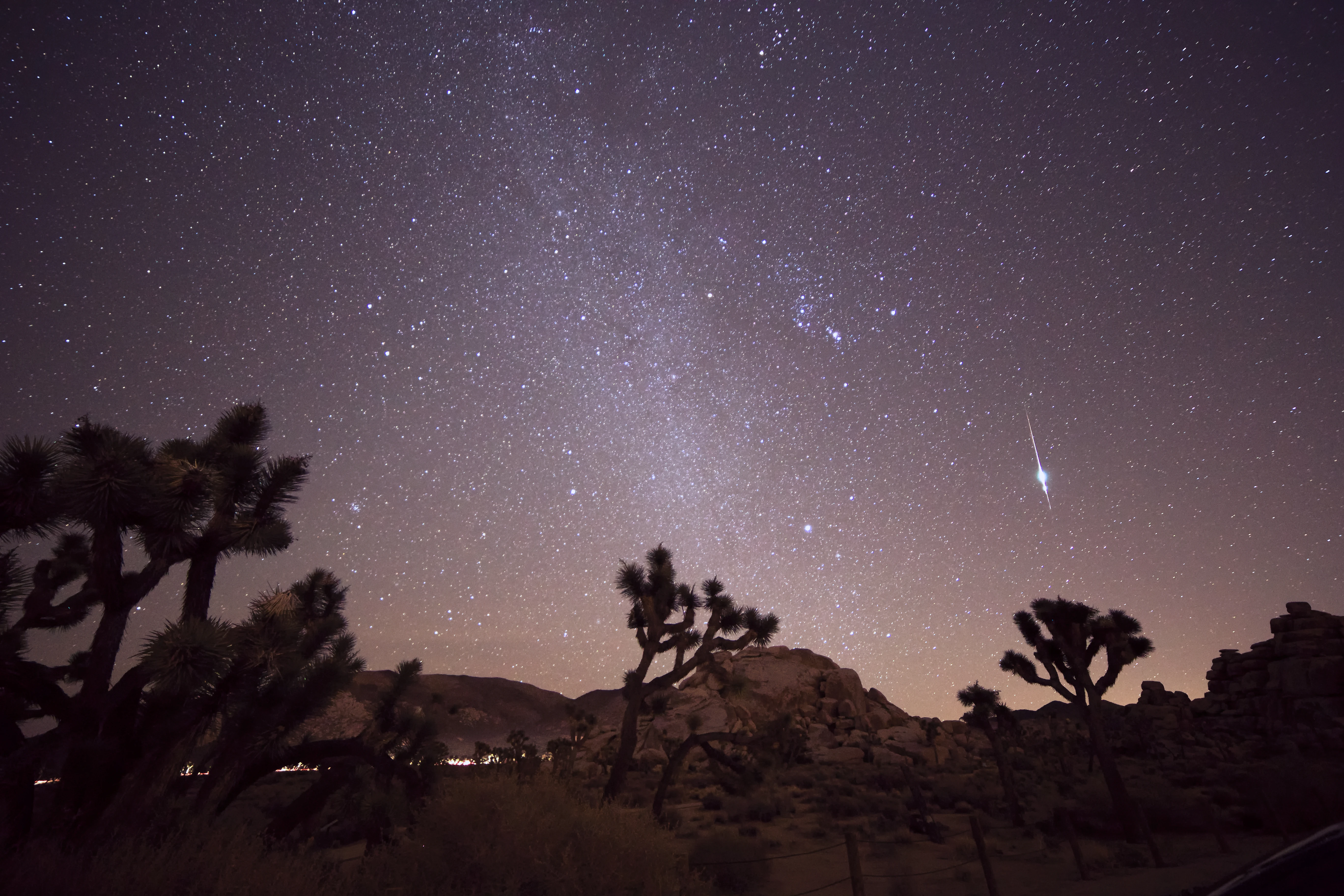
The best-documented recent case is 2015, the year this article’s cover photo was taken. Spurný et al. (2017) analysed 144 Taurid fireballs recorded by the European Fireball Network that autumn. Orbits of 113 of them formed one tight group with semimajor axes of 2.23–2.28 AU, overlapping the 7:2 resonance. The meteoroid masses ran from 0.1 g to more than 1,000 kg. The authors also argued that two asteroids, 2015 TX24 and 2005 UR, both 200–300 m across, belong to the same branch. A later observational synthesis by Egal et al. (2022) found the swarm in optical fireball data but not in radar data, which detects much smaller particles. Their reading is that small meteoroids get pulled out of the resonance faster than the big ones that make fireballs.
For 2026 the IMO calendar lists normal ZHRs for both branches and predicts no swarm enhancement. Its only special note is a suggestion, credited to the meteor researcher Koseki, that the October 13 maximum might run higher than average, and that’s already past. If you see a “Taurid swarm 2026” headline in the next week, check whether it cites a model. I haven’t found one.
What else is up
Jupiter and Mars rise together in Leo around midnight. They’re about 4° apart on November 5 and about 2° on the 12th, closing toward the 1.2° conjunction on November 16 that I covered in the Mars–Jupiter preview. Jupiter, at magnitude −2, will be the brightest point in the eastern sky after midnight.
Two other showers overlap with the Taurids, and they’re easy to tell apart:
- Orionids (active until November 7): fast, 66 km/s, tracing back to a point north of Betelgeuse in Orion, which rises after about 20:00 and is high by midnight.
- Leonids (active from November 6, peak November 17): the fastest of all at 71 km/s, from a radiant in Leo that only clears the horizon around 23:25 on November 11. Before midnight, a quick meteor is very unlikely to be a Leonid.
If a meteor is slow and traces back toward Taurus, it’s a Taurid. If it’s quick, it probably isn’t. Satellites are the other trap: they move at a steady speed, don’t fade or flare, and take minutes to cross the sky. The moving-lights guide covers the rest.
My plan
From my balcony in Nicosia (Bortle 7, limiting magnitude around 4.5 on a good night) I’d see about one Taurid an hour, so the balcony only works as a fireball watch. A fireball brighter than magnitude −4 cuts through city light easily. On whichever peak night I’m not on the mountain, I’ll sit out from about 21:00 for an hour with the camera running.
For a proper count I’ll drive up to Troodos for the peak night with the better forecast, back to the Mount Olympos pull-off at about 1,700 m from the Troodos guide. The early radiant makes this an easy trip by meteor-shower standards. I can be set up by 21:00, count through the midnight culmination, and be home before 02:00 without missing much. The Northern Taurid night (November 11–12) is my first choice, with the whole night moonless.
For photography the Taurids suit a fixed tripod well. The IMO calendar notes that their brightness and slowness make them ideal for still imaging. A slow meteor leaves more light on each pixel than a fast one of the same brightness. Use the fixed-tripod setup from the Perseids: a wide lens 30–40° from the radiant, continuous 15-second frames, and an intervalometer doing the work while you watch. The Seestar stays home again; a one-degree field is no use for meteors.
If you do catch a fireball, report it. The IMO fireball form asks for your location, the time, where the meteor started and ended against the stars, and how bright it was. With reports from several observers, the IMO can estimate the fireball’s path through the atmosphere.
Quick reference
- Southern Taurids peak: night of November 4–5 (ZHR 5–10). The Moon rises at 02:16 local time, 18% lit.
- Northern Taurids peak: night of November 11–12 (ZHR 5). No Moon all night.
- New Moon: November 9. Any clear night from about November 3 to 14 works.
- Watch window (Cyprus): 20:00 to 02:00 local; radiants highest around midnight
- Look: east to overhead, 30–40° away from the Pleiades
- Rates: about 5–8 Taurids per hour combined from a mountain site, 1–2 from a city
- Speed: 27–29 km/s, slow streaks with occasional fireballs
- Equipment: none. A reclining chair, warm layers, and patience.