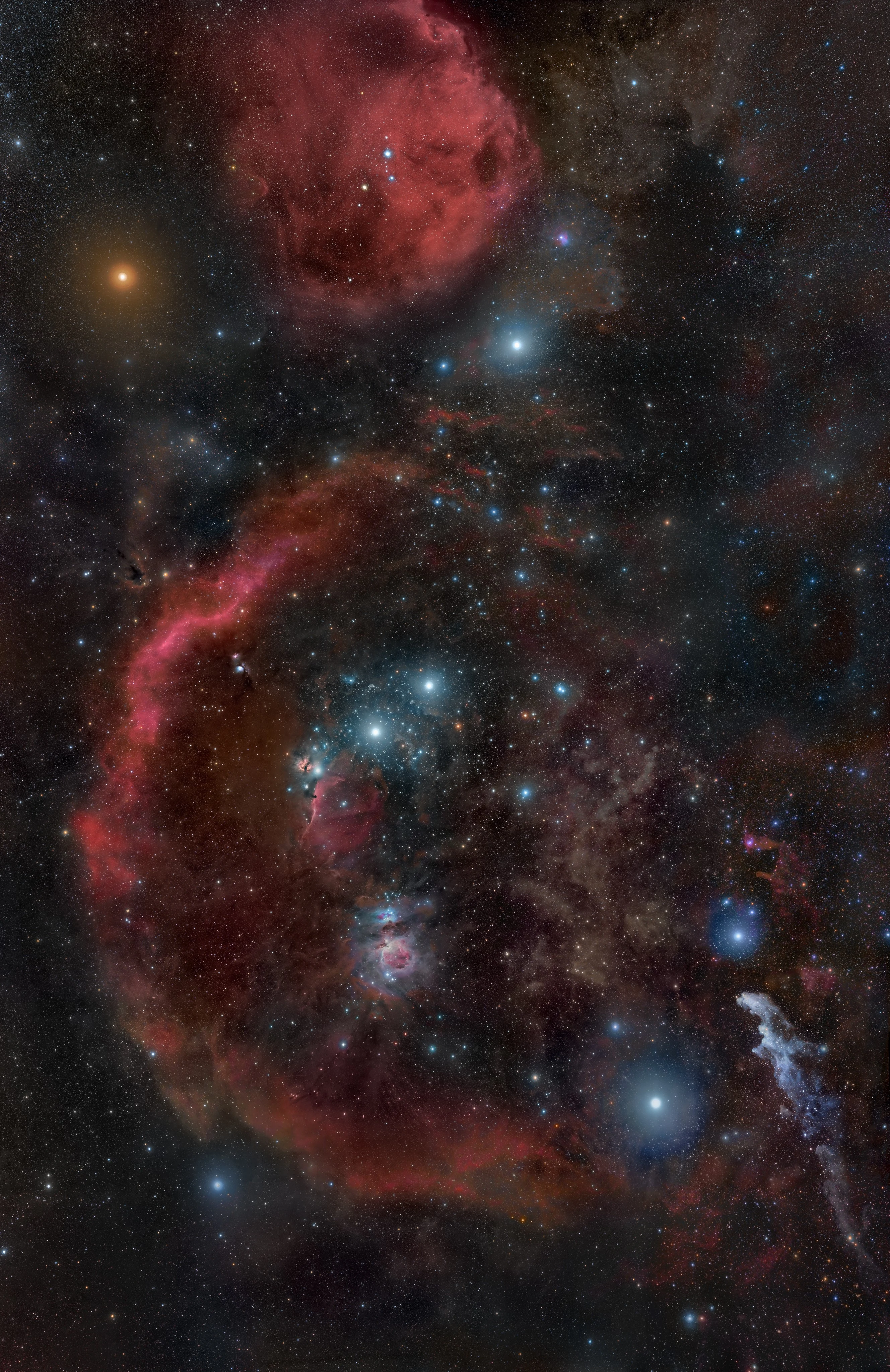
Orion is back in the evening sky. From Cyprus this week it clears the eastern horizon at about 20:20 local time, lying on its side, and by 22:00 it’s high enough to see properly. Three bright stars in a short, straight row mark its belt. Find those and you have the whole constellation, the brightest stars of the winter sky around it, and, hanging just below the belt, a nebula you can pick out from a town with your bare eyes. You don’t need any gear. And the next ten evenings are the best time this month to look, because the Moon is out of the evening sky until about November 14.
When to look
All times below are for Nicosia (35°N), in local winter time (EET, UT+2). Because the belt sits on the celestial equator, your latitude barely changes these times. Longitude does: add 4 minutes for every degree you are west of Nicosia (33.4°E), subtract 4 for every degree east, then convert to your own time zone.
| Date | Belt rises | Belt 20° up | Belt highest (south) |
|---|---|---|---|
| November 5 | 20:25 | 22:07 | 02:24 |
| November 12 | 19:58 | 21:39 | 01:56 |
| November 20 | 19:26 | 21:08 | 01:25 |
| December 1 | 18:43 | 20:25 | 00:41 |
| December 15 | 17:48 | 19:30 | 23:46 |
I computed these from catalogue positions; treat them as good to a couple of minutes. Twenty degrees is about two fists held at arm’s length. Below that you’re looking through thick, hazy air and the fainter stars of the figure get lost.
Like every star, Orion rises about four minutes earlier each night, two hours earlier each month. By mid-December it’s already up when astronomical twilight ends, around 18:07, and by mid-January it stands due south at about 21:45, which is when most people first notice it. Sitting on the celestial equator, it’s visible from every inhabited continent, though from the Southern Hemisphere it appears upside down, with the belt above the nebula.
Moonlight hurts the nebula far more than the stars. The Moon is a waning crescent that rises after 02:00 this week, and it’s new on November 9. Until around November 14 the evening sky is moonless or holds only a thin crescent that sets early. After that the waxing Moon takes over the evenings, full on November 24, and the next dark run is around the December 9 new Moon. The Moon phases guide explains why those windows drift each month.
How to find Orion
Start with the belt
Face east about two hours after sunset and look for three stars of nearly equal brightness in a short, straight line. In November they rise standing almost vertically, one above the other. The full line is only about 2.7° long, roughly the width of two fingers at arm’s length. No other trio this bright sits this close in a straight row, so you won’t mistake it.
From top to bottom as they rise, the three are Mintaka, Alnilam and Alnitak. Mintaka sits less than a third of a degree south of the celestial equator, which makes it a free compass: it rises almost exactly due east and sets almost exactly due west, from almost anywhere on Earth.
Then the four corners
The belt is the waist of an hourglass. Two bright stars mark the shoulders and two the knees (most charts call them the feet). As Orion rises on its side, the shoulders are to the left of the belt and the feet to the right:
- Betelgeuse, the hunter’s raised shoulder, orange, upper left once he’s up.
- Bellatrix, the other shoulder, bluish-white and noticeably fainter.
- Rigel, the forward foot, blue-white and usually the brightest star in the figure.
- Saiph, the back foot, the faintest of the four.
Betelgeuse and Rigel rise within a few minutes of each other, Betelgeuse at about 81° azimuth (east, a little north) and Rigel at about 100° (east, a little south). They’re 18.6° apart, almost two fists. As the night goes on, Orion swings upright, and by the time it crosses the meridian in the south it stands the way the charts show: Betelgeuse top left, Rigel bottom right, belt tilted across the middle.
The brightness numbers, in apparent magnitude (the scale of brightness as seen from Earth: smaller numbers are brighter, and each step of 1 is about 2.5× in brightness), come from the stars’ catalogue entries: Rigel 0.13, Betelgeuse usually around 0.5 but variable, Bellatrix 1.64, Alnilam 1.69, Alnitak 1.77, Saiph 2.09 and Mintaka 2.23. Even from a bright town sky, all seven are easy.
Use it as a signpost
Orion’s belt is the best pointer in the winter sky. Run a line from Alnitak through Mintaka and keep going (up and to the right, once Orion is upright). About 22° along you reach orange Aldebaran in Taurus. Keep going about 14° beyond and you land on the Pleiades. Run the line the other way, from Mintaka through Alnitak and on down to the left, and about 22° along you reach Sirius, the brightest star in the night sky at magnitude −1.46. In early November Sirius doesn’t rise until about 22:20, so this one works better late in the evening or later in the month.
Betelgeuse also anchors the Winter Triangle. Join it to Sirius and to Procyon, the bright star that rises in the east about an hour and three-quarters after Betelgeuse, and you get a nearly equilateral triangle about 26–27° on a side.
If you want confirmation the first night, any stargazing app will label the stars as you hold the phone up. After that you won’t need it.
Two colours you can see with your eyes
Look from Betelgeuse to Rigel and back: one is orange, the other blue-white. It’s the clearest pair of contrasting star colours in the sky, and the colour is temperature. Rigel is a blue supergiant with a surface around 12,000 K. Betelgeuse is a red supergiant, under 4,000 K. Most stars glow close to a blackbody, so their colour runs from orange through white to pale blue as the temperature climbs. I explained why that range almost never includes green, and the white dwarf that breaks the rule, in the piece on star colours. Orion is the easiest place to see the normal range for yourself.
Betelgeuse is the more interesting of the two to watch over the years. It’s a semi-regular variable, and its brightness wanders by a few tenths of a magnitude over months. Starting in October 2019 it dimmed so far that, by mid-February 2020, it had dropped to about magnitude 1.6, roughly a third of its usual brightness. Speculation that it was about to go supernova spread widely online. A 2021 study in Nature by Montargès and colleagues, using images from ESO’s Very Large Telescope, attributed the Great Dimming to a cloud of dust the star had thrown off, which blocked part of its surface from our view.
How far away it is remains uncertain. A 2020 modelling study by Joyce and colleagues derived a distance of 168 (+27/−15) parsecs, about 550 light-years, and noted that this sits closer to the Hipparcos satellite’s parallax than to some radio measurements. In July 2025 a team led by Steve Howell reported the probable direct detection of a faint companion star, using the Gemini North telescope. The IAU’s star-name working group has since adopted the name Siwarha, “her bracelet”, for it. It’s far too faint, and too close to Betelgeuse, for any amateur telescope.
The nebula below the belt
Find the sword
Hanging below the belt (to the right of it while Orion is still rising, then straight below once it’s upright) is a short, fainter line of stars: the hunter’s sword. It runs roughly perpendicular to the belt, and its middle “star” is about 4.2° from Alnilam. Look straight at that middle point, then a little to one side of it. Under a reasonably dark sky it looks soft, more like a smudge than a star. That smudge is the Orion Nebula, Messier 42.
The catalogue magnitude for M42 is 4.0, which puts it within reach of a suburban sky. The bottom of the sword is easier: Hatysa (iota Orionis) at magnitude 2.77. From my Bortle 7 balcony in Nicosia (Bortle is the 1–9 scale of sky darkness, with 9 an inner-city sky), I get Hatysa and the fuzzy middle point on a clear night in winter, and nothing else of the sword. Up at Troodos, the middle of the sword looks visibly nebulous with no optics at all. In both places, give your eyes the full 30 minutes to dark-adapt before you judge.
What you’re looking at
M42 is a cloud of gas lit up from inside by a handful of young, hot stars that formed in it. Their ultraviolet light ionises the hydrogen around them, and the gas glows. Two radio-telescope parallax measurements with the Very Long Baseline Array put it at 414 ± 7 parsecs (Menten et al. 2007) and 388 ± 5 parsecs (Kounkel et al. 2017), so roughly 1,270–1,350 light-years. The two results don’t agree within their error bars, and I don’t know of a value that settles it, so I’d quote the range.
It’s the nearest large region of massive-star formation to us. The first recorded telescopic observation of it as a nebula is credited to the French astronomer Nicolas-Claude Fabri de Peiresc, on November 26, 1610. Look on November 26 this year and you’ll be exactly 416 years behind him.
The cover image is a long-exposure photograph, so it shows far more than your eye will. The red arcs and loops are hydrogen glow from the wider Orion molecular cloud, the big curve on the left is Barnard’s Loop, and none of that red is visible without a camera. To the eye, even through a telescope, M42 looks grey, sometimes with a faint green tint, because the colour-sensing cones in your eye barely respond to light this faint.
Binoculars and small telescopes
Binoculars turn the smudge into a small, glowing fan of grey light with a bright point inside it. Any ordinary pair works, and 10×50s will show the whole sword in one view: the nebula in the middle, the small star cluster NGC 1981 above it towards the belt, and Hatysa below. If you’re deciding between binoculars and a first telescope, Orion makes a good case for binoculars.
In a small telescope, the bright point at the heart of the nebula resolves into four tight stars in a little trapezoid, the Trapezium. These are the young, hot stars doing most of the lighting. Start with your longest-focal-length eyepiece to frame the whole nebula, then step up the magnification to split the four. On a clear, transparent night at a dark site, faint wings of nebulosity curve out from the core well beyond what a city sky shows.
M42 got a dozen sessions with my Seestar S50 last winter. Even a 10-minute stack from the balcony shows the Trapezium region and the wings. The trouble is the opposite of most targets: the core is so bright that long stacks blow it out to a white blob. Emission nebulae like this one respond well to a light-pollution filter, and M42 tolerates a city sky better than any other nebula I’ve tried.
Your first night
Pick a clear evening before November 14, go out around 21:30 (half an hour earlier for each week after the first week of November), and leave the phone in your pocket while your eyes adjust. Find the belt standing upright in the east, then Betelgeuse and Rigel on either side of it, then the soft point in the sword. If you’re still out after midnight, wait for Sirius to clear the trees in the east-southeast and follow the belt down to it. That’s the brightest star in the night sky, found by a route you’ll use every winter from now on.