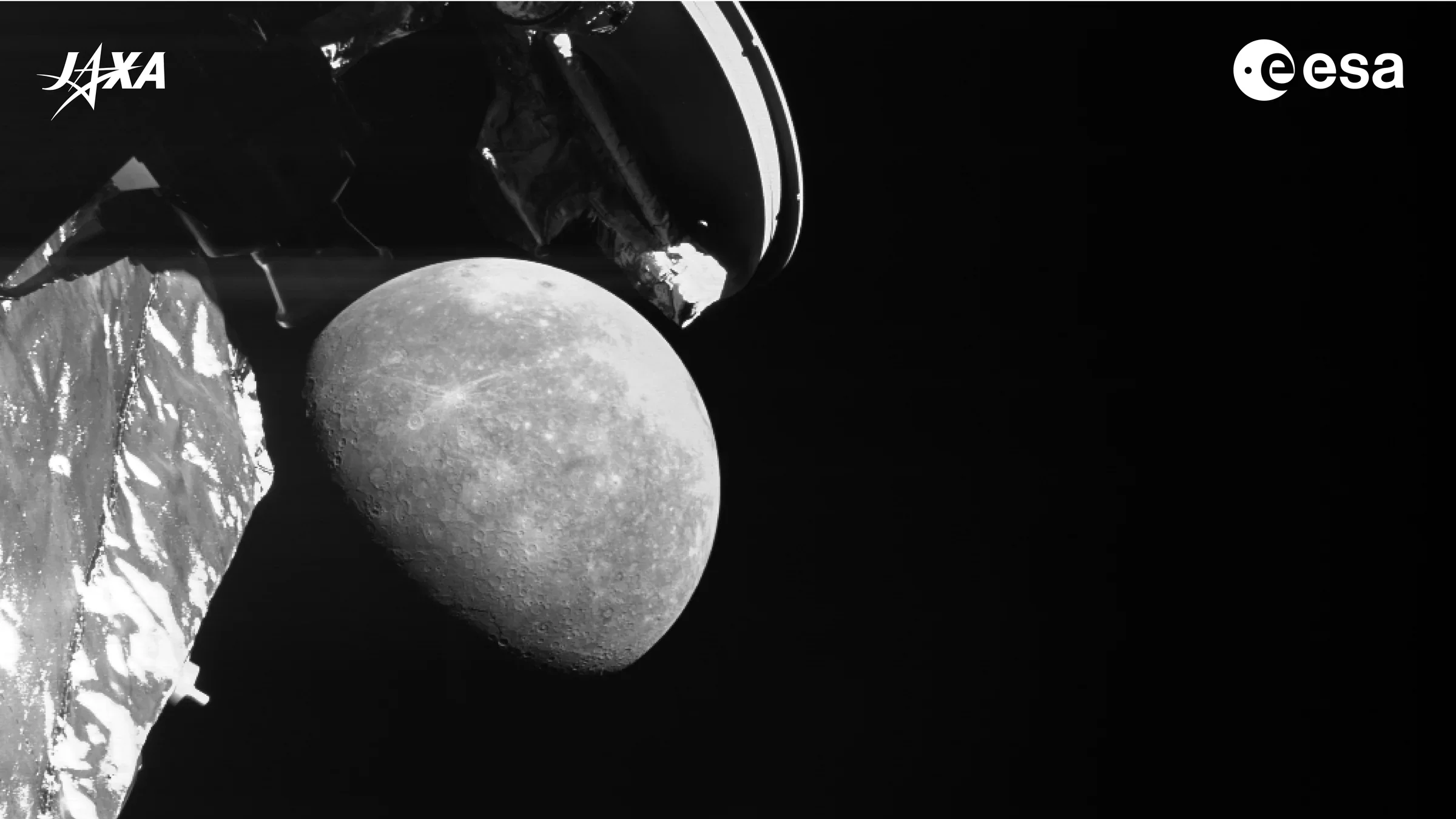
On Saturday 21 November 2026, ESA and JAXA’s BepiColombo is due to be captured into a polar orbit around Mercury, eight years and one month after launch. By chance, the date is also Mercury’s greatest western elongation, its widest angle from the Sun in this morning apparition. JPL’s Horizons ephemeris puts the peak at 19.6° around 00:00 UT on the 21st. From Cyprus and the rest of the northern mid-latitudes, that makes this the easiest week of the year to find the planet before sunrise.
Below: what the spacecraft has to do, what’s still left after capture, and when to look east if you want to see its target for yourself.
Eight years, nine flybys, one late arrival
BepiColombo launched on an Ariane 5 from Kourou on 20 October 2018. According to the ESA factsheet, the launch mass was 4,100 kg. Of that, 1,400 kg was propellant, 1,230 kg was ESA’s Mercury Planetary Orbiter (MPO) and 255 kg was JAXA’s Mercury Magnetospheric Orbiter, known as Mio. The two orbiters flew stacked on top of ESA’s Mercury Transfer Module (MTM), which provided solar power and ion propulsion.
It’s taken this long because falling towards the Sun speeds a spacecraft up. To end up in orbit around a small planet that close to the Sun, BepiColombo had to get rid of that speed. ESA’s factsheet notes that putting a spacecraft into a stable Mercury orbit takes more energy than sending a mission to Pluto. The mission’s answer was nine gravity-assist flybys: Earth once (April 2020), Venus twice (October 2020, August 2021) and Mercury six times between October 2021 and January 2025. ESA counts 9.9 billion km travelled in total.
Arrival was originally planned for 5 December 2025, per ESA’s older science fact sheet. In April 2024, unexpected electrical currents between the MTM’s solar array and its power-distribution unit cut the power available to the ion thrusters. Flight dynamics redesigned the trajectory, and arrival slipped by just under a year to November 2026.
The ion drive was switched off on 15 June 2026, and on 3 September the MTM separated from the stack at a distance of about 200 million km from Earth. Since then MPO’s chemical thrusters have done the steering. The MTM had no antenna or computer of its own, so it’s now an inert object in solar orbit.
What happens on 21 November, and after
Capture is the middle step of what ESA calls a six-month arrival sequence. The current timeline, updated in July 2026, runs:
| Date | Step |
|---|---|
| 3 September 2026 | MTM separates (done) |
| 21 November 2026 | MPO + Mio, still stacked, captured into polar orbit |
| 9–10 December 2026 | MPO releases Mio into its elliptical polar orbit |
| 16 December 2026 | MPO drops Mio’s sunshield (MOSIF) and begins lowering its own orbit |
| 10 March 2027 | MPO reaches its final orbit |
| 6 April 2027 | Science phase begins |
ESA adds that “exact dates may change for operational reasons,” so treat everything after the capture burn as a plan.
The two final orbits are deliberately very different. MPO is the surface mapper and goes into a 480 × 1,500 km polar orbit with a period of about 2.3 hours. Mio studies the magnetic field and plasma around the planet, and goes much wider, 590 × 11,640 km with a 9.3-hour period. Both figures come from ESA’s fact sheet. If everything holds, BepiColombo becomes the first mission to put two spacecraft in orbit around Mercury. It’s only the second to orbit the planet at all, after NASA’s MESSENGER (2011–2015), and the third to visit, counting Mariner 10’s three flybys in 1974–75.
You can follow the approach yourself. JPL’s Horizons system serves ESA’s trajectory for BepiColombo as target body -121. I asked it for range from Mercury’s centre. It gave about 205,000 km at 00:00 UT today (11 November) and about 109,000 km at 00:00 UT on the 20th, and the range is shrinking only slowly. For comparison, the Moon is about 384,000 km from Earth, so the stack is already well inside the equivalent distance. I’m not quoting the trajectory after the burn. That part is a prediction until ESA confirms the capture.
There’s no way to steer the burn live. On 21 November Mercury is 1.0009 au from Earth (149.7 million km), which is 8.3 light-minutes. A command takes that long to arrive, and confirmation takes the same again to come back. When I checked on 11 November, ESA hadn’t posted a burn time or a livestream. The arrival updates page is where it ran the MTM separation blog in September, and I’d expect the capture news there too.
Why the arrival date is good for observers
Mercury never gets more than about 28° from the Sun, and most of its appearances are poorly placed for someone at 35°N. In a morning apparition near the northern autumn, though, the line of the ecliptic, along which the planets travel, rises steeply out of the eastern horizon before dawn. A western elongation in October or November therefore lifts Mercury well clear of the haze.
This one went through inferior conjunction on about 4–5 November, when it passed between Earth and the Sun. Horizons shows the elongation climbing quickly from there to 19.6° on 21 November, then sinking slowly: 17.6° on the 15th, 18.1° on the 28th, still 16.8° on 1 December. Across that fortnight the planet also brightens, from magnitude +0.1 on the 15th to −0.5 on the 21st and −0.7 by the 28th. On the apparent-magnitude scale lower numbers are brighter, and −0.5 beats every star in the sky except Sirius and Canopus. Mercury spends the week moving from Virgo into Libra.
How to see it from Cyprus
These numbers are for Nicosia (35.2°N), from Horizons, with Cyprus time running at UTC+2 in November.
On 21 November Mercury rises at about 04:52 local time (02:52 UT), at an azimuth of about 105°, a little south of due east. Sunrise is at 06:31 (04:31 UT). The window I’d use runs from about 05:40 to 06:15 local. At the start of it Mercury is roughly 9° up, about a fist held at arm’s length. By the time civil twilight begins at 06:00 (04:00 UT) it’s around 13° up at azimuth 115°, in the east-southeast. You need a clear horizon in that direction down to about 5°. In Nicosia that means a rooftop or open ground. I’ll be heading up the Troodos road.
The rest of the dawn sky helps you find it:
- Venus, at magnitude −4.9, is the brilliant point about 15.6° to Mercury’s upper right. It’s around 28° up as twilight starts, and it’s sitting about 2° from Spica (magnitude +1.0) on 20–21 November. If you can see Venus, sweep down and to the left along the same slanting line and Mercury is the next bright object.
- Mars and Jupiter are high in the south, about 68° up, five days after their 16 November conjunction in Leo.
- The Moon is a waxing gibbous that has set well before dawn (Horizons has it more than 30° below the horizon at 06:00 local on the 21st), so it won’t brighten the sky.
Binoculars make the twilight search much easier. A telescope at 100× or more shows a small gibbous disc 6.7 arcseconds across and about 60% lit, though at 13° altitude the air will smear it. Atmospheric dispersion adds red and blue fringes to anything that low. You won’t see surface detail. What you get is knowing that a spacecraft is braking into orbit around that dot the same morning.
One safety rule: put the binoculars down before sunrise. Mercury is under 20° from the Sun, and once the Sun is up, a sweep that overshoots the planet can put sunlight straight into your eye.
You won’t see the spacecraft itself. The stack is a few metres across and 150 million km away, so it’s far beyond any amateur instrument.
What the orbiters will measure
MESSENGER left a list of open questions, and BepiColombo was built around several of them. MPO carries eleven instruments, among them a laser altimeter (BELA), a thermal-infrared spectrometer (MERTIS), an X-ray spectrometer (MIXS) and the SIMBIO-SYS camera suite. Mio carries five, focused on the magnetic field, plasma, dust and the sodium in Mercury’s thin exosphere.
The two orbits split the job. MPO’s low orbit is for the surface and interior. Mio’s long, looping orbit takes it out through the planet’s small magnetosphere, so it can measure how the solar wind pushes on it. Having two spacecraft there at once means one can watch the solar wind arrive while the other measures what it does closer in, which a single orbiter can’t do.
None of the full results will arrive before the science phase starts in April 2027, and the commissioning months will produce engineering milestones rather than discoveries. Expect mostly status updates and test images until then.
What I’m watching
Two things, both on the morning of the 21st. The first is ESA’s confirmation that the capture burn worked, which will probably come hours after the event. The second is whether the Troodos horizon is clear at 06:00. If both go well, I’ll have seen Mercury on the morning it got its second orbiter, and I’ll try a short Seestar sequence with Venus and Spica in the same frame. If the burn news is bad, the planet will still be there, at its best for the year, all the same week.