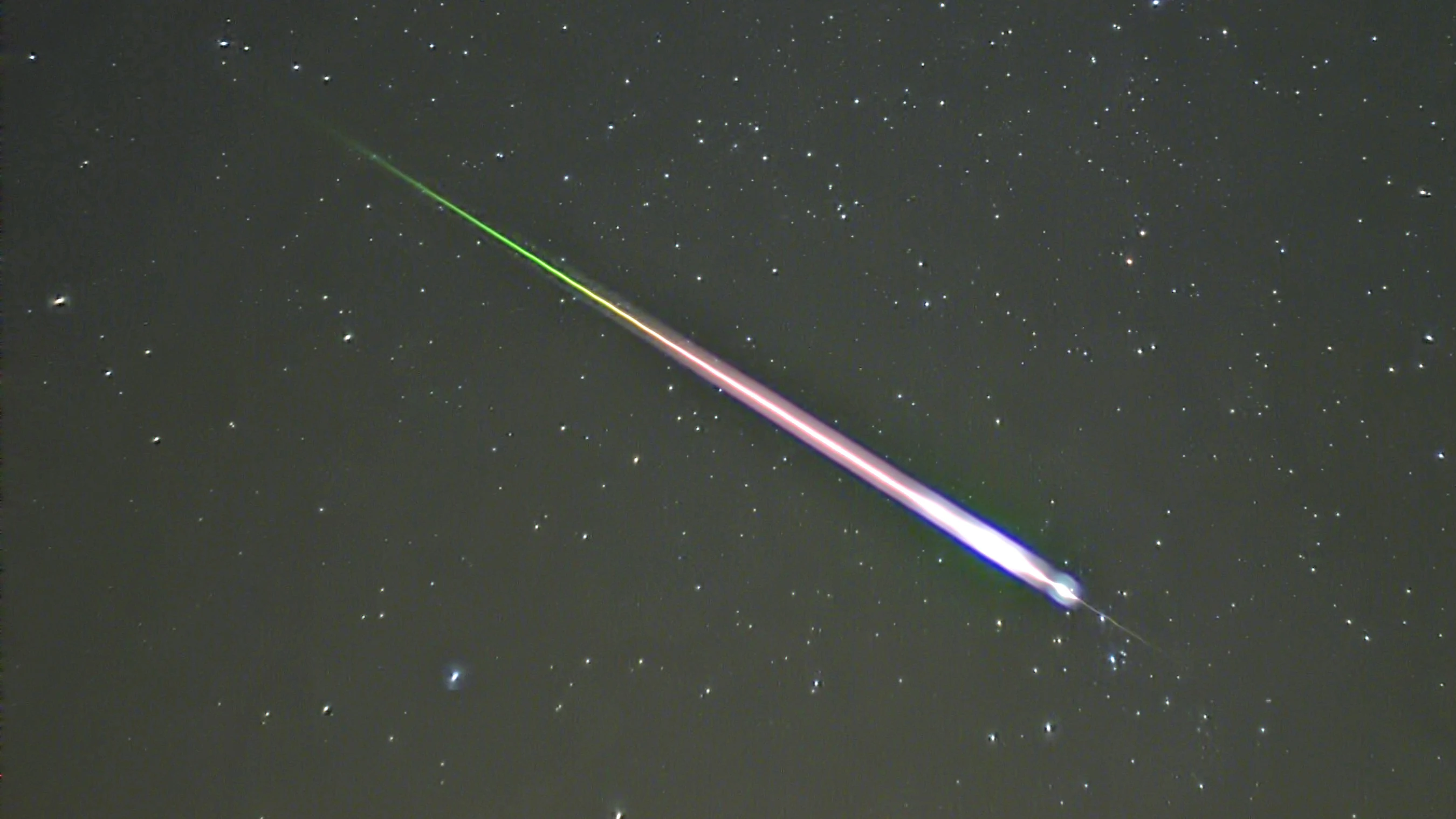
The Leonids reach maximum overnight on November 17–18. The International Meteor Organization puts the peak at 23:45 UT on the 17th, which is 01:45 on the 18th in Cyprus, with a zenithal hourly rate of about 15. That makes 2026 a modest year, a long way from the storms the Leonids are famous for. The Moon helps, though. It’s just past first quarter and sets at 23:36 local time on the peak night, so from then until dawn the sky is dark while the radiant climbs. The best counting window is about 03:00 to 05:00. As a bonus, Jupiter and Mars, a day past their conjunction, rise at the same time about 8° below the radiant.
Times below are for Nicosia (35.2° N), local time UTC+2, computed from JPL Horizons. Elsewhere in Europe and the Mediterranean the pattern is the same; shift the clock times for your longitude.
The 2026 numbers
From the IMO 2026 meteor shower calendar:
| Leonids (013 LEO) | |
|---|---|
| Active | Nov 6 – Nov 30 |
| Maximum | Nov 17, 23:45 UT (solar longitude 235.27°) |
| ZHR | about 15 |
| Radiant at maximum | RA 152°, Dec +22° |
| Entry speed | 71 km/s |
| Population index r | 2.5 |
ZHR is the count one observer would make with the radiant overhead under a perfectly dark sky (naked-eye limit magnitude 6.5). Real counts are always lower. The population index r says how fast the count grows as you go fainter: with r = 2.5, every magnitude of sky brightness you lose divides the count by 2.5. Solar longitude is Earth’s position along its orbit expressed as an angle, which is how meteor predictions are pinned down; the calendar date and time follow from it.
The 23:45 UT figure is the “nodal” maximum, the moment Earth crosses the plane of the parent comet’s orbit. The IMO also quotes a model by Maslov (2007) that puts the 2026 peak at 16:00 UT on November 17, also at a ZHR of about 15. At 16:00 UT it’s 18:00 in Cyprus and Leo is below the horizon, so that timing favours East Asia. The American Meteor Society calendar lists the night of November 16–17 as peak night. With predictions eight hours apart and a broad active period, I’d treat both the 16–17 and 17–18 nights as worth going out for, with the second one closer to the IMO’s nodal time for our longitude.
Moon and darkness, night by night
The Moon is at first quarter on the 17th. A half-lit Moon in the evening sky is a nuisance, but this one sets around the time Leo rises:
| Night | Moonset (lit) | Radiant rises | Astronomical dawn begins | Moon-free dark with radiant up |
|---|---|---|---|---|
| Mon Nov 16 → Tue Nov 17 | 22:36 (43%) | ~23:05 | 04:56 | ~5 h 50 min |
| Tue Nov 17 → Wed Nov 18 (IMO peak) | 23:36 (53%) | ~23:05 | 04:56 | ~5 h 20 min |
| Wed Nov 18 → Thu Nov 19 | 00:36 (64%) | ~23:00 | 04:58 | ~4 h 20 min |
Astronomical dawn starts when the Sun climbs to 18° below the horizon. After that the sky brightens steadily, and faint meteors disappear first. Sunrise is around 06:25.
Where to look, and when
The radiant sits in the Sickle of Leo, the backwards question mark that forms the lion’s head. It lies inside the curve of the Sickle, about 2.5° west of Adhafera and 10° north of Regulus, the bright star at the bottom. The radiant drifts east by a little under a degree per night (the IMO calendar tabulates the track), which is relevant for plotting meteors but not for deciding where to face.
Altitude of the radiant from Nicosia on the peak night:
| Local time | Radiant altitude |
|---|---|
| 00:00 | 11° |
| 01:00 | 23° |
| 02:00 | 35° |
| 03:00 | 48° |
| 04:00 | 60° |
| 04:56 (astronomical dawn) | 70° |
The radiant is highest, at 77°, around 06:15, by which time the sky is too bright for counting. Leonids are a pre-dawn shower for a reason. Comet Tempel-Tuttle orbits the Sun in the opposite direction to the planets, so its debris meets Earth almost head-on, and Earth’s leading side faces the radiant after midnight. The head-on geometry is also why Leonids are the fastest of the major showers, at 71 km/s; the IMO’s scale tops out at 72 km/s. The Orionids come in at 66 km/s and the Taurids at 27–29 km/s.
Fast meteors are short and quick, but they’re often bright, and the faster ones are more likely to leave a glowing train for a second or two after the meteor has gone. NASA’s Leonids page describes them as “bright meteors” that “can also be colorful”. It also mentions Earth-grazers, which appear when the radiant is just above the horizon: meteors that skim the upper atmosphere at a shallow angle and cross a long stretch of sky. Rates are very low in the first hour after Leo rises, with the radiant low in the east-north-east, but that’s when you’d see a grazer: a long, slow-looking streak climbing away from the eastern horizon around midnight.
For counting, don’t stare at the radiant. Meteors near it are foreshortened into stubs. Face east or south-east, and look about 40–50° up and 30–40° away from Leo, or lie back and take in as much sky as you can.
How many you’ll actually see
The same field estimate I used for the Orionids and Taurids:
observed rate ≈ ZHR × sin(radiant altitude) ÷ r^(6.5 − limiting magnitude)
With ZHR 15 and r = 2.5:
| Sky | Limiting magnitude | 02:00 (radiant 35°) | 04:30 (radiant 65°) |
|---|---|---|---|
| Mountain site, e.g. Troodos | ~6.0 | ~5 per hour | ~8–9 per hour |
| Rural village | ~5.0 | ~2 per hour | ~3–4 per hour |
| City balcony | ~4.5 | ~1 per hour | ~2 per hour |
These are my estimates from the IMO parameters, and they assume you’re watching near the time of maximum. On the nights either side, expect fewer. NASA’s page makes the same point less kindly: in ordinary years Leonid rates “are often as low as about three meteors per hour.” Sporadic meteors, which belong to no shower, add a few more per hour from a dark site, and the sporadic rate also climbs towards dawn.
The dust trails due on November 18–19
Leonid storms don’t come from the general stream. They come from individual dust trails, each shed by Tempel-Tuttle at a particular past perihelion, that stay narrow and dense for centuries. Modellers follow those trails forward and work out when Earth will pass through one. For 2026 the IMO lists six encounters from Vaubaillon (2025) and Sato (2025):
| Date | UT | Trail ejected | Model note |
|---|---|---|---|
| Nov 17 | 10:33 | 1533 | weak (Sato) |
| Nov 18 | 21:55 | 1800 | low level (Vaubaillon) |
| Nov 19 | 03:31 | 1699 | weak (Sato) |
| Nov 19 | 03:52 | 1699 | low level (Sato) |
| Nov 19 | 16:26 | 1600 | weak (Sato) |
| Nov 19 | 16:42 | 1600 | very weak (Vaubaillon) |
None of these is expected to produce a real outburst. Vaubaillon’s note says the 1800 trail reaches Earth “but the number of meteoroids will not be sufficient for a significant outburst.” Sato’s note says the trails have low dust densities, though their lower ejection velocities “may imply a modest increase of meteor activity.”
From Cyprus, two of the encounters land at night, both at bad times. The 1800 trail arrives at 23:55 local time on November 18, with the radiant only about 11° up and the 64%-lit Moon still in the sky for another 40 minutes. The 1699 trail encounters, at 05:31 and 05:52 on November 19, come after astronomical dawn, with the radiant high but the sky already brightening. If you happen to be out on the 18–19 night anyway, stay until the twilight gets too bright. I wouldn’t plan a trip around either one.
Storm history, and why 2031 probably won’t repeat 1966
NASA defines a meteor storm as at least 1,000 meteors per hour. The Leonids have produced the most famous ones. In 1966, according to NASA’s page, “thousands of meteors per minute fell through Earth’s atmosphere during a 15-minute period.” The AMS lists Leonid storms in 1833, 1866, 1966, 1999, 2001 and 2002, and NASA gives 2002 as the last.
The pattern follows the comet. Tempel-Tuttle has a nucleus about 3.6 km across and takes 33 years to orbit the Sun. Ernst Tempel and Horace Tuttle discovered it independently in 1865 and 1866. Its last perihelion was in 1998, and the IMO gives the next as May 20, 2031. The storms cluster around perihelion. As the AMS explains, that isn’t fresh dust from the latest pass but debris from earlier returns that happens to be densest near the comet at the same time. Right now, the IMO notes, the meteoroids we meet are ahead of the comet.
Don’t book flights for 2033 just yet. The AMS writes that “it appears that Earth will not encounter any dense clouds of debris until 2099,” and that around the 2031 and 2064 returns “there may not be any meteor storms, but there may be several good displays with rates exceeding 100 per hour.” That would still be the best Leonid showing in a generation, and a good reason to log this year’s modest numbers for comparison.
What else is up
Jupiter and Mars rise together in Leo at about 23:10, 8–9° south-west of the radiant and about 4–5° north-west of Regulus. Their closest approach, 1.2°, falls on the morning of November 16 (the subject of my Mars–Jupiter preview). By the morning of the 17th they’re about 1.3° apart, and about 1.5° on the 18th. Jupiter is at magnitude −2.1, the brightest thing in the eastern sky after midnight, and Mars sits a little over a degree north-east of it at +0.6. Both are 65° up at the start of dawn. The pair makes a convenient signpost: the radiant is about 8° north of them, inside the Sickle.
The Northern Taurids are still active (until December 10 in the IMO calendar), with a radiant in Taurus that’s high in the south-west to west in the early morning. A Taurid is slow and trails back towards Taurus; a Leonid is quick and trails back to Leo. Satellites move at a steady pace without fading or flaring, and the moving-lights guide covers the other impostors.
Looking ahead, the IMO lists the Geminids at ZHR 150 for December 14, under a thin crescent Moon. That’s the big shower of the season, and I’ll write up the details in early December.
My plan
From my balcony in Nicosia (Bortle 7, limiting magnitude around 4.5 on a good night) the estimate says one or two Leonids an hour. On the 16–17 night I’ll sit out from about 03:00 to 04:45, mostly to watch Jupiter and Mars and to catch anything bright.
For the peak night (17–18) I’ll drive up to Troodos, to the Mount Olympos pull-off at about 1,700 m from the Troodos guide. The Moon sets at 23:36, so I can leave Nicosia around midnight, be set up by 01:30, and count from just before the 01:45 maximum through to the end of darkness at 04:56. The best rates should come in the last hour and a half, as the radiant passes 50°. Cold is the main hazard. Troodos in mid-November can be near freezing before dawn, so the sleeping bag comes along as well as the down jacket.
The camera goes on a fixed tripod, using the Perseids setup: a wide lens aimed 30–40° from the radiant, continuous 15-second frames, and an intervalometer doing the work while I count. Fast meteors leave less light per pixel than slow ones of the same brightness, so the camera will mostly catch the bright Leonids, which are the ones worth having anyway. The Seestar stays home. A one-degree field is no use for meteors.
If you see a fireball, report it through the IMO fireball form. It asks for your location, the time, the start and end points against the stars, and the brightness.
Quick reference
- Peak: night of November 17–18, IMO maximum at 01:45 local time on the 18th (23:45 UT on the 17th). ZHR about 15.
- Also worth trying: the night of November 16–17 (AMS peak night; Maslov’s model peak, 16:00 UT on the 17th, favours East Asia).
- Moon: sets 22:36, 23:36 and 00:36 on the nights of the 16th, 17th and 18th
- Watch window (Cyprus): from moonset to astronomical dawn at about 04:56; best 03:00–05:00
- Look: east to south-east, 40–50° up, away from the Sickle of Leo. Jupiter and Mars mark the spot.
- Rates: about 8–9 Leonids per hour from a mountain site before dawn, 1–2 from a city
- Speed: 71 km/s, quick streaks, some bright with trains
- Equipment: none. A reclining chair, a sleeping bag, and a flask of something hot.