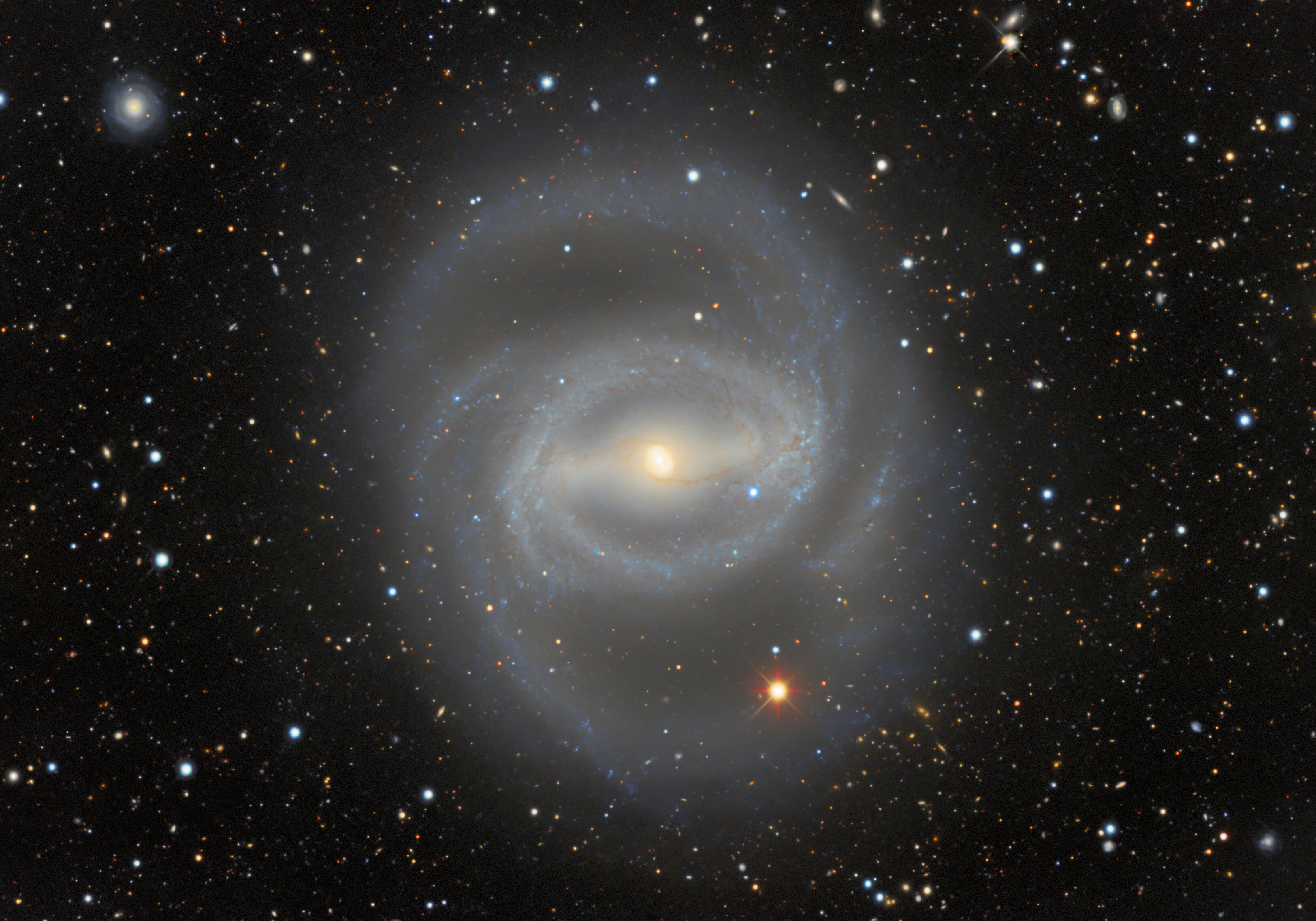
A white dwarf exploded in the southern barred spiral NGC 1433, and astronomers caught it within a day or two of its first light. SN 2026ahvu is a Type Ia supernova that the ATLAS survey found on November 2 at magnitude 17. By November 12 it had climbed to about 12.3, and NSF NOIRLab expects a peak somewhere between magnitude 10.5 and 12.1, sometime between November 18 and 23. That’s a wide window for a class of explosion famous for its predictable brightness, and the reason is that nobody agrees how far away NGC 1433 is. The two published distances from the same method differ by 50%, which works out to a full magnitude in the predicted peak. The supernova is going to settle it.
It also clears the horizon from Cyprus, barely. From Nicosia it transits due south at 7.8° altitude around 23:30 local time this week. Below is the science and then the observing plan, including why Troodos is the wrong place to go for this one.
Caught within a day or two of first light
ATLAS, the asteroid-hunting survey that sweeps the sky every night or two, detected a new source in NGC 1433 on November 2 at 04:20 UT, at cyan magnitude 17.06 ± 0.13. Its previous visit, on November 1.40 UT, saw nothing (AstroNote 2026-310). The GOTO survey then found a marginal, roughly 3-sigma source at the position in its own frame from November 1 at 12:58 UT (L = 21.51 ± 0.37), with nothing there on October 30 (AstroNote 2026-312). That pins first light to a window of about two days.
A Keck/DEIMOS spectrum taken on November 3 by Wynn Jacobson-Galán, Maggie Li and K-Ryan Hinds of Caltech classified it as a young Type Ia (AstroNote 2026-311). The South African Astronomical Observatory’s Lesedi telescope took a second spectrum about ten hours later, a follow-up triggered automatically by ATLAS’s alert-ranking software.
Since then the amateur light curve on David Bishop’s bright-supernova page has done the textbook thing. Pepe Manteca’s V-band estimates run 15.9 on November 3.6, 13.9 on November 6.6, 12.6 on November 10.6 and 12.3 on November 12.6. That’s 3.6 magnitudes in nine days, a factor of about 27 in brightness, and the climb is visibly flattening: only 0.3 magnitudes over the last two of those days.
How much further it has to go comes down to the rise time. A study of 18 well-observed Type Ia supernovae by Firth et al. (2015) found a mean of 18.98 ± 0.54 days from first light to peak, with individual events ranging from 16 to 24.7 days. Start the clock between October 31 and November 1 and an average rise puts the peak around November 19 to 20, the middle of NOIRLab’s window. The spread between individual supernovae is wide enough to cover the whole window.
What the first days can show
A Type Ia is a carbon-oxygen white dwarf (the kind of dead stellar core from the green white dwarf piece) blowing itself apart in a runaway thermonuclear burn. What’s still argued over is what tips it into exploding: steady feeding from a normal companion star, or a merger with a second white dwarf.
Daniel Kasen (2010) showed how the first days can tell them apart. If there’s a companion star, the expanding debris slams into it within hours, and the shocked gas adds optical and ultraviolet light that outshines the supernova’s normal radioactive glow for the first few days. The catch is geometry: the signal is prominent only when we look down on the collision side, about 10% of the time. One supernova without a bump proves little.
The benchmark is SN 2011fe in M101, 6.4 Mpc away. Nugent et al. (2011) showed the exploding star was a carbon-oxygen white dwarf, and Bloom et al. (2012) used a non-detection from about four hours after explosion to force the companion’s radius below about 0.1 solar radii, ruling out red giants and Roche-lobe-filling main-sequence partners.
SN 2026ahvu has a comparable early record: the GOTO detection, ATLAS forced photometry, and a follow-up campaign NOIRLab is coordinating across DECam on the Blanco 4-metre telescope, Gemini South and SOAR (AstroNote 2026-324). The Dark Energy Survey imaged NGC 1433 with DECam between 2013 and 2019, so deep pre-explosion images of the spot exist too. Nobody has said yet whether the early light curve shows a companion bump. That’s the first paper to watch for.
Two distances, one magnitude apart
Now the part that turns a bright supernova into a measurement. Type Ia supernovae are the long-range rung of the cosmic distance ladder because they peak at nearly the same luminosity, an absolute magnitude near −19.3 in V. Absolute magnitude is how bright an object would look from a standard 10 parsecs; apparent magnitude is what we actually see. The gap between the two, the distance modulus, tells you the distance. For SN 2026aaiv in NGC 7331 in September that arithmetic gave one clean answer. Here it gives two.
Both distances for NGC 1433 come from the tip of the red giant branch, or TRGB. As a Sun-like star ages, it swells into a red giant, and its brightening stops abruptly when helium ignites in its core. That cut-off happens at a nearly fixed luminosity, so the brightest red giants in any old stellar population make a standard candle. Measure the apparent magnitude where the red giant count suddenly drops off, and you have a distance.
The ATLAS team adopted 9.0 Mpc, about 29 million light-years, from Sabbi et al. (2018), part of the Hubble LEGUS survey of nearby galaxies. Two years later, Tikhonov & Galazutdinova (2020) went back to archival Hubble images of four galaxies in the Dorado group, including NGC 1433, and got 14.2 ± 1.2 Mpc, about 46 million light-years. They argue the earlier result latched onto a jump in the star counts at I = 25.7 that really marks asymptotic giant branch stars, a later and brighter stage of stellar evolution, and that the true red giant tip sits a magnitude fainter. Their four Dorado galaxies come out between 14.2 and 15.9 Mpc, averaging 15.0. NOIRLab’s release goes with the larger scale: it adopts about 50 million light-years (roughly 15 Mpc) and adds a footnote that published estimates differ.
Here’s what each distance predicts for the peak, using M = −19.3 and the 0.03 magnitudes of Milky Way dust from the ATLAS note:
| Host distance | Distance modulus | Predicted peak (V) |
|---|---|---|
| 9.04 Mpc (Sabbi et al. 2018) | 29.78 | 10.5 |
| 14.2 Mpc (Tikhonov & Galazutdinova 2020) | 30.76 | 11.5 |
| 15.0 Mpc (Dorado group mean) | 30.88 | 11.6 |
The bright end of NOIRLab’s 10.5–12.1 range is exactly the short-distance answer. The faint end leaves room for the larger distance plus some dust inside NGC 1433.
A one-magnitude gap is big compared with how well Type Ia supernovae standardize. After correcting for light-curve shape (brighter ones fade more slowly), their peaks scatter by roughly 0.15 magnitudes. Even the systematic disagreement behind the Hubble tension, Planck’s 67.4 km/s/Mpc against the local distance ladder’s roughly 73, amounts to under 0.2 magnitudes in the supernova zero point. A peak near 10.5 would back the 9 Mpc distance; a peak near 11.5 would back 14 Mpc. Either way, one of two published TRGB measurements to the same galaxy is off by a magnitude.
The catch is dust in NGC 1433 itself, which dims and reddens the supernova in a way that can mimic extra distance. Astronomers measure it from the colour around maximum, when a normal Type Ia’s B−V is close to zero. The University of British Columbia’s Thunderbird South telescope measured V = 14.58 and B−V = +0.44 on November 5 (AstroNote 2026-320), but that was two weeks before peak, when young Type Ia colours are still changing fast. Reading dust from it now would be premature.
My bet is on the larger distance. NGC 1433’s recession velocity is 1,076 km/s, which at 70 km/s/Mpc puts it at about 15 Mpc before correcting for its motion within the group. That’s a crude estimate, but it lines up with the other three Dorado galaxies and not with 9 Mpc. I’ll know in a week whether I’m wrong.
Seeing it from Cyprus: 7.8° of sky
SN 2026ahvu sits at RA 03h 41m 55.5s, Dec −47° 13′ 39″ (J2000), in the faint southern constellation Horologium. It’s about 1 arcminute west and 20 arcseconds south of the galaxy’s nucleus, per the ATLAS discovery note. That declination is almost identical to Omega Centauri’s, which I described from the Atacama trip as grazing about 7° above my southern horizon. Same story here.
I computed the geometry for Nicosia (35.2° N) with Moon and Sun positions from JPL Horizons:
- Maximum altitude is 7.7° geometrically, about 7.8° once refraction lifts it. Transit is due south at 23:50 EET tonight (November 15), 23:35 on November 18–19, and 23:20 on November 22–23.
- It’s above 5° for a bit over three hours, roughly 22:15 to 01:25 local tonight. The window shifts about four minutes earlier each night.
- At 7.8° you’re looking through about seven airmasses, seven times the atmosphere overhead. At a typical 0.2–0.3 magnitudes of extinction per airmass that costs 1.4–2.1 magnitudes, so a supernova peaking at 11.5 will look like 13 to 13.5 from here, and redder.
- The Moon sets at 21:40 EET tonight, 22:40 on the 16th and 23:35 on the 17th, which is right at transit. From the 18th, through the whole predicted peak window, a gibbous Moon between 63% and 99% lit is up during transit, swinging from the west-southwest on the 18th to the south-southwest by the 23rd. That’s 75° to 35° of azimuth from the supernova, close enough to brighten the low sky around it. Tonight through Tuesday the 17th are the Moon-free nights, with the supernova probably within a magnitude of its peak.
Where to stand is the less obvious part. Troodos is my default for anything faint, but as I noted in the Troodos guide, the massif blocks part of the southern horizon from most places you can set up at night. For an object that never gets above 8°, a flat sea horizon beats altitude. Cape Greco looks straight south over open water, and so does any stretch of the south coast without a town’s glow in that direction. My balcony has rooftops to the south, so it’s out.
For the rest of Europe it’s a latitude cutoff. The supernova culminates at 90° minus your latitude minus 47.1°, so you need to be south of about 37.9° N to get it above 5°. Athens gets 5°, Lisbon about 4°, Madrid under 3°, and Rome about a degree. North of roughly 43° N it never rises. From Sydney it passes 77° up, and NOIRLab’s follow-up campaign runs from telescopes in Chile for the same reason.
What to point at it
The host galaxy is magnitude 10 overall and about 6.5 by 5.9 arcminutes. Through seven airmasses most of its spiral structure will drown in the horizon murk, and the supernova, a point source, may outshine everything visible of the galaxy. Visually, this calls for 8 inches or more of aperture, a clean sea horizon and a chart. Binoculars won’t get there.
Imaging is the realistic route. A Seestar S50 or any small smart scope reaches well past 13th magnitude in a few minutes of stacking. The open question at 8° is whether the plate solve finds enough stars through the haze to lock on; if it struggles, solve on a field a few degrees higher and nudge down. My plan is a coast run on Monday or Tuesday night, before the Moon gets into the window: face south, start stacking at transit, and look for one 13th-magnitude point beside a smudge of galaxy core. If the night is clear, I’ll add the frame here.
NGC 1433 has hosted one earlier supernova, SN 1985P, a Type II found by Robert Evans on 10 October 1985 at magnitude 13.5. This one has already beaten it.
Check the magnitude before you set up
Any magnitude in this post is already out of date. Pull a current estimate from the Rochester page or the TNS record before you drive anywhere. If you get a calibrated V measurement around the peak, send it to the AAVSO or the Rochester page. A well-sampled peak is the measurement that decides whether NGC 1433 is 29 or 46 million light-years away. I’ll write that follow-up once the peak is in and the colours tell us how much dust there is.