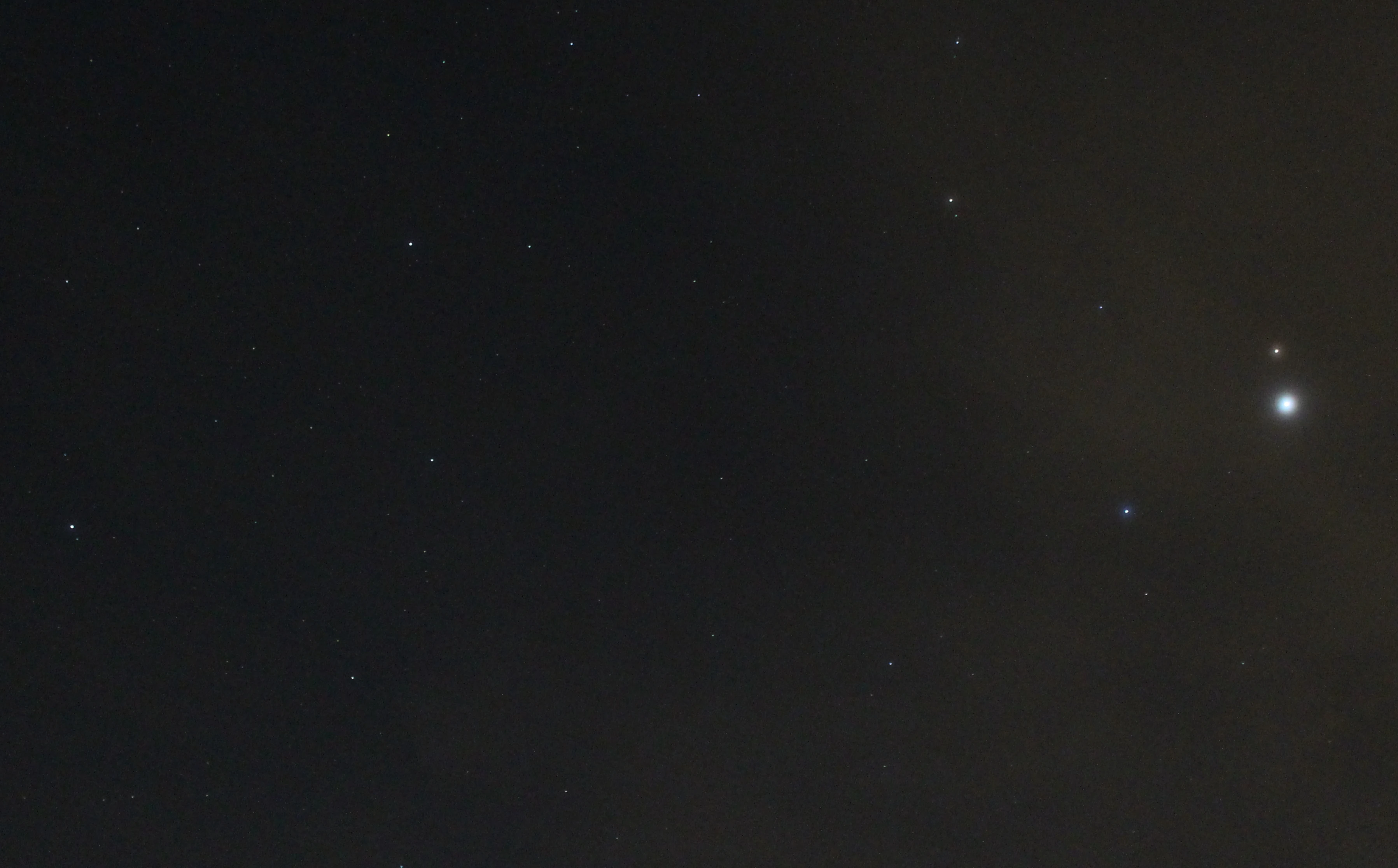
Mars passed Jupiter at about 02:00 UT on November 16, closing to 1.19°, a little over two full-Moon widths, in the pre-dawn sky over Leo. If you missed it, you haven’t lost much. Tomorrow morning the gap is still only 1.4°, and the two planets stay within about 15° of each other until late May. From here the gap opens to 15.3° by mid-January. Both planets then reach opposition eight days apart in February, and after that, with both moving backwards against the stars, Mars swings back to within 4.3° of Jupiter around April 1. This week’s pre-dawn pair becomes an evening pair by spring, high in the south at a sociable hour.
As in the October preview, every position, magnitude and date below comes from JPL Horizons. Separations are geocentric. Altitudes and clock times are for Nicosia (35.2° N). Times are UT unless I say local. Cyprus is on EET (UTC+2) until 28 March 2027 and on EEST (UTC+3) after that.
The conjunction, by the numbers
At closest approach Mars sat north of Jupiter, at apparent magnitude +0.7 against Jupiter’s −2.1. Apparent magnitude is brightness as seen from Earth, and lower numbers mean brighter, so Jupiter was sending us about 13 times as much light. In a telescope, Mars’ disc was 7.2 arcseconds across and Jupiter’s 37.4. Mars was 1.31 AU from us and Jupiter 5.27 AU.
The approach was shallow. On the mornings of the 15th and 17th the gap was within 0.06° of the minimum, so a cloudy 16th cost very little. The cover photo was taken at 02:05 UT on the 15th from Baden-Württemberg, with a 27 mm lens and a 6-second exposure. It shows the naked-eye view well: two points, one much brighter than the other, and an obvious difference in colour.
If you kept the hand-measurement log from the preview, here’s the rest of the season to check against:
| Date | Mars–Jupiter gap | What’s happening |
|---|---|---|
| Nov 16, 2026 | 1.19° | Conjunction: Mars passes north of Jupiter |
| Nov 26 | 3.7° | Mars 1.7° north of Regulus |
| Dec 13 | 9.1° | Jupiter stationary, starts moving west (retrograde) |
| Jan 12, 2027 | 15.0° | Mars stationary, starts retrograde |
| Jan 19 | 15.3° | Widest gap of the season |
| Feb 11 | 12.5° | Jupiter at opposition |
| Feb 19 | 10.6° | Mars at opposition |
| Feb 21 | 10.1° | Mars 4.0° north of Regulus |
| Apr 1 | 4.3° | Closest return |
| Apr 3 | 4.3° | Mars stationary, resumes eastward motion |
| Apr 13 | 5.0° | Jupiter stationary, resumes eastward motion |
| May 15 | 11.6° | Mars 1.2° north of Regulus |
The gaps are planet centre to planet centre at 00:00 UT on each date.
Why the gap comes back
For the past month Mars has been gaining on Jupiter because both were moving east against the stars and Mars was moving about five times faster. That changes as Earth comes round to overtake each of them. Near opposition, Earth passes between the Sun and an outer planet, and our faster orbit makes the planet appear to drift backwards for a few months. That backward drift is retrograde motion, and each planet traces a loop on the sky.
The two loops are very different in size. Jupiter’s backward run lasts from December 13 to April 13 and covers about 9.8° of right ascension, the sky’s east–west coordinate. Mars’ run lasts from January 12 to April 3 and covers about 19°. Mars is the closer planet, at 0.68 AU at opposition against Jupiter’s 4.36, so Earth’s motion shifts its apparent position much more.
The timing explains the gap. Jupiter turns back first, in mid-December, while Mars keeps heading east for another month. The two move apart in opposite directions, and the gap reaches 15.3° on January 19. Then Mars reverses too and retreats west two to three times faster than Jupiter, so the gap closes again. Mars halts on April 3 at a right ascension of 144.0°, with Jupiter at 139.6°, about 4.4° short. That’s why April brings a close approach and no second conjunction. If Mars’ loop had reached Jupiter, the pair would have passed each other twice more. This time it falls short, and the minimum is 4.3° around April 1.
Two oppositions a week apart, both in Leo
Jupiter reaches opposition first, around 00:30 UT on February 11. It’ll be magnitude −2.55, with a disc 45.2 arcseconds across, at 4.36 AU. Mars follows on February 19 at magnitude −1.3 and 13.8 arcseconds. It’s closest to Earth about a day later, at 0.678 AU (roughly 101 million km).
Both planets are in Leo for both dates, 12.5° apart at Jupiter’s opposition and 10.6° at Mars’. A planet at opposition rises at sunset and sets at sunrise, so for that week both are up all night. In mid-February, both cross the meridian close to local midnight from Cyprus, Jupiter 70° up and Mars 69°. At 70° your line of sight passes through only about 6% more air than it would straight up. At 20° it’s nearly three times as much, and the extra air blurs and reddens a planet more on most nights than a bigger mirror can make up for.
This is a small opposition for Mars. Even at its best it’ll show only about a third of Jupiter’s width in the eyepiece. This time Mars reaches opposition only a couple of weeks before aphelion, the far point of its orbit, so even at its closest it’s 0.68 AU away. I covered this opposition in the MMX piece too. With a 150–200 mm telescope and steady air, 13.8 arcseconds is still enough for the larger dark markings and a polar cap. Jupiter at 45 arcseconds is the easy target. If you’re thinking about imaging it, the planetary camera guide works through pixel size and focal ratio for exactly this opposition.
Regulus gets visited three times
Retrograde loops make Mars pass the same star more than once. Regulus, Leo’s brightest star at magnitude 1.4, is right on Mars’ path, so Mars passes it three times:
- November 26, 2026: 1.7° north of Regulus, Mars at +0.6. The two are nearly equal in brightness, so the colour difference stands out: blue-white star, orange planet.
- February 21, 2027: 4.0° north, Mars moving westward at magnitude −1.3, by then much brighter than the star.
- May 15, 2027: 1.2° north, Mars back to +0.5 and heading east again, low in the west after dusk.
For a binocular observer the November pass is the best of the three. Ten days from now, a 10×50 field (5–6.5° wide) can hold Mars, Regulus and Jupiter together, with the gap to Jupiter at 3.7°.
The Moon joins the pair on November 30 and December 1
The waning Moon passes both planets at the end of the month. On the morning of November 30, at 05:00 local, the 62%-lit Moon stands 3.3° west of Jupiter (to its right when you face south), with Mars beyond Jupiter, 8.4° from the Moon. All three sit near the meridian, close to 68° up. The next morning at the same time the Moon is 51% lit and 6.8° from Mars, now below and to the left of it. The Moon’s closest pass to Jupiter falls around midday UT on the 30th, in daylight for Europe, so the pre-dawn view is the one to plan for.
Tonight: Leonids above the planets
Tonight is also the Leonid peak, with the nodal maximum at 23:45 UT and a ZHR near 15. ZHR is the hourly count one observer would make with the radiant overhead under a perfectly dark sky, so expect fewer. The Leonid radiant, at RA 152°, Dec +22°, sits about 8° north of Mars and 9° north of Jupiter. If you go out for meteors after midnight, you’ll be looking at the planets anyway. Don’t let Jupiter’s glare pull your eyes to one spot, though. Leonids show up all over the sky, and the radiant only tells you which way they’re moving.
What I’m planning for the rest of the season
The November part of this was always going to be the least interesting to look at: two points close together. The months ahead give a telescope more to do. In February I’ll move the planetary camera between Jupiter and Mars on the same nights, since both cross the meridian within an hour or so of each other. My balcony faces the right way, and at 70° the Nicosia light dome mostly doesn’t matter for planets.
The one I’m most looking forward to is April 1. Around 21:00 local (18:00 UT), both planets stand about 70° up in the south-south-east, 4.3° apart, after twilight has ended. Jupiter will be magnitude −2.3, back over the border in Cancer. Mars will be −0.4 in Leo, past its best but still brighter than any star near it. You won’t need binoculars or an early alarm for that one.