
Artist's rendering of the star Vega, a blue-tinged white main-sequence star in the constellation Lyra
Beginner stargazing

How to find the Summer Triangle: three stars, no gear, one June evening

If you step outside tonight around 22:00 local time and face east, you’ll see a bright blue-white star roughly a third of the way up from the horizon. That’s Vega — the fifth-brightest star in the entire sky, magnitude +0.03, and your entry point to the largest asterism of the summer. Vega belongs to a pattern called the Summer Triangle: three stars in three separate constellations that together frame one of the richest stretches of sky visible from northern latitudes. You don’t need a telescope. You don’t need an app, though one helps. All you need is a clear evening and a rough sense of east. ...
June 9, 2026 · 7 min · Andreas Ioannou
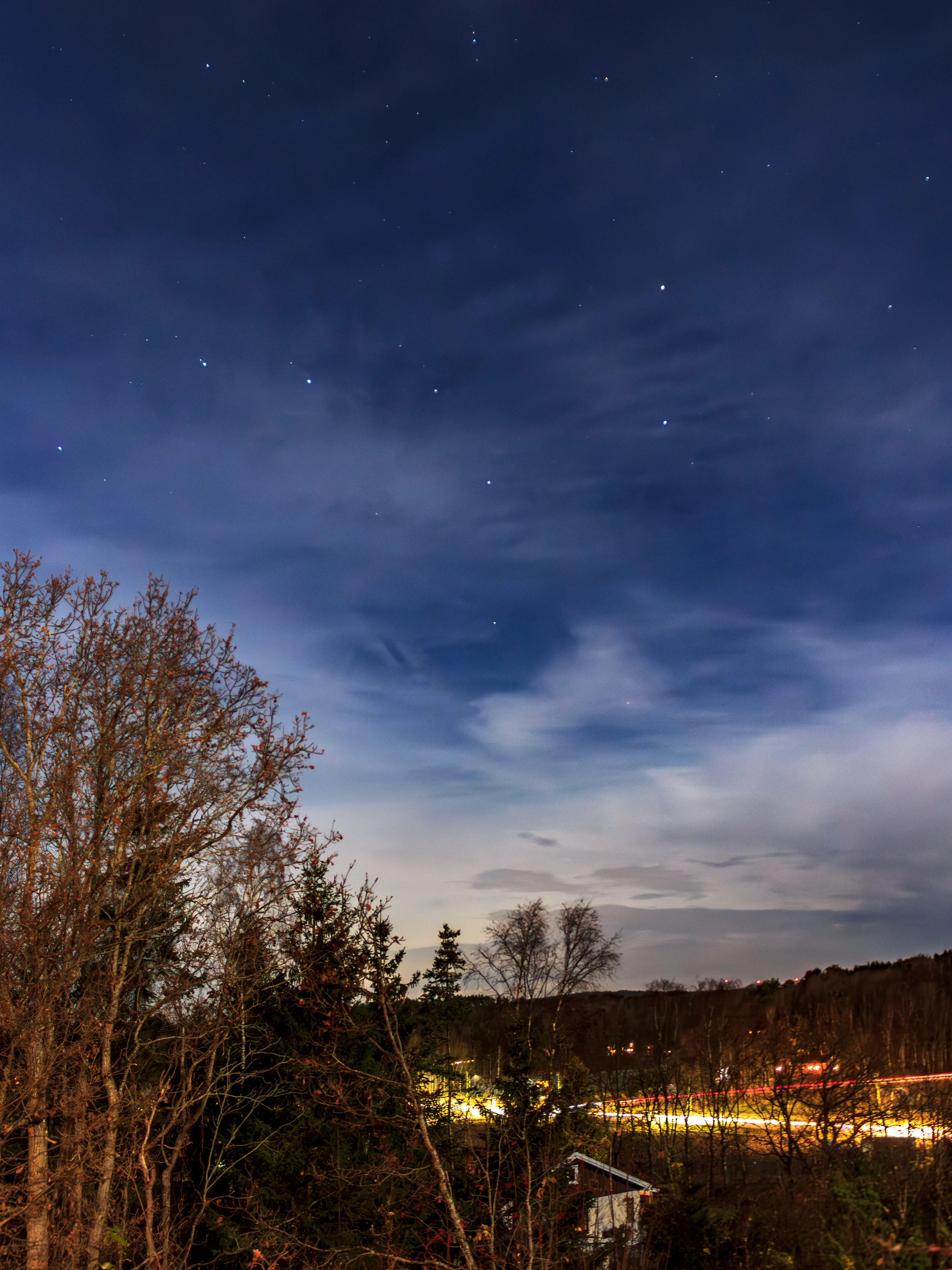
The Big Dipper asterism above trees at night, with thin clouds, over Brastad, Sweden
Beginner stargazing

Five star-hops from the Big Dipper: a beginner's map to the May sky

You don’t need an app tonight. You need one pattern. The Big Dipper sits almost directly overhead on May evenings from mid-northern latitudes, and its seven stars — all between magnitude +1.8 and +3.3, easy to spot even under suburban light pollution — form the single best starting point for learning the rest of the sky. Five hops, no telescope, about ten minutes. What star-hopping is Star-hopping is the oldest navigation trick in observational astronomy: use a pattern you already recognise to find something you don’t. Point your eyes at a known bright star, move a known angular distance in a known direction, and land on the next target. ...

May 14, 2026 · 6 min · Andreas Ioannou