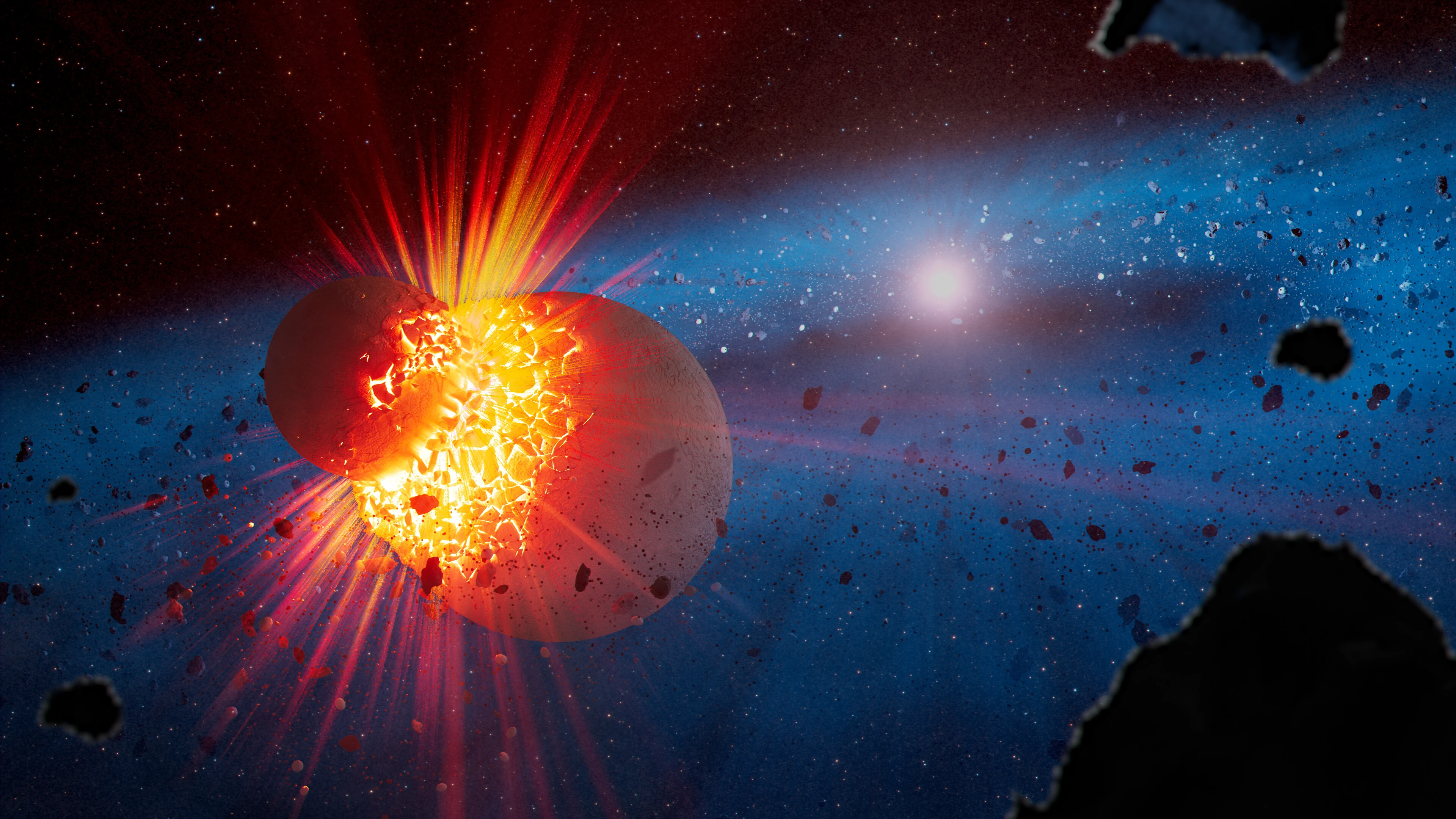
The dust of Moon-forming crashes: what Webb found in 21 extreme debris disks
The leading explanation for our Moon is a crash: something roughly the size of Mars hit the young Earth, and the debris that stayed in orbit pulled itself together into the Moon. Nobody was around to watch that, but a new study shows we can watch the same kind of event around other stars through the dust it leaves behind. Kate Su of the Space Science Institute in Boulder and nine co-authors combined JWST and Spitzer mid-infrared spectra of 21 “extreme debris disks”, rare systems where planet-sized bodies are colliding right now. The dust chemistry splits them in two. Silica-rich disks point to violent crashes between Mars-sized embryos, and they turn up only around stars younger than about 300 million years. Silica-poor disks point to Moon-sized impacts, and they also appear around much older stars. The paper is accepted in The Astrophysical Journal (preprint: arXiv:2607.06684), and NASA and ESA/Webb released it on 2026-10-01. ...