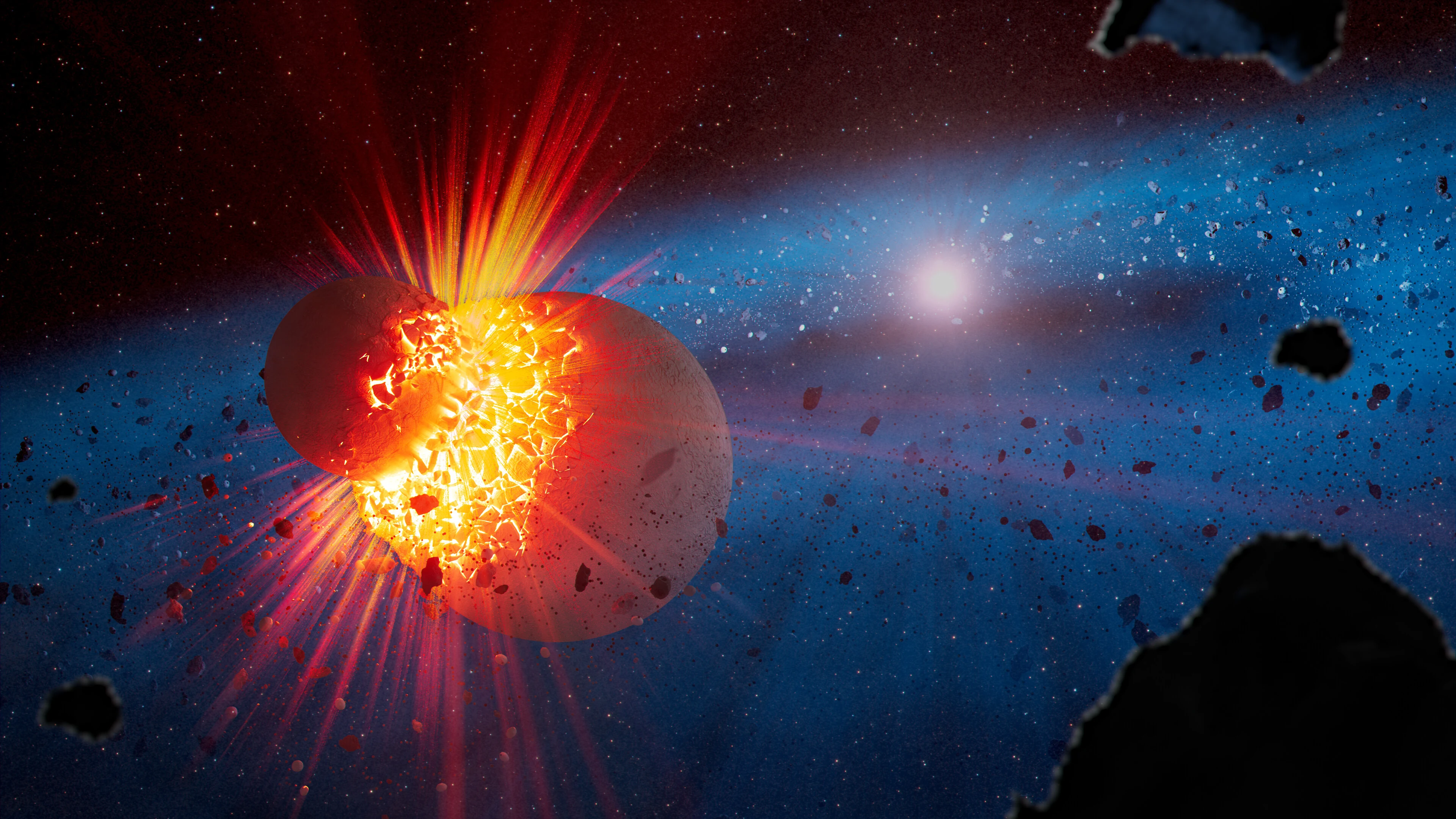
Artist's illustration of a young star inside a broad blue ring of dusty debris, with a small planetary body crashing into a larger one in the foreground and glowing orange vapor streaming from the impact.
Space science

The dust of Moon-forming crashes: what Webb found in 21 extreme debris disks

The leading explanation for our Moon is a crash: something roughly the size of Mars hit the young Earth, and the debris that stayed in orbit pulled itself together into the Moon. Nobody was around to watch that, but a new study shows we can watch the same kind of event around other stars through the dust it leaves behind. Kate Su of the Space Science Institute in Boulder and nine co-authors combined JWST and Spitzer mid-infrared spectra of 21 “extreme debris disks”, rare systems where planet-sized bodies are colliding right now. The dust chemistry splits them in two. Silica-rich disks point to violent crashes between Mars-sized embryos, and they turn up only around stars younger than about 300 million years. Silica-poor disks point to Moon-sized impacts, and they also appear around much older stars. The paper is accepted in The Astrophysical Journal (preprint: arXiv:2607.06684), and NASA and ESA/Webb released it on 2026-10-01. ...
October 3, 2026 · 10 min · Andreas Ioannou
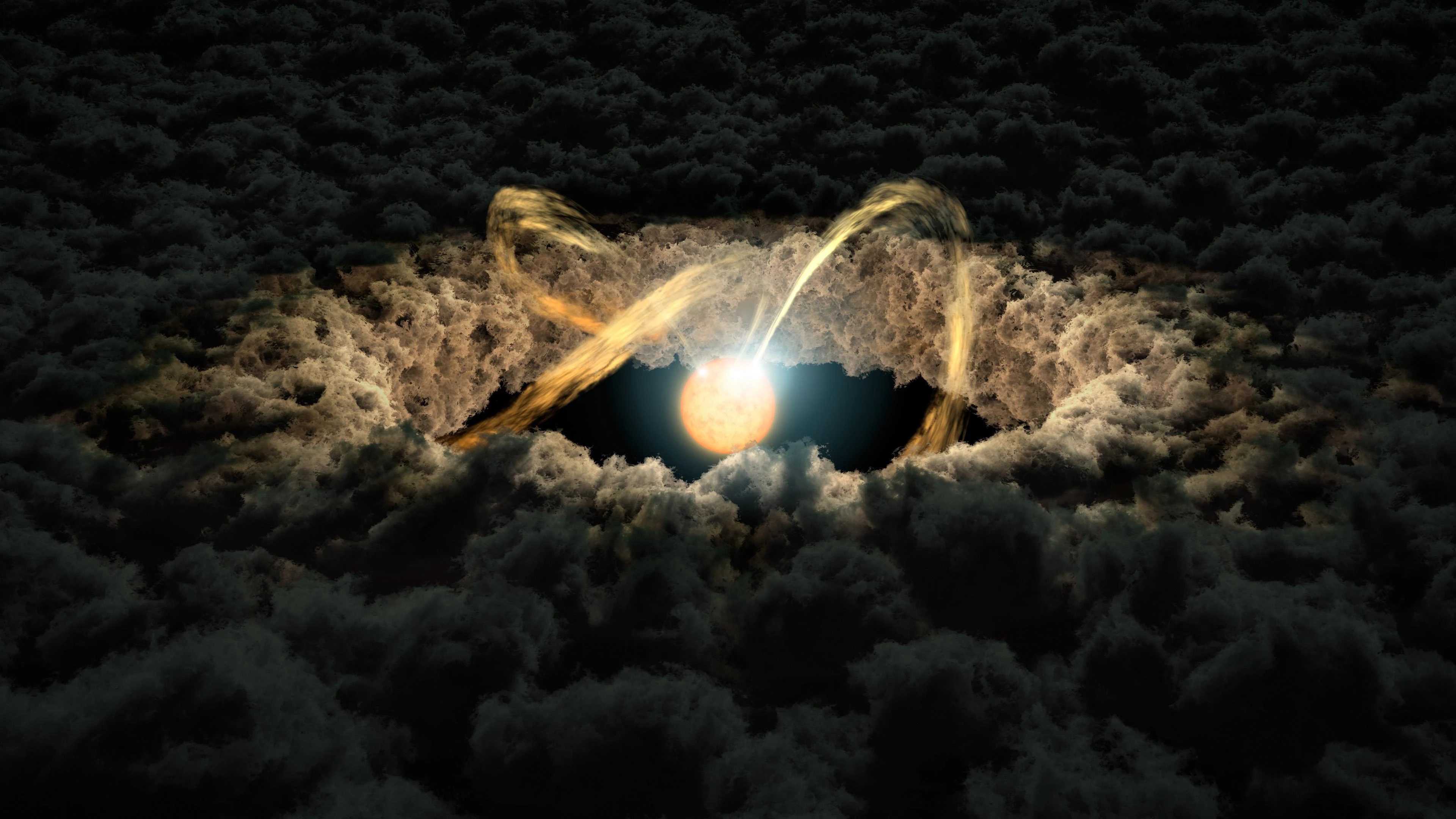
Artist's concept of a young star surrounded by a bright, dusty protoplanetary disk of gas and dust seen nearly edge-on (NASA/JPL-Caltech illustration).
Space science

How planet-forming disks lose their gas: JWST mapped the winds in 72 young stars

Every planet, ours included, assembled inside a flat disk of gas and dust that has since vanished. That disk is the raw material and the deadline at once: it survives only a few million years around a young star before the gas is gone, and any world that wants a thick hydrogen-helium atmosphere has to grab it before the tank runs dry. A new study led by Naman Bajaj at the University of Arizona used JWST to watch that gas actually leaving, mapping the jets and winds carrying it off in 72 young disks and showing how the escape route changes as a disk ages. The paper, “JWST/MIRI Reveals the Evolution from Molecular to Atomic Disk Winds”, is one of the largest JWST disk-wind surveys to date. ...

September 3, 2026 · 7 min · Andreas Ioannou