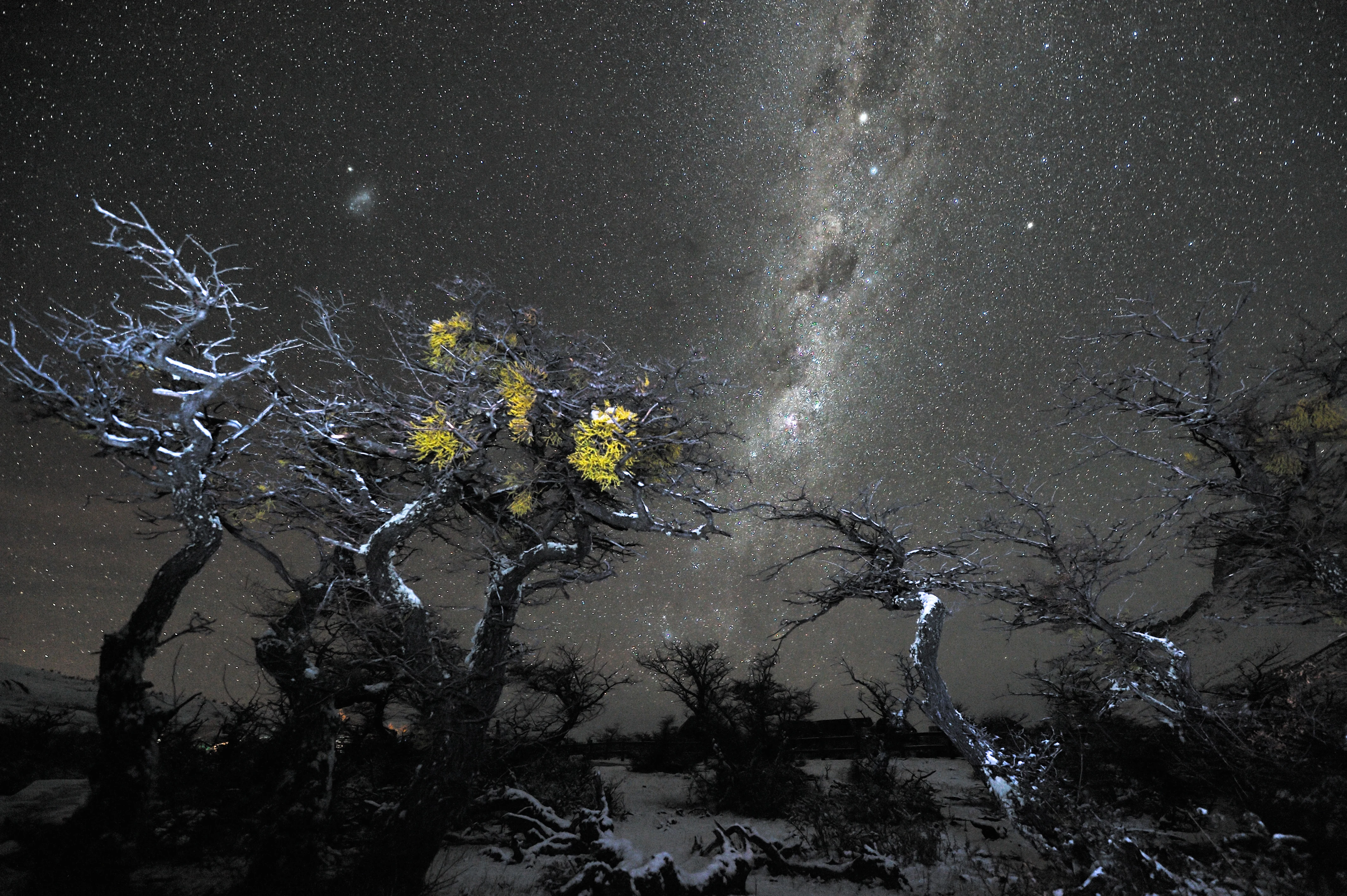
The Milky Way arching over snow-covered trees at Torres del Paine in Patagonia, with Alpha and Beta Centauri the two brightest stars in the band.
Beginner stargazing

Turn your phone into a star chart: a beginner's guide to stargazing apps

The fastest way to start finding things in the night sky costs nothing and is already in your pocket. Hold your phone up, and a decent stargazing app will name the bright dot you’ve been squinting at: Arcturus, or Jupiter, or the International Space Station about to clear your roofline. No telescope, no printed atlas, no memorising constellations first. That’s the pitch, and it mostly holds up. The catch is that the app store is stuffed with near-identical star maps, half of them want a subscription, and the headline “just point your phone at the sky” feature breaks in ways nobody warns you about. Here’s how I’d pick one, based on what I actually keep on my phone in Nicosia and hand to friends who’ve never found anything but the Moon. ...

July 18, 2026 · 8 min · Andreas Ioannou
Wide-field photo of the summer Milky Way stretching from Vulpecula down to Scorpius, its bright star clouds crowding toward the galactic center low in the sky
Beginner stargazing

How to find the center of the galaxy with your own eyes this July

On a dark night this month you can stand in a field, face south, and look almost exactly toward the supermassive black hole at the center of our galaxy. No telescope. No binoculars, though they help. Just your eyes, a clear southern horizon, and enough patience to let them adjust. The direction sits low in the sky between two constellations that are up all July: Scorpius and Sagittarius. You won’t see the black hole itself (its light is buried behind thousands of light-years of dust), but you can point your face down the barrel toward it and see the thickest, brightest star clouds of the whole Milky Way piled up in that direction. From my usual dark spot in the Troodos mountains, that stretch of sky is the best thing summer offers. Here’s how to find it. ...

July 5, 2026 · 8 min · Andreas Ioannou
Artist's rendering of the star Vega, a blue-tinged white main-sequence star in the constellation Lyra
Beginner stargazing

How to find the Summer Triangle: three stars, no gear, one June evening

If you step outside tonight around 22:00 local time and face east, you’ll see a bright blue-white star roughly a third of the way up from the horizon. That’s Vega — the fifth-brightest star in the entire sky, magnitude +0.03, and your entry point to the largest asterism of the summer. Vega belongs to a pattern called the Summer Triangle: three stars in three separate constellations that together frame one of the richest stretches of sky visible from northern latitudes. You don’t need a telescope. You don’t need an app, though one helps. All you need is a clear evening and a rough sense of east. ...

June 9, 2026 · 7 min · Andreas Ioannou
Venus, Moon, and Jupiter in conjunction above the horizon
Celestial event

Venus–Jupiter conjunction on June 9: both planets fit in one binocular view

On the evening of June 9, Venus and Jupiter close to within roughly 1.5° of each other, about three full-moon widths, low in the western twilight. Venus, near magnitude −4, is the brighter of the two. Jupiter sits at about magnitude −2, dimmer but impossible to miss. Both planets fit comfortably inside a standard binocular field of view, and you don’t need anything more than your eyes to enjoy the pairing. The show runs for the better part of a week on either side of the closest approach, so one cloudy night won’t ruin it. ...

June 2, 2026 · 7 min · Andreas Ioannou
Four planets aligned above the horizon in the predawn sky, photographed from Brisbane, Australia
Beginner stargazing

Five planets you can see without a telescope this June

All five naked-eye planets are out this June, split between the evening and morning sky. The headline act: Venus and Jupiter converge to within 1°38’ of each other on June 9, the two brightest objects in the night sky after the Moon, close enough to cover both with your thumb at arm’s length. You don’t need a telescope, a dark sky, or any experience. Here’s where and when to look. ...

May 28, 2026 · 6 min · Andreas Ioannou
The Big Dipper asterism above trees at night, with thin clouds, over Brastad, Sweden
Beginner stargazing

Five star-hops from the Big Dipper: a beginner's map to the May sky

You don’t need an app tonight. You need one pattern. The Big Dipper sits almost directly overhead on May evenings from mid-northern latitudes, and its seven stars — all between magnitude +1.8 and +3.3, easy to spot even under suburban light pollution — form the single best starting point for learning the rest of the sky. Five hops, no telescope, about ten minutes. What star-hopping is Star-hopping is the oldest navigation trick in observational astronomy: use a pattern you already recognise to find something you don’t. Point your eyes at a known bright star, move a known angular distance in a known direction, and land on the next target. ...

May 14, 2026 · 6 min · Andreas Ioannou